

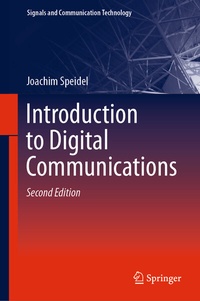
Introduction to Digital Communications
Description

This book offers students, scientists, and engineers an extensive introduction to the theoretical fundamentals of digital communications, covering single-input single-output (SISO), multiple-input multiple-output (MIMO), and time-variant systems. Further, the main content is supplemented by a wealth of representative examples and computer simulations.
The book is divided into three parts, the first of which addresses the principles of wire-line and wireless digital transmission over SISO links. Digital modulation, intersymbol interference, and various detection methods are discussed; models for realistic time-variant, wireless channels are introduced; and the equivalent time-variant baseband system model is derived. This book covers two new topics such as blockwise signal transmission and multicarrier modulation with orthogonal frequency-division multiplexing (OFDM) systems.
Since not all readers may be familiar with this topic, Part II is devoted to the theory of linear time-variant systems. The generalized convolution is derived, and readers are introduced to impulse response, the delay spread function, and system functions in the frequency domain. In addition, randomly changing systems are discussed. Several new examples and graphs have been added to this book.
In turn, Part III deals with MIMO systems. It describes MIMO channel models with and without spatial correlation, including the Kronecker model. Both linear and nonlinear MIMO receivers are investigated. The question of how many bits per channel use can be transmitted is answered, and maximizing channel capacity is addressed. Principles of space-time coding are outlined in order to improve transmission quality and increase data rates. In closing, the book describes multi-user MIMO schemes, which reduce interference when multiple users in the same area transmit their signals in the same time slots and frequency bands.
More details
Other editions
Additional editions
Previous edition
Person
Joachim Speidel received his Dipl.-Ing. (M.Sc.) and Dr.-Ing. (Ph.D.) degree in Communications Engineering from the University of Stuttgart, Germany, in 1974 and 1980, respectively. From 1980-1992 he worked in various R&D positions for Philips in the broad ?eld of digital video and data transmission. In 1992, he became a Professor at the Faculty of Computer Science, Electrical Engineering and Information Technology at the University of Stuttgart and Director of the Institute of Telecommunications. His research area includes telecommunications in wireless, ?xed, electrical, and optical networks with a focus on coding, modulation, detection, and MIMO systems. Since 2017, he is a Professor Emeritus. Through his numerous publications and patents, Prof. Speidel has made extensive contributions to the ?eld of telecommunications, its products, and international standards.
