

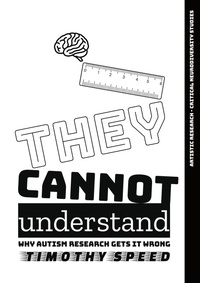
They Cannot Understand
Why Autism Research Gets It Wrong
1st Edition
Published on 13. January 2026
176 pages
978-3-6957-0369-2 (ISBN)
Description

One cannot exist and be understood at the same time - with this sentence, the neurodivergent artist, researcher and activist Timothy Speed opened the field of Autistic Epistemology: a new mode of thought in which autism is not the object of knowledge, but its origin. He fuses Critical Autism Studies, Artistic Research and Systems Theory into a unified ontology of resonance.
Speed is among the few thinkers who do not merely theorise posthumanism, but live it. An overlooked systems theorist of our time - speaking of resonance long before Hartmut Rosa, unfolding an understanding of reality as cyclical, embodied interaction that links economic, social and energetic processes and, like Nobel Prize-winning theorists of market and behavioural economics such as Mokyr, Aghion and Howitt, anticipated the end of linear rationality and the necessity of a relational economy.
His work is not simply a contribution to autism research; it is a fundamental theory of perception, labour and existence in the age of overstimulation. It belongs to the line of paradigmatic shifts that do not speak about deviation, but generate knowledge from within it - comparable to Fanon, Haraway, Deleuze or Manning.
Speed exposes the ontological gap between the neurodivergent and the neurotypical and transforms not only the Double Empathy Problem, but our understanding of masking and of reality itself. They cannot understand shows that every existence is a distortion - and that neurodivergence might be the key to recognising this fracture as a generative force.
Speed is among the few thinkers who do not merely theorise posthumanism, but live it. An overlooked systems theorist of our time - speaking of resonance long before Hartmut Rosa, unfolding an understanding of reality as cyclical, embodied interaction that links economic, social and energetic processes and, like Nobel Prize-winning theorists of market and behavioural economics such as Mokyr, Aghion and Howitt, anticipated the end of linear rationality and the necessity of a relational economy.
His work is not simply a contribution to autism research; it is a fundamental theory of perception, labour and existence in the age of overstimulation. It belongs to the line of paradigmatic shifts that do not speak about deviation, but generate knowledge from within it - comparable to Fanon, Haraway, Deleuze or Manning.
Speed exposes the ontological gap between the neurodivergent and the neurotypical and transforms not only the Double Empathy Problem, but our understanding of masking and of reality itself. They cannot understand shows that every existence is a distortion - and that neurodivergence might be the key to recognising this fracture as a generative force.
More details
Other editions
Additional editions
Book
11/2025
1st Edition
BoD - Books on Demand
€11.99
Shipment within 7-9 days
Person
Timothy Speed (1973, England) is an artist, author, and neurodivergent theorist. He does not write about autism, poverty, and power - he lives inside them. As an autistic person with ADHD, he has worked for almost three decades outside institutions, in material precarity and radical intellectual autonomy. His work is born where academia normally stops: in embodiment.
Speed investigates consciousness, reality, and social order not in a laboratory but in conflict zones - job centres, government offices, courts, and the margins of society. From this practice he develops an original theory of the Real, the MNO theory: a model that derives nonlocality, subjectivity, and social dynamics from an ontological gap - from what is missing, from what is displaced.
His research puts the self at stake. Every idea is an action; every action an experiment. His texts are not reports about the world but traces of a life that constantly collides with it. Wild, precise, unyielding.
Speed asks questions no faculty wants to ask:
What if reality is not made of things, but of absences?
What if subjectivity is not distortion, but origin?
What if freedom begins only where adaptation fails?
Speed investigates consciousness, reality, and social order not in a laboratory but in conflict zones - job centres, government offices, courts, and the margins of society. From this practice he develops an original theory of the Real, the MNO theory: a model that derives nonlocality, subjectivity, and social dynamics from an ontological gap - from what is missing, from what is displaced.
His research puts the self at stake. Every idea is an action; every action an experiment. His texts are not reports about the world but traces of a life that constantly collides with it. Wild, precise, unyielding.
Speed asks questions no faculty wants to ask:
What if reality is not made of things, but of absences?
What if subjectivity is not distortion, but origin?
What if freedom begins only where adaptation fails?
