

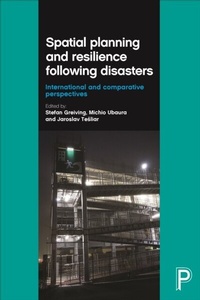
Spatial Planning and Resilience Following Disasters
International and Comparative Perspectives
Policy Press
1st Edition
Published on 29. July 2016
352 pages
978-1-4473-2360-0 (ISBN)
Description

Population shifts and an increase in the number of natural (and man-made) disasters are having a profound effect on urban and rural habitats globally. This book brings together for the first time the experiences and knowledge of international contributors from academia, research, policy and practice to discuss the role of spatial planning after significant disasters. It highlights on-going efforts to improve spatial resilience across the globe and predicts future trends. Comparisons from five countries including Japan, the US, Indonesia, Slovakia and Germany, highlight the influence of significant disasters on spatial planning and spatial resiliency under different legal-administrative and cultural frameworks.
Reviews / Votes
"In times of growing awareness on the crucial role of spatial planning in disaster recovery and resilience building this book meets the challenge outstandingly by bringing together prominent contributors from academia, research and policy-making to judge remediation efforts after calamities with an indelible imprint on human history." Sapountzaki Kalliopi, Harokopio University, GreeceMore details
Edition
First Edition
Language
English
Place of publication
Bristol
United Kingdom
Publishing group
Bristol University Press
Target group
Professional and scholarly
Illustrations
Not illustrated
ISBN-13
978-1-4473-2360-0 (9781447323600)
DOI
https://doi.org/10.51952/9781447323600
Copyright in bibliographic data and cover images is held by Nielsen Book Services Limited or by the publishers or by their respective licensors: all rights reserved.
Schweitzer Classification
Other editions
Additional editions
Spatial Planning and Resilience Following Disasters
International and Comparative Perspectives
Book
12/2017
1st Edition
Policy Press
€46.70
Shipment within 15-20 days
Spatial Planning and Resilience Following Disasters
International and Comparative Perspectives
Book
07/2016
1st Edition
Policy Press
€108.10
Shipment within 15-20 days
Spatial Planning and Resilience Following Disasters
International and Comparative Perspectives
E-Book
07/2016
1st Edition
Policy Press
€51.99
Available for download
Persons
Stefan Greiving is Executive Director of the Institute of Spatial Planning at TU Dortmund University. His main interests are in the areas of disaster risk management, adaptation to climate change and spatial planning.
Michio Ubaura is Associate Professor in the Department of Architecture and Building Science at Tohoku University. His specialty is spatial planning.
Jaroslav Tesliar is Director of the Agency for the Support of Regional Development Kosice, Slovakia. His interest is regional development in general with focus on climate change.
Michio Ubaura is Associate Professor in the Department of Architecture and Building Science at Tohoku University. His specialty is spatial planning.
Jaroslav Tesliar is Director of the Agency for the Support of Regional Development Kosice, Slovakia. His interest is regional development in general with focus on climate change.
Contributions
TU Dortmund, IRPUD
TU Dortmund
Agency for the Support of Regional Development, Kosice
Agency for the Support of Regional Development, Kosice
Agency for the Support of Regional Development, Kosice
Agency for the Support of Regional Development
Stony Brook University
Unknown
United Nations University
Content
Introduction: Disaster response and spatial planning - key challenges and strategies ~ Stefan Greiving;
PART A;
I. Japan;
Disaster risk management and land use in Japan: In geography vulnerable to water-related disasters ~ Kanako Iuchi;
Spatial Planning Control for Housing Recovery after Great East Japan Earthquake ~ Tamiyo Kondo;
Reconstruction plans and planning processes after the Great East Japan Earthquake ~ Michio Ubaura;
II. Indonesia;
Land use politics after Indian Ocean Tsunami 2004 ~ Togu Pardede;
Coastal resilience in Indonesia: From plan to implementation ~ Surtiari, G.A.K ., Garschagen, M ., Birkmann , J., Setiadi, N ., Manuati, Y;
III. USA;
Planning for resilience in the New York metro region after Superstorm Sandy ~ Donovan Finn;
IV. Slovakia;
Spatial planning focusing on risk management in Slovakia ~ Alena Kuceravcova, Jan Dzurdzenik;
Enhancement of flood management and flood-protection planning in Eastern Slovakia ~ Jozef Sulak, Jaroslav Tesliar;
V. Germany;
Flood risk management by spatial planning ~ Stefan Greiving, Nadine Maegdefrau;
Major-accident hazards in spatial planning ~ Nadine Maegdefrau;
Cross-Analysis of Part A ~ Stefan Greiving, Nadine Maegdefrau, Teresa Sprague;
PART B;
Planning systems for risk reduction and issues in pre-disaster implementation ~ Kanako Iuchi;
Efforts and limitations in spatial transformation after disasters ~ Michio Ubaur;
Role of coordination in building spatial resilience after disasters ~ Alena Kuceravcova, Jozef Sulak, Jaroslav Tesliar, Jan Dzurdzenik;
Residents' participation in rebuilding more resilient space ~ Nadine Maegdefrau, Teresa Sprague;
Spatial planning and uncertainties associated with future disasters ~ Stefan Greiving;
Conclusion: Change-proof cities and regions - an integrated concept for tackling key challenges for spatial development ~ Stefan Greiving, Kanako Iuchi, Jaroslav Tesliar, Michio Ubaura.
PART A;
I. Japan;
Disaster risk management and land use in Japan: In geography vulnerable to water-related disasters ~ Kanako Iuchi;
Spatial Planning Control for Housing Recovery after Great East Japan Earthquake ~ Tamiyo Kondo;
Reconstruction plans and planning processes after the Great East Japan Earthquake ~ Michio Ubaura;
II. Indonesia;
Land use politics after Indian Ocean Tsunami 2004 ~ Togu Pardede;
Coastal resilience in Indonesia: From plan to implementation ~ Surtiari, G.A.K ., Garschagen, M ., Birkmann , J., Setiadi, N ., Manuati, Y;
III. USA;
Planning for resilience in the New York metro region after Superstorm Sandy ~ Donovan Finn;
IV. Slovakia;
Spatial planning focusing on risk management in Slovakia ~ Alena Kuceravcova, Jan Dzurdzenik;
Enhancement of flood management and flood-protection planning in Eastern Slovakia ~ Jozef Sulak, Jaroslav Tesliar;
V. Germany;
Flood risk management by spatial planning ~ Stefan Greiving, Nadine Maegdefrau;
Major-accident hazards in spatial planning ~ Nadine Maegdefrau;
Cross-Analysis of Part A ~ Stefan Greiving, Nadine Maegdefrau, Teresa Sprague;
PART B;
Planning systems for risk reduction and issues in pre-disaster implementation ~ Kanako Iuchi;
Efforts and limitations in spatial transformation after disasters ~ Michio Ubaur;
Role of coordination in building spatial resilience after disasters ~ Alena Kuceravcova, Jozef Sulak, Jaroslav Tesliar, Jan Dzurdzenik;
Residents' participation in rebuilding more resilient space ~ Nadine Maegdefrau, Teresa Sprague;
Spatial planning and uncertainties associated with future disasters ~ Stefan Greiving;
Conclusion: Change-proof cities and regions - an integrated concept for tackling key challenges for spatial development ~ Stefan Greiving, Kanako Iuchi, Jaroslav Tesliar, Michio Ubaura.
