

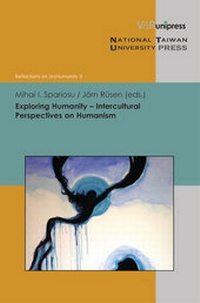
Exploring Humanity
Intercultural Perspectives on Humanism
1st Edition
Published on 11. September 2012
295 pages
978-3-8470-0016-7 (ISBN)
Description

The old humanistic model, aiming at universalism, ecumenism, and the globalization of various Western systems of values and beliefs, is no longer adequate - even if it pleads for an ever-wider inclusion of other cultural perspectives and for intercultural dialogue.In contrast, it would be wise to retain a number of its assumptions and practices - which it incidentally shares with humanistic models outside the Western world. We must now reconsider and remap it in terms of a larger, global reference frame. This anthology does just that, thus contributing to a new field of study and practice that could be called »intercultural humanism«.
More details
Other editions
Additional editions
Book
09/2012
1st Edition
Brill Deutschland
€69.00
Shipment within 7-9 days
Persons
Editor
Maihai Spariosu is Distinguished Research Professor at the University of Georgia, Athens.
Prof Dr Jörn Rüsen ist Senior Fellow am Kulturwissenschaftlichen Institut der Universität Essen und Professor emeritus an der Universität Witten/Herdecke.
Contributions
Series Editor
Prof Dr Jörn Rüsen ist Senior Fellow am Kulturwissenschaftlichen Institut der Universität Essen und Professor emeritus an der Universität Witten/Herdecke.
Prof Dr Chun-chieh Huang is National Chair Professor and Dean of the Institute for Advanced Studies in Humanities and Social Sciences, National Taiwan University, and Research Fellow at the Institute of Chinese Literature and Philosophy, Academia Sinica, Taiwan.
Content
- Intro
- Title Page
- Copyright
- Table of Contents
- Mihai I. Spariosu: Introduction
- Body
- Part One: Reopening the Door on Humanism
- Jörn Rüsen: Temporalizing Humanity: Towards a Universal History of Humanism
- Why humanism?
- What is humanism? - The Western concept
- Main trends of historical development
- 1) Anthropological and universal-historical preconditions
- 2) Humanizing humankind in Western history
- Secularization
- Universalization
- Naturalization
- Idealization
- Historization
- Individualization
- Limits and self-criticism
- Future perspectives
- Roger Griffin: Homo Humanistus? Towards an Inventory of Transcultural Humanism
- The secular, culture-specific connotations of `humanism'
- Humanism as a universal, primordial force in history
- The scientific substratum of universal humanism
- The evidence of comparative linguistics
- The basis for transcultural humanism in world religions
- Transcendental humanism in the Abrahamic faiths
- Et cetera.
- Towards a conclusion
- Kirill Thompson: Lessons from Early Chinese Humanist Impulses
- Introduction: the problems
- Confucius' ethics: from individual self to relational being
- Confucius' vocabulary for "self" as relational being
- Confucian introspection as relational
- Formation of relational self?/being and Confucianism
- First-order and second-order relational ethics and Confucianism
- Mozi's critique of Confucius' stress on first-order morality
- Relational self?/being and humanism
- Laozi and Zhuangzi vs. human species centrism
- The Laozi
- The Zhuangzi
- Conclusion
- Sayyed Mohsen Fatemi: Islam, Secular Modernity and Intercultural Humanism
- Mihai I. Spariosu: Intercultural Humanism and Global Intelligence: Definition, Principles, Practice
- 1) Intercultural humanism ought to work toward redefining the ideas of "human" and "humanity" within a global reference frame
- 2) Intercultural humanism ought to work toward establishing a common core of human values
- 3) Intercultural humanism ought to downplay the role of mimesis and instead introduce and develop the idea of intercultural resonance
- 4) Intercultural humanism ought to practice responsive understanding through intercultural hermeneutics
- 5) Intercultural humanism should practice global (self-) awareness, instead of "cultural critique" and "critical thinking"
- 6) Intercultural humanism ought to practice in-depth intercultural comparative analysis
- 7) Intercultural humanism ought to cultivate transdisciplinary modes of knowledge and learning
- 8) Intercultural humanism ought to explore and revaluate such anthropological tools of intercultural comparative analysis as "intercultural contact" and "liminality"
- 9) Intercultural humanism ought to cultivate a peace-oriented mentality, based on global intelligence
- 10) Intercultural humanism ought to submit the notions of intercultural dialogue and negotiation themselves to an in-depth comparative analysis and employ them as cognitive instruments in helping us move toward a mentality of peace
- 1. Launch and develop a new, transdisciplinary field of intercultural humanism
- 2. A global network of intercultural learning centres
- 3. An interactive E-faith website
- 4. An interactive E-negotiation website
- 5. Other advanced, AI-driven, technological platforms, to implement the research and learning objectives of intercultural humanism
- Part Two: The Treasures of Humankind
- Hubert Cancik: The Awareness of Cultural Diversity in Ancient Greece and Rome
- 1. History
- 1.1. `Many were the humans whose cities he saw, and whose minds he learned.' (Homer, Odyssey I.3)
- 1.2. Ethnography and historiography - forms, authors, regions
- 1.3. The categories
- 2. Medical anthropology
- 2.1. Nature and culture: Hippocrates on airs, waters, and places
- 2.2. The Canon of human beings: Galen of Pergamon
- 3. Empathy and reflection
- 3.1. The Persian dramas of the 5th century B.C.
- 3.2. Historíe in Aeschylus
- 3.3 Inversion (`self-alienation'): Atossa's question
- 4. Summary, lacunae, questions
- 4.1. Summary
- 4.2 Lacunae
- 4.3. Ethno-?/eurocentrism, colonialism?/imperialism
- Robert Evans: European Humanism: East and West
- Chen Chao-ying ??: Human Being as Species Being: A Reconsideration on Xunzi's Humanism
- Two modern visions of Xunzi: Xu Fuguan and Tang Junyi
- The centrality of tiangren zhi fèn ????: allotting, partaking and sharing
- Human being as species being: a dialogue with the young Marx
- M. Satish Kumar: Buddhism and Intercultural Humanism: An Exploration in Context
- The Buddha-Carita, or The Life of Buddha
- Nature and humanity
- Sanctity?/sacredness and dignity of life
- Tolerance?/justice as a universal principle
- The Earth Charter
- Lotus Sutra-Buddha nature: a touchstone for cosmic humanism
- Living Buddha: some anecdotes
- Conclusion
- Acknowledgements
- Ming Xie: Harmony in Difference: Tension and Complementarity
- Introduction: harmony and its antinomies
- Harmony as a regulative ideal
- "Harmonious society"
- Harmony in difference: tension and complementarity
- From pluralism to immanence
- Conclusion
- Part Three: Challenging Humanity: The Multiple Dimensions
- Mikhail Epstein: Humanology: The Fate of the Human in the "Posthuman" Age
- Part 1. Humanology and technology
- 1.1 Technohumanism vs. posthumanism and antitechnicism
- 1.2 Technohuman and superhuman
- 1.3 Anthropology, the humanities and humanology
- 1.4 Human species within a larger set of forms
- 1.5 Humanology and ecology: the human environment
- Part 2. Human creative potential and technotheism
- 2.1 Humanology and theology
- 2.2 Information technologies and an argument for the existence of the supreme mind
- 2.3 Cognitive faith
- 2.4 The simulation argument
- 2.5 The theological paradox of technical advancement
- 2.6 The Universe is much bigger
- Gheorghe ?tefan: Integral Humanism and Its Challenges
- The three global nets
- Integral humanism vs. "humanisms"
- Integral humanism and the fragmentation of knowledge
- Integral humanism and learning
- Conclusions
- Erhard Reckwitz: Otherness? Towards an Intercultural Literary Anthropology
- 1.
- 2.
- 3.
- 4.
- 5.
- 6.
- Michael Onyebuchi Eze: Ubuntu?/Botho: Ideology or Promise?
- Virgil Nemoianu: Tradition, the Beautiful, and the Uncertainties of Global Humanism
- List of Contributors
- Bibliography
- Printed Resources
- Digital resources
