

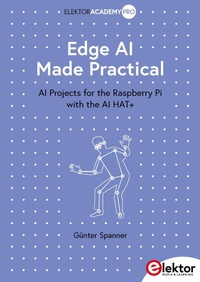
Edge AI Made Practical
Description

Dr. Günter Spanner has been active in research and development for several major corporations for more than 30 years. Project and technology management in the fields of biosensors and physical measurement technologies form the core of his work. In addition to his role as a lecturer at ETH Zurich and EU|FH, the author has successfully published technical articles and books on a wide range of topics - from electronics to measurement and sensor technology, all the way to gravitational-wave physics. His contributions to the frequency stabilization of lasers found application in the field of direct gravitational-wave detection, which was awarded the Nobel Prize in 2017.
More details
Other editions
Additional editions
Person
Edge AI is transforming everyday devices by putting intelligence where it matters most: directly inside the hardware. With on-device inference, a camera can recognize a visitor instantly, a phone can translate speech without streaming audio to the cloud, and a wearable can detect anomalies in real time-fast, private, and reliable even when the network disappears.
This book is your practical guide to building exactly those kinds of systems with the Raspberry Pi AI HAT+ and the Hailo-8L accelerator. You'll start with clear foundations: core AI and machine-learning concepts, how neural networks work, and what truly distinguishes Edge AI from cloud AI-plus an honest look at ethical considerations and future impacts.
Then it's straight to hands-on physical computing. Step by step, you'll set up Raspberry Pi OS, power and cooling, and develop in Python using the Thonny IDE. You'll learn GPIO basics with lights and servos, mount the AI HAT+ hardware, install and verify the Hailo software stack, and connect the right camera-official modules or USB webcams, even multiple cameras.
From your first pipeline to real projects, you'll run person detection, pose estimation, segmentation, and depth estimation, then level up with YOLO object detection: smart alerts, guest counters, and custom extensions. You'll even connect vision to motion by combining gesture recognition with servo-driven mechanisms, including a robotic arm.
With troubleshooting tips, hardware essentials, and a practical Python refresher, this book turns Edge AI from buzzword into buildable reality.
