

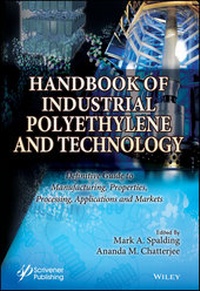
Handbook of Industrial Polyethylene and Technology
Description

This handbook provides an exhaustive description of polyethylene. The 50+ chapters are written by some of the most experienced and prominent authors in the field, providing a truly unique view of polyethylene. The book starts with a historical discussion on how low density polyethylene was discovered and how it provided unique opportunities in the early days. New catalysts are presented and show how they created an expansion in available products including linear low density polyethylene, high density polyethylene, copolymers, and polyethylene produced from metallocene catalysts. With these different catalysts systems a wide range of structures are possible with an equally wide range of physical properties. Numerous types of additives are presented that include additives for the protection of the resin from the environment and processing, fillers, processing aids, anti-fogging agents, pigments, and flame retardants. Common processing methods including extrusion, blown film, cast film, injection molding, and thermoforming are presented along with some of the more specialized processing techniques such as rotational molding, fiber processing, pipe extrusion, reactive extrusion, wire and cable, and foaming processes. The business of polyethylene including markets, world capacity, and future prospects are detailed. This handbook provides the most current and complete technology assessments and business practices for polyethylene resins.
More details
Other editions
Additional editions
Persons
Mark A. Spalding is a Fellow in the Materials & Parts Processing Group at The Dow Chemical Company, Midland, MI. He joined Dow in 1985 after completing a BS from The University of Toledo and a MS and PhD from Purdue University, all in Chemical Engineering. He has performed fundamental research in single-screw extrusion, developed methods to measure resin physical properties that are important to polymer processing, developed numerous techniques to troubleshoot and increase the rates of extrusion lines, and has developed new mathematical models for extrusion simulation. He co-authored the book "Analyzing and Troubleshooting Single-Screw Extruders" with Gregory A. Campbell. Dr. Spalding is a Fellow and Honored Service Member of the Society of Plastics Engineers (SPE).
Ananda M. Chatterjee started his career at Celanese Plastics (1978) and worked for Shell Development, Union Carbide, Dow Chemical, Kaneka Texas, and Ingenia Polymers. He had extensive and in-depth experience in polymer research and development, product commercialization, polymer film processing and products technology, polymer additives technology, additive blends technology and processing, customer technical service, intellectual property (patent) invention and licensing and technology transfer of UNIPOL polypropylene technology worldwide. He was a Fellow and Honored Service Member of the Society of Plastics Engineers (SPE). Dr. Chatterjee held a PhD from the University of Massachusetts Amherst and held over 25 U.S. patents. Dr. Chatterjee passed away in 2016 during the development of this book.
Content
Foreword by Barry Morris xi
Preface xiii
List of Contributors xv
Part 1: Principles and Properties of Polyethylene
1 An Industrial Chronology of Polyethylene 3
Christopher Dobbin
2 Catalysts for the Manufacture of Polyethylene 25
Yury V. Kissin
3 Ethylene Polymerization Processes and Manufacture of Polyethylene 61
Ian D. Burdett and Ronald S. Eisinger
4 Types and Basics of Polyethylene 105
Rajen M. Patel
5 Molecular Structural Characterization of Polyethylene 139
A. Willem deGroot, David Gillespie, Rongjuan Cong, Zhe Zhou and Rajesh Paradkar
6 Thermal Analysis of Polyethylene 217
Kevin Menard and Noah Menard
7 Rheology of Polyethylene 239
Gregory W. Kamykowski
8 Processing-Structure-Property Relationships in Polyethylene 283
Rajen M. Patel
9 Mechanical Properties of Polyethylene: Deformation and Fracture Behavior 309
Alexander Chudnovsky, and Kalyan Sehanobish
Part 2: Processing and Fabrication of Polyethylene
10 Single-Screw Extrusion of Polyethylene Resins 339
Mark A. Spalding
11 Twin-Screw Extrusion of Polyethylene 357
Yoshitaka Kumura, Amit K. Chaudhary and Mark A. Spalding
12 Blown Film Processing 381
Thomas I. Butler
13 Cast Film Extrusion of Polyethylene 411
Hyunwoo Kim, Mark A. Spalding, Kurt A. Koppi, Wes Hobson and Joseph Dooley
14 Extrusion Coating and Laminating 429
Thomas Bezigian
15 Injection Molding 443
Jon Ratzlaff and Thomas Giovannetti
16 Blow Molding of Polyethylene 475
Mohammad Usman and Abdul Sami Siddiqui
17 Rotational Molding 535
Jon Ratzlaff and Glenn E. Larkin, Jr.
18 Thermoforming Polyethylene 573
Roger C. Kipp
19 Polyethylene Pipe Extrusion 591
Pam Maeger, V. Rohatgi, D. Hukill, N. Koganti and B. Martinez
20 Polyethylene Foam Extrusion 603
N. S. Ramesh
21 Expanded Polyethylene Bead Foam Technology 637
Steven R. Sopher
22 Polyethylene Fiber Extrusion 669
Johannes Fink
23 Polyethylene Compounding Technologies 695
Charles D. Park II and Steven Blazey
24 Polyethylene Modification by Reactive Extrusion 715
Adriana I. Moncada, Wenyi Huang and Nicholas Horstman
Part 3: Additives for Polyethylene
25 Degradation and Stabilization of Polyethylene 753
Joseph J. Fay and Roswell E. King, III
26 Light Stabilization of Polyethylene 771
Feng Zuo and Tad Finnegan
27 Acid Scavengers for Polyethylene 793
Robert L. Sherman Jr. and Kimberly E. Kern
28 Slip Agents 821
John Gray and Thomas Breuer
29 Antiblocking Additives 833
Johannes Fink
30 Antistatic Additives for Polyethylene 853
Gina Butuc, Gea Spijkerman, Sue te Hofstee and Ted Kampen
31 Antifogging Agents for Polyethylene Films 865
Michele Potenza and Bjarne Nielsen
32 Lubricants for Polyethylene 877
Johannes Fink
33 Fluorinated Polymer Processing Aids for Polyethylene 889
David A. Seiler, Francois Beaume, Samuel Devisme and Jason A. Pomante
34 Chemical Blowing Agents for Polyethylene 909
Peter Schroeck, Randy Minton, Theresa Healy and Larry Keefe
35 Flame Retardants for Polyethylene 921
Rudolf Pfaendner
36 Nucleating Agents for Polyethylene 935
Darin L. Dotson
37 Antimicrobial Agents for Polyethylene 967
Ivan Ong
38 Pigments and Colorants for Polyethylene 985
Roger Reinicker
Part 4: Applications of Polyethylene
39 Fillers and Reinforcing Agents for Polyethylene 1035
Janos Moczo and Bela Pukanszky
40 Flexible Packaging Applications of Polyethylene 1071
Jeff Wooster and Jill Martin
41 Rigid Packaging Applications 1091
Cliff R. Mure
42 Pipe and Tubing Applications of Polyethylene 1109
Bryan E. Hauger
43 Wire and Cable Applications of Polyethylene 1125
Scott H. Wasserman, Bharat I. Chaudhary, Jeffrey M. Cogen, Mohamed Esseghir and Timothy J. Person
44 Medical Applications of Polyethylene 1155
Benjamin Poon and Len Czuba
45 Automotive Applications for Polyethylene 1169
Kalyan Sehanobish
46 Textile, Hygiene, Health, and Geosynthetic Applications of Polyethylene 1179
Sanjiv R. Malkan
47 Applications of Polyethylene Elastomers and Plastomers 1197
Kim L. Walton, Tim Clayfield, Jim Hemphill and Lisa Madenjian
Part 5: The Business of Polyethylene
48 Product Regulatory Considerations for Polyethylene 1221
Tor H. Palmgren
49 Sustainability and Recycling of Polyethylene 1245
Thomas Nosker and Jennifer Lynch
50 Bio-Polyethylene and Polyethylene-Biopolymer Blends 1253
Johannes Fink
51 The Business of Polyethylene 1297
Jorge O. Buhler-Vidal
Appendix A1: Polymer Abbreviation Definitions 1331
Index 1333
List of Contributors
Francois Beaume is a senior development engineer at Arkema S.A. (France). He graduated in Chemistry from Chimie ParisTech and received a PhD in Polymer Science from ESPCI ParisTech in 1996. He has been with Arkema for over 20 years and is actively involved in Fluoropolymers R&D since 2002.
Tom Bezigian is a graduate of the UMASS-Lowell Plastics Engineering program, where he is now an adjunct professor specializing in film and sheet extrusion. He is the author/editor of TAPPI's Extrusion Coating Manual. He has worked in various capacities in the industry for companies such as Cryovac, Mobil Chemical, James River Corporation, and Felix Schoeller GmbH after which he founded and formed his own specialty film and extrusion laminating business in Syracuse, New York. He now consults and teaches on many aspects of the film and laminating industry, both here in the USA and abroad.
Steven Blazey received his PhD in organic chemistry from Case Western Reserve University in 1978 and currently works in A. Schulman's Technology Center in Akron, Ohio, as a Research and Development Engineer developing new products for targeted applications. His career spans 30+ years formulating and compounding polymers. He has a broad knowledge of plastic materials and additives and colorants as well as polymer processing.
Thomas E. Breuer is retired from Witco Chemical/Chemtura, now PMC Biogenix. He was Director of their Research and Applications Laboratory when he retired after 30 years of working in the field of polymer additives and other fatty chemical derivatives. He was involved in technical service for polymer additives worldwide for many years and was author or coauthor of many papers for SPE and other technical organizations.
Jorge O. Bühler-Vidal studied Mechanical Engineering at the University of Buenos Aires and at the Catholic University of America in Washington, DC. He joined Union Carbide in 1976 and was at the Bound Brook laboratories from 1978 to 2001. He is currently the Director of Polyolefins Consulting LLC and President of the Petrochemical Consulting Alliance which provides consulting services to global petrochemical and plastics industries.
Ian Burdett graduated from Manchester University Institute of Science and Technology, U.K. with a PhD In Chemical Engineering in 1976. The majority of his working career was spent with Union Carbide Corporation and subsequently The Dow Chemical Company. He worked in the area of Polyolefin Process Technology for 31 years and became Director of Process R&D for Gas Phase Polyolefins. He was awarded Union Carbide's Chairman's Award for development of the UNIPOLT Gas-Phase Process for Polypropylene in 1992.
Thomas I. Butler is retired from The Dow Chemical Company. While at Dow, he was a Technical Leader in Polyolefins and Elastomers R&D, Technical Service and Development. He was responsible for fabrication technology, including blown film processes, extrusion, and coextrusion. Tom graduated from New Mexico State University in Chemical Engineering. He was involved in product and application development for LDPE film, LLDPE film, ethylene acrylic acid copolymer film, and polyolefin plastomers.
Gina Butuc is the Technical Development Manager for Crosslinking Peroxides and Polymer Additives at AkzoNobel, Functional Chemicals. Gina has more than 15 years of experience in the polymer field, either polymer synthesis or application development and polymer testing, ranging from bench chemist to business management. She is the inventor or co-inventor on six U.S. and international patents and the author of four technical articles and a book chapter. Gina holds a MSc in Organic Chemistry from University of Bucharest, Rumania.
Amit K. Chaudhary is a Research Scientist in the Materials & Parts Processing Group at The Dow Chemical Company, Midland, MI. He joined Dow in 2010 after completing a BSc (Chemistry) and BTech (Chemical Engineering) from The University of Calcutta, India and a PhD (Chemical Engineering) from Michigan State University. He has performed fundamental research in twin-screw extrusion based processes, developed composite materials and processes for application in transportation industry for mass savings, and developed processes and compositions for water borne polymer dispersions for various industrial applications.
Bharat Chaudhary is a Fellow of the Society of Plastics Engineers and a Principal Research Scientist at The Dow Chemical Company. He obtained his PhD and MSc from Imperial College, London, and a BEng from the University of Benin, Nigeria, all in Chemical Engineering. He has 28 years of experience leading research and development in a variety of areas related to polymer modification. Bharat has received several awards for his work and he is author of 33 journal papers and 21 conference/technical presentations, as well as inventor on 63 U.S. granted patents, 28 European granted patents and numerous other patents and patent applications.
Alexander Chudnovsky is a UIC Distinguished Professor Emeritus and Director of the Fracture Mechanics and Materials Durability Laboratory, The University of Illinois at Chicago. He has broad expertise in thermodynamics, fracture mechanics, materials science, stress analysis, probability and statistics. He is widely recognized for his pioneering work in theoretical and experimental fracture mechanics, assessment of materials durability, accelerated testing of lifetime as well as forensic studies.
Tim Clayfield has a BSc and PhD in Polymer Physics from the University of Manchester Institute of Science and Technology. He joined Dow in 1989 in Stade, Germany in product and process R&D for the TYRINT group and moved to DuPont Dow Elastomers (DDE) in 1996. At DDE, he became Business Development Manager with projects across a range of markets. Returning to Dow and TS&D in 2005, he worked in the NORDELT EPDM space where he was the Global Application Technology Leader and Product Technology Leader for 8 years. He is currently a Technical Manager at Resinex.
Jeffrey Cogen is a Fellow at The Dow Chemical Company. He has 26 years of experience working with polymers, polymer additives, and polymer compounds. His expertise includes materials for communication and power cables. He is an expert in formulation of polyethylene and in polymer additive mechanisms and applications. He is an inventor on 43 issued U.S. patents and has published more than 40 papers and two invited book chapters. Dr. Cogen received a PhD in Organic Chemistry from the University of California, Berkeley.
Rongjuan Cong received a PhD in Chemical Engineering from McMaster University, Canada in 2001. She joined The Dow Chemical Company in 2005, where she led the development of various new separation techniques to characterize the microstructure of polyolefins and quantify the additives. She is currently a Research Scientist in the Performance Plastics Characterization Group. She has published 40 peer-reviewed papers. She is an inventor of 14 granted patents in new polyolefin products and polyolefin separation science.
Len Czuba is the President of Czuba Enterprises, Inc. a 2001, Chicago-based medical device product development consultancy. He holds 15 U.S. patents and has given more than 100 presentations or seminars and has more than 25 publications. In 2004, Mr. Czuba was one of the 100 "Medical Device & Diagnostic Industry" Notable Persons in the medical device industry. He has been a member of the Society of Plastics Engineers since 1975 and is very active in the Medical Plastics Division. He was the Society's International President during SPE's 2005 - 2006 year and is now a Distinguished, Honored Service, Fellow of SPE.
Samuel Devisme graduated as a Chemical Engineer from INP-ENSIACET, Toulouse, France and received his PhD from École Nationale Supérieure des Mines de Paris in 2006. He is employed by Arkema as the R&D Fluoropolymer Europe Manager and has worked in various areas of technical polymers for 10 years.
Christopher J. B. Dobbin is a Senior Scientist in the Polyethylene Product Research and Development Team at NOVA Chemicals in Calgary, AB, Canada. He completed his PhD in Organic and Polymer Chemistry at the University of Waterloo. In 1998 he joined NOVA Chemicals Corporation as a member of its solution-phase single site catalysis program. Here he has played a fundamental role in the molecular design, development and commercialization of the SURPASST family of dual reactor single site catalyzed ethylene-octene copolymer resins.
Joseph Dooley received his PhD in Mechanical Engineering from Eindhoven University of Technology, the Netherlands. He is currently the President of JDooley Consulting LLC, an organization that provides consulting services on polymer processing operations, equipment design, and R&D to the plastics industry. Joe retired from The Dow Chemical Company after 35 years in Dow's Research and Development organization. He has published more than 100 technical papers as well as authoring articles in the Encyclopedia of Polymer Science and Technology and chapters in textbooks on polymer processing instabilities and coextrusion. Joe is a Fellow of the Society of Plastics Engineers.
Darin L. Dotson obtained his PhD degree in Chemistry from Virginia...
