

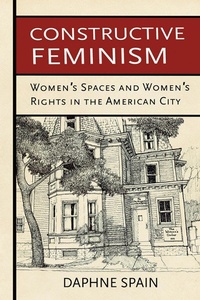
Constructive Feminism
Description

In Constructive Feminism, Daphne Spain examines the deliberate and unintended spatial consequences of feminism's second wave, a social movement dedicated to reconfiguring power relations between women and men. Placing the women's movement of the 1970s in the context of other social movements that have changed the use of urban space, Spain argues that reform feminists used the legal system to end the mandatory segregation of women and men in public institutions, while radical activists created small-scale places that gave women the confidence to claim their rights to the public sphere.Women's centers, bookstores, health clinics, and domestic violence shelters established feminist places for women's liberation in Boston, Los Angeles, and many other cities. Unable to afford their own buildings, radicals adapted existing structures to serve as women's centers that fostered autonomy, health clinics that promoted reproductive rights, bookstores that connected women to feminist thought, and domestic violence shelters that protected their bodily integrity. Legal equal opportunity reforms and daily practices of liberation enhanced women's choices in education and occupations. Once the majority of wives and mothers had joined the labor force, by the mid-1980s, new buildings began to emerge that substituted for the unpaid domestic tasks once performed in the home. Fast food franchises, childcare facilities, adult day centers, and hospices were among the inadvertent spatial consequences of the second wave.
More details
Other editions
Additional editions
Person
Daphne Spain is James M. Page Professor of Urban and Environmental Planning at the University of Virginia. She is the author of How Women Saved the City and Gendered Spaces, coauthor of Balancing Act: Motherhood, Marriage and Employment among American Women, and coeditor of Back to the City: Issues in Neighborhood Renovation.
Content
Introduction: Spatial Consequences of the Second Wave
1. Feminist Practice: Social Movements and Urban Space
2. Women's Centers: Nurturing Autonomy
3. Feminist Bookstores: Building Identity
4. Feminist Health Clinics: Promoting Reproductive Rights
5. Domestic Violence Shelters: Protecting Bodily Integrity
6. After the Second Wave: Necessary Spaces
