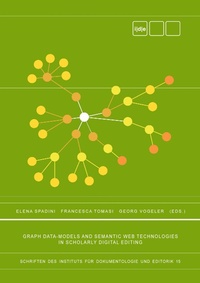
Graph Data-Models and Semantic Web Technologies in Scholarly Digital Editing
Schriften des Instituts für Dokumentologie und Editorik (Publisher)
1st Edition
Published on 18. November 2021
224 pages
978-3-7543-5876-4 (ISBN)
System requirements
for PDF without DRM
E-Book Single Licence
You are acquiring a single user licence for this eBook, which you might not transfer. [L]
Available for download
Description
Alles über E-Books | Antworten auf Fragen rund um E-Books, Kopierschutz und Dateiformate finden Sie in unserem Info- & Hilfebereich.
In scholarly digital editing, the established practice for semantically enriching digital texts is to add markup to a linear string of characters. Graph data-models provide an alternative approach, which is increasingly being given serious consideration. Labelled-property-graph databases, and the W3c's semantic web recommendation and associated standards (RDF and OWL) are powerful and flexible solutions to many of the problems that come with embedded markup. This volume explores the combination of scholarly digital editions, the graph data-model, and the semantic web from three perspectives: infrastructures and technologies, formal models, and projects and editions.
More details
Series
Edition
1. Auflage
Language
English
Publishing group
Books on Demand
ISBN-13
978-3-7543-5876-4 (9783754358764)
Schweitzer Classification
Other editions
Additional editions

Elena Spadini | Francesca Tomasi | Georg Vogeler
Graph Data-Models and Semantic Web Technologies in Scholarly Digital Editing
Book
10/2021
1st Edition
BoD - Books on Demand
€34.00
Shipment within 10-15 days

System requirements
File format: PDF
Copy protection: without DRM (Digital Rights Management)
System requirements:
- Computer (Windows; MacOS X; Linux): Use the free software Adobe Reader, Adobe Digital Editions, or any other PDF viewer of your choice (see eBook Help).
- Tablet/Smartphone (Android; iOS): Install the free app Adobe Digital Editions or another reading app for eBooks, e.g., PocketBook (see eBook Help).
- E-reader: Bookeen, Kobo, Pocketbook, Sony, Tolino and many more (only limited: Kindle).
The file format PDF always displays a book page identically on any hardware. This makes PDF suitable for complex layouts such as those used in textbooks and reference books (images, tables, columns, footnotes). Unfortunately, on the small screens of e-readers or smartphones, PDFs are rather annoying, requiring too much scrolling.
This eBook does not use copy protection or Digital Rights Management.
For more information, see our eBook Help page.