

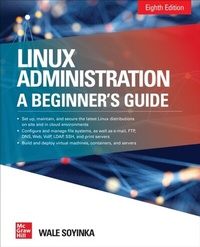
Linux Administration: A Beginner's Guide, Eighth Edition
1st Edition
Published on 10. April 2020
688 pages
978-1-260-44171-0 (ISBN)
Available for download
Description

Publisher's Note: Products purchased from Third Party sellers are not guaranteed by the publisher for quality, authenticity, or access to any online entitlements included with the product.Gain Essential Linux Administration Skills EasilyEffectively set up and manage popular Linux distributions on individual servers and build entire network infrastructures using this practical resource. Fully updated to cover the latest tools and techniques, Linux Administration: A Beginner s Guide, Eighth Edition features clear explanations, step-by-step instructions, and real-world examples. Find out how to configure hardware and software, work from the command line or GUI, maintain Internet and network services, and secure your data. Performance tuning, virtualization, containers, software management, security, and backup solutions are covered in detail.Install and configure Linux, including the latest distributions from Fedora, Ubuntu, CentOS, openSUSE, Debian, and RHEL.Set up and administer core system services, daemons, users, and groups.Manage software applications from source code or binary packages.Customize, build, or patch the Linux kernel.Understand and manage the Linux network stack and networking protocols, including TCP/IP, ARP, IPv4, and IPv6.Minimize security threats and build reliable firewalls and routers with Netfilter (iptables and nftables) and Linux.Create and maintain DNS, FTP, web, e-mail, print, LDAP, VoIP, and SSH servers and services.Share resources using GlusterFS, NFS, and Samba.Spin-up and manage Linux-based servers in popular cloud environments, such as OpenStack, AWS, Azure, Linode, and GCE.Explore virtualization and container technologies using KVM, Docker, Kubernetes, and Open Container Initiative (OCI) tooling.Download specially curated Virtual Machine image and containers that replicate various exercises, software, servers, commands, and concepts covered in the book.Wale Soyinka is a father, system administrator, a DevOps/SecOps aficionado, an open source evangelist, a hacker, and a well-respected world-renowned chef (in his mind). He is the author of Advanced Linux Administration as well as other Linux, Network, and Windows administration training materials.
More details
Other editions
Additional editions
Wale Soyinka
Linux Administration: A Beginner's Guide, Eighth Edition
A Beginner's Guide, Eighth Edition
Book
04/2020
8th Edition
McGraw-Hill Education
€50.40
Shipment within 10-20 days
Content
- Cover
- Title Page
- Copyright Page
- Dedication
- About the Author
- Contents at a Glance
- Contents
- Acknowledgments
- Introduction
- Part I Introduction and Installation
- Chapter 1 Introduction to Linux, Distributions, and FOSS
- Linux: The Operating System
- Open Source Software and GNU: Overview
- The GNU Public License
- Upstream and Downstream
- The Advantages of Open Source Software
- Understanding the Differences Between Windows and Linux
- Single Users vs. Multiple Users vs. Network Users
- The Monolithic Kernel and the Micro-Kernel
- Separation of the GUI and the Kernel
- My Network Places
- The Registry vs. Text Files
- Domains and Active Directory
- Summary
- Chapter 2 Installing a Linux Server
- Hardware and Environmental Considerations
- Server Design
- Uptime
- Methods of Installation
- Installing Fedora
- Project Prerequisites
- The Installation
- Installation Summary
- Localization Section
- Software Section
- System Section
- User Settings Section
- The Installation
- Installing Ubuntu Server
- Start the Installation
- Configure the Network
- Configure Proxy
- Configure Ubuntu Archive Mirror
- File System Setup
- Profile Setup
- SSH Setup
- Featured Server Snaps
- Install Complete
- Summary
- Chapter 3 Deploying Linux Servers in the Cloud
- Behind the Cloud
- Obtaining and Spinning Up New Virtual Linux Servers
- Free-to-Run Virtual Linux Servers
- Commercial Cloud Service Providers
- Summary
- Part II Single-Host Administration
- Chapter 4 The Command Line
- An Introduction to Bash
- Job Control
- Environment Variables
- Pipes
- Redirection
- Command-Line Shortcuts
- Filename Expansion
- Environment Variables as Parameters
- Multiple Commands
- Backticks
- Documentation Tools
- The man Command
- The texinfo System
- Files (Types, Ownership, and Permissions)
- Normal Files
- Directories
- Hard Links
- Symbolic Links
- Block Devices
- Character Devices
- Listing Files: ls
- Change Ownership: chown
- Change Group: chgrp
- Change Mode: chmod
- File Management and Manipulation
- Copy Files: cp
- Move Files: mv
- Link Files: ln
- Find a File: find
- File Compression: gzip
- File Compression: bzip2
- File Compression: xz
- Create a Directory: mkdir
- Remove Files or Directories: rm
- Show Present Working Directory: pwd
- Tape Archive: tar
- Concatenate Files: cat
- Display a File One Screen at a Time: more or less
- Show the Directory Location of a File: which
- Locate a Command: whereis
- Editors
- vi
- emacs
- pico
- sed
- Miscellaneous Tools
- Disk Utilization: du
- Disk Free: df
- List Processes: ps
- Show an Interactive List of Processes: top
- Send a Signal to a Process: kill
- Show System Information: uname
- Who Is Logged In: who
- A Variation on who: w
- Switch User: su
- Putting It All Together (Moving a User and Its Home Directory)
- Summary
- Chapter 5 Managing Software
- The Red Hat Package Manager
- Managing Software Using RPM
- Querying for Information the RPM Way (Getting to Know One Another)
- Installing Software with RPM (Moving in Together)
- Uninstalling Software with RPM (Ending the Relationship)
- Other Things RPM Can Do
- Yum
- DNF
- GUI RPM Package Managers
- Fedora or Ubuntu
- openSUSE and SLE
- The Debian Package Management System
- APT
- Software Management in Ubuntu
- Querying for Information
- Installing Software in Ubuntu
- Removing Software in Ubuntu
- Compile and Install GNU Software
- Getting and Unpacking the Source Package
- Looking for Documentation
- Configuring the Package
- Compiling the Package
- Installing the Package
- Testing the Software
- Cleanup
- Common Problems when Building from Source Code
- Problems with Libraries
- Missing Configure Script
- Broken Source Code
- Summary
- Chapter 6 Managing Users and Groups
- What Exactly Constitutes a User?
- Where User Information Is Kept
- The /etc/passwd File
- The /etc/shadow File
- The /etc/group File
- User Management Tools
- Command-Line User Management
- GUI User Managers
- Users and Access Permissions
- Understanding SetUID and SetGID Programs
- Sticky Bit
- Pluggable Authentication Modules
- How PAM Works
- PAM's Files and Their Locations
- Configuring PAM
- A Sample PAM Configuration File
- The "Other" File
- D'oh! I Can't Log In!
- Debugging PAM
- A Grand Tour
- Creating Users with useradd
- Creating Groups with groupadd
- Modifying User Attributes with usermod
- Modifying Group Attributes with groupmod
- Deleting Users and Groups with userdel and groupdel
- Summary
- Chapter 7 Booting and Shutting Down
- Boot Loaders
- GRUB Legacy
- GRUB 2
- Bootstrapping
- The init Process
- Systemd Scripts
- Writing Your Own rc Script
- Enabling and Disabling Services
- Enabling a Service
- Disabling a Service
- Odds and Ends of Booting and Shutting Down
- fsck!
- Booting into Single-User ("Recovery") Mode
- Summary
- Chapter 8 File Systems
- The Makeup of File Systems
- i-Nodes
- Blocks
- Superblocks
- ext4
- Btrfs
- XFS
- Managing File Systems
- Mounting and Unmounting Local Disks
- Using fsck
- Adding a New Disk
- Overview of Partitions
- Traditional Disk and Partition Naming Conventions
- Volume Management
- Creating Partitions and Logical Volumes
- Creating File Systems
- Summary
- Chapter 9 Core System Services
- systemd
- systemd's Role
- How systemd Works
- xinetd
- The /etc/xinetd.conf File
- Examples: A Simple (echo) Service Entry
- The Logging Daemon
- rsyslogd
- systemd-journald (journald)
- The cron Program
- The crontab File
- Editing the crontab File
- Summary
- Chapter 10 The Linux Kernel
- What Exactly Is a Kernel?
- Finding the Kernel Source Code
- Getting the Correct Kernel Version
- Unpacking the Kernel Source Code
- Building the Kernel
- Preparing to Configure the Kernel
- Kernel Configuration
- Compiling the Kernel
- Installing the Kernel
- Booting the Kernel
- The Author Lied! It Didn't Work!
- Patching the Kernel
- Downloading and Applying Patches
- If the Patch Worked
- If the Patch Didn't Work
- Summary
- Chapter 11 Knobs and Dials: API (Virtual) File Systems
- What's Inside the /proc Directory?
- Tweaking Files Inside of /proc
- Some Useful /proc Entries
- Enumerated /proc Entries
- Common proc Settings and Reports
- SYN Flood Protection
- Issues on High-Volume Servers
- SysFS
- cgroupfs
- tmpfs
- tmpfs Example
- Summary
- Part III Networking and Security
- Chapter 12 TCP/IP for System Administrators
- The Layers
- Packets
- TCP/IP Model and the OSI Model
- Headers
- Ethernet
- IP (IPv4)
- TCP
- UDP
- A Complete TCP Connection
- Opening a Connection
- Transferring Data
- Closing the Connection
- How ARP Works
- The ARP Header: ARP Works with Other Protocols, Too!
- Bringing IP Networks Together
- Hosts and Networks
- Subnetting
- Netmasks
- Static Routing
- Dynamic Routing with RIP
- tcpdump Bits and Bobs
- Reading and Writing Dumpfiles
- Capturing More or Less per Packet
- Performance Impact
- Don't Capture Your Own Network Traffic
- Troubleshooting Slow Name Resolution (DNS) Issues
- IPv6
- IPv6 Address Format
- IPv6 Address Types
- IPv6 Backward Compatibility
- Summary
- Chapter 13 Network Configuration
- Modules and Network Interfaces
- Network Device Configuration Utilities (ip, ifconfig, and nmcli)
- Sample Usage: ifconfig, ip, and nmcli
- Setting Up NICs at Boot Time
- Managing Routes
- Sample Usage: Route Configuration
- Displaying Routes
- A Simple Linux Router
- Routing with Static Routes
- VPCs, Subnets, IPs, and Route Configuration (AWS Cloud Example)
- VPCs and Subnets (AWS)
- Internet Gateways and Routing (AWS)
- Security Groups (AWS)
- Launch a Linux Server in Its Own Subnet (AWS)
- Hostname Configuration
- Summary
- Chapter 14 Linux Firewall (Netfilter)
- How Netfilter Works
- A NAT Primer
- Chains
- Installing Netfilter
- Enabling Netfilter in the Kernel
- Configuring Netfilter
- Saving Your Netfilter Configuration
- The iptables Command
- firewalld
- Cookbook Solutions
- Simple NAT: iptables
- Simple NAT: nftables
- Simple Firewall: iptables
- Summary
- Chapter 15 Local Security
- Common Sources of Risk
- SetUID Programs
- Unnecessary Processes
- Picking the Right Runlevel
- Nonhuman User Accounts
- Limited Resources
- Mitigating Risk
- chroot
- SELinux
- AppArmor
- Monitoring Your System
- Logging
- Using ps and netstat
- Watch That Space (Using df)
- Automated Monitoring
- Staying in the Loop (Mailing Lists)
- Summary
- Chapter 16 Network Security
- TCP/IP and Network Security
- The Importance of Port Numbers
- Tracking Services
- Using the netstat Command
- Security Implications of netstat's Output
- Binding to an Interface
- Shutting Down Services
- Shutting Down xinetd and inetd Services
- Shutting Down Non-xinetd Services
- Monitoring Your System
- Making the Best Use of syslog
- Monitoring Bandwidth with MRTG
- Handling Attacks
- Trust Nothing (and No One)
- Change Your Passwords
- Pull the Plug
- Network Security Tools
- nmap
- Snort
- Nessus and OpenVAS
- Wireshark/tcpdump
- Summary
- Part IV Internet Services
- Chapter 17 Domain Name System (DNS)
- The Hosts File
- How DNS Works
- Domain and Host Naming Conventions
- The Root Domain
- Subdomain
- The in-addr.arpa Domain
- Types of Servers
- Installing a DNS Server
- Understanding the BIND Configuration File
- The Specifics
- Configuring a DNS Server
- Defining a Primary Zone in the named.conf File
- Defining a Secondary Zone in the named.conf File
- Defining a Caching Zone in the named.conf File
- DNS Records Types
- SOA: Start of Authority
- NS: Name Server
- A and AAAA: Address Records
- PTR: Pointer Record
- MX: Mail Exchanger
- CNAME: Canonical Name
- RP and TXT: The Documentation Entries
- Setting Up BIND Database Files
- DNS Server Setup Walkthrough
- The DNS Toolbox
- host
- dig
- resolvectl
- nslookup
- whois
- nsupdate
- The rndc Tool
- Configuring DNS Clients
- The Resolver
- Configuring the Client (Traditional)
- Summary
- Chapter 18 File Transfer Protocol (FTP)
- The Mechanics of FTP
- Client/Server Interactions
- Obtaining and Installing vsftpd
- Configuring vsftpd
- Starting and Testing the FTP Server
- Customizing the FTP Server
- Setting Up an Anonymous-Only FTP Server
- Setting Up an FTP Server with Virtual Users
- Summary
- Chapter 19 Apache Web Server
- Understanding HTTP
- Headers
- Ports
- Process Ownership and Security
- Installing the Apache HTTP Server
- Apache Modules
- Starting Up and Shutting Down Apache
- Starting Apache at Boot Time
- Testing Your Installation
- Configuring Apache
- Creating a Simple Root-Level Page
- Apache Configuration Files
- Common Configuration Options
- Troubleshooting Apache
- Summary
- Chapter 20 Simple Mail Transfer Protocol (SMTP)
- Understanding SMTP
- Rudimentary SMTP Details
- Security Implications
- E-mail Components
- Installing the Postfix Server
- Installing Postfix via DNF in Fedora, CentOS, or RHEL
- Installing Postfix via APT in Ubuntu
- Configuring the Postfix Server
- The main.cf File
- Checking Your Configuration
- Running the Server
- Checking the Mail Queue
- Flushing the Mail Queue
- The newaliases Command
- Making Sure Everything Works
- Summary
- Chapter 21 Post Office Protocol and Internet Mail Access Protocol (POP and IMAP)
- POP3 and IMAP Protocol Basics
- Dovecot (IMAP and POP3 Server)
- Installing Dovecot
- Dovecot Configuration Files and Options
- Configuring Dovecot
- Running Dovecot
- Checking Basic POP3 Functionality
- Checking Basic IMAP Functionality
- Other Issues with Mail Services
- SSL/TLS Security
- Availability
- Log Files
- Summary
- Chapter 22 Voice over Internet Protocol (VoIP)
- VoIP Overview
- VoIP Server
- Analog Telephone Adapter (ATA)
- IP Phones
- VoIP Protocols
- VoIP Implementations
- Asterisk
- How Asterisk Works
- Asterisk Installation
- Starting and Stopping Asterisk
- Understanding Asterisk Configuration Files and Structure
- The Dialplan: extensions.conf
- Modules: modules.conf
- Asterisk Network, Port, and Firewall Requirements
- Configuring the Local Firewall for Asterisk
- Configuring the PBX
- Local Extensions
- Outside Connection (VoIP Trunking)
- Trunking Using Twilio Elastic SIP Trunks
- Asterisk Maintenance and Troubleshooting
- Asterisk CLI Commands
- Helpful CLI Commands
- Common Issues with VoIP
- Summary
- Chapter 23 Secure Shell (SSH)
- Understanding Public Key Cryptography
- Key Characteristics
- SSH Backstory (Versions)
- OpenSSH and OpenBSD
- Alternative Vendors for SSH Clients
- Installing OpenSSH on RPM-Based Systems
- Installing OpenSSH via APT in Ubuntu
- Server Startup and Shutdown
- SSHD Configuration File
- Using OpenSSH
- Secure Shell (ssh) Client Program
- Secure Copy (scp) Program
- Secure FTP (sftp) Program
- Files Used by the OpenSSH Client
- Summary
- Part V Intranet Services
- Chapter 24 Network File System (NFS)
- The Mechanics of NFS
- Versions of NFS
- Security Considerations for NFS
- Mount and Access a Partition
- Enabling NFS in Fedora, RHEL, and CentOS
- Enabling NFS in Ubuntu and Debian
- The Components of NFS
- Kernel Support for NFS
- Configuring an NFS Server
- The /etc/exports Configuration File
- Configuring NFS Clients
- The mount Command
- Soft vs. Hard Mounts
- Cross-Mounting Disks
- The Importance of the intr Option
- Performance Tuning
- Troubleshooting Client-Side NFS Issues
- Stale File Handles
- Permission Denied
- Sample NFS Client and NFS Server Configuration
- Common Uses for NFS
- Summary
- Chapter 25 Samba
- The Mechanics of SMB
- Usernames and Passwords
- Encrypted Passwords
- Samba Daemons
- Installing Samba via RPM
- Installing Samba via APT
- Samba Administration
- Starting and Stopping Samba
- Creating a Share
- Using smbclient
- Mounting Remote Samba Shares
- Samba Users
- Creating Samba Users
- Allowing Null Passwords
- Changing Passwords with smbpasswd
- Using Samba to Authenticate Against a Windows Server
- winbindd Daemon
- Troubleshooting Samba
- Summary
- Chapter 26 Distributed File Systems (DFS)
- DFS Overview
- DFS Implementations
- GlusterFS
- Summary
- Chapter 27 Lightweight Directory Access Protocol (LDAP)
- LDAP Basics
- LDAP Directory
- Client/Server Model
- Uses of LDAP
- LDAP Terminology
- OpenLDAP
- Server-Side Daemons
- OpenLDAP Utilities
- Installing OpenLDAP
- Configuring OpenLDAP
- Configuring slapd
- Starting and Stopping slapd
- Configuring OpenLDAP Clients
- Creating Directory Entries
- Searching, Querying, and Modifying the Directory
- Using OpenLDAP for User Authentication
- Configuring the Server
- Configuring the Client
- Summary
- Chapter 28 Printing
- Printing Terminologies
- The CUPS System
- Running CUPS
- Installing CUPS
- Configuring CUPS
- Adding Printers
- Local Printers and Remote Printers
- Using the Web Interface to Add a Printer
- Using Command-Line Tools to Add a Printer
- Routine CUPS Administration
- Setting the Default Printer
- Enabling, Disabling, and Deleting Printers
- Accepting and Rejecting Print Jobs
- Managing Printing Privileges
- Managing Printers via the Web Interface
- Using Client-Side Printing Tools
- lpr
- lpq
- lprm
- Summary
- Chapter 29 Dynamic Host Configuration Protocol (DHCP)
- The Mechanics of DHCP
- The DHCP Server
- Installing DHCP Software via RPM
- Installing DHCP Software via APT in Ubuntu
- Configuring the DHCP Server
- A Sample dhcpd.conf File
- The DHCP Client Daemon
- Summary
- Chapter 30 Virtualization
- Why Virtualize?
- Virtualization Concepts
- Virtualization Implementations
- Hyper-V
- Kernel-Based Virtual Machine (KVM)
- QEMU
- VirtualBox
- VMware
- Xen
- KVM
- KVM Example
- Managing KVM Virtual Machines
- Setting Up KVM in Ubuntu/Debian
- Containers
- Containers vs. Virtual Machines
- Docker
- Summary
- Chapter 31 Backups
- Evaluating Your Backup Needs
- Amount of Data
- Backup Hardware and Backup Medium
- Network Throughput
- Speed and Ease of Data Recovery
- Data Deduplication
- Tape Management
- Command-Line Backup Tools
- dump and restore
- tar
- rsync
- Miscellaneous Backup Solutions
- Summary
- Part VI Appendixes
- A Creating a Linux Installer on Flash/USB Devices
- Overview
- Native Solutions
- Distro-Specific Solutions
- Universal Solutions
- B Demo Virtual Machine and Container
- Basic Host System Requirements
- Installing the Virtualization Applications and Utilities
- Download and Prep the Demo VM Image File
- Import the Demo VM Image and Create a New VM Instance
- Managing the Demo Virtual Machine
- Connecting to the Demo VM
- Virtual Network Computing (VNC)
- Virtual Serial TTY Console
- Connecting via SSH
- Cockpit Application
- Just Use It!
- Demo Containers (Docker, podman, buildah, and kubectl)
- Feedback
- Index

