

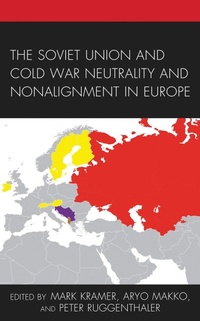
The Soviet Union and Cold War Neutrality and Nonalignment in Europe
Lexington Books (Publisher)
1st Edition
Published on 22. March 2021
644 pages
978-1-9787-5050-0 (ISBN)
Description

The Soviet Union and Cold War Neutrality and Nonalignment in Europe examines how the neutral European countries and the Soviet Union interacted after World War II. Amid the Cold War division of Europe into Western and Eastern blocs, several long-time neutral countries abandoned neutrality and joined NATO. Other countries remained neutral but were still perceived as a threat to the Soviet Union's sphere of influence. Based on extensive archival research, this volume offers state-of-the-art essays about relations between Europe's neutral states and the Soviet Union during the Cold War and how these relations were perceived by other powers.
More details
Series
Edition
1. Auflage
Language
English
Place of publication
United States
Publishing group
Bloomsbury Publishing Plc
Target group
Professional and scholarly
Illustrations
1 graphs;
ISBN-13
978-1-9787-5050-0 (9781978750500)
Copyright in bibliographic data and cover images is held by Nielsen Book Services Limited or by the publishers or by their respective licensors: all rights reserved.
Schweitzer Classification
Other editions
Additional editions
Mark Kramer | Aryo Makko | Peter Ruggenthaler
The Soviet Union and Cold War Neutrality and Nonalignment in Europe
Book
08/2022
Lexington Books
€65.40
Shipment within 3-4 weeks
Persons
Mark Kramer is director of Cold War studies at Harvard University and senior fellow at Harvard's Davis Center for Russian and Eurasian Studies.
Aryo Makko is pro futura scientia fellow at the Swedish Collegium for Advanced Study (SCAS), professor of history at Stockholm University, and director of the Hans Blix Centre for the History of International Relations.
Peter Ruggenthaler is deputy director and senior research fellow at the Ludwig Boltzmann Institute for Research on War's Consequences, Austria.
Aryo Makko is pro futura scientia fellow at the Swedish Collegium for Advanced Study (SCAS), professor of history at Stockholm University, and director of the Hans Blix Centre for the History of International Relations.
Peter Ruggenthaler is deputy director and senior research fellow at the Ludwig Boltzmann Institute for Research on War's Consequences, Austria.
Content
Introduction, Peter Ruggenthaler and Aryo Makko
PART I. Theories and Practices of Neutrality in Cold War Europe
Chapter 1: Austria's Neutrality-Myth versus Reality, Franz Cede
Chapter 2: Swedish Neutrality, 1949-1991, Olof Kronvall
Chapter 3: Swiss Cold War Neutrality: Undisputed Principle of Foreign Policy, Thomas Fischer
Chapter 4: Neutrality as Compromises: Finland's Cold War Neutrality, Johanna Rainio-Niemi
PART II. The Neutrals in Soviet Policy from Stalin to Gorbachev
Chapter 5: Swedish Neutrality: The View from Moscow, Alexey Komarov
Chapter 6: Soviet Attitudes to Finnish Neutralism, 1947-1989, Kimmo Rentola
Chapter 7: A Hidden Danger for the Eastern Bloc? Neutral Austria in Soviet Policy from 1955 to the End of the Cold War, Peter Ruggenthaler
Chapter 8 The Soviet Union and Neutral Switzerland: Concerns and Hopes in 1989, Olga Pavlenko
PART III. The Soviet Union in the Policies of the European Neutrals
Chapter 9: Old Fears, New Realities: Sweden and the Soviet Union during the Cold War, Ar
PART I. Theories and Practices of Neutrality in Cold War Europe
Chapter 1: Austria's Neutrality-Myth versus Reality, Franz Cede
Chapter 2: Swedish Neutrality, 1949-1991, Olof Kronvall
Chapter 3: Swiss Cold War Neutrality: Undisputed Principle of Foreign Policy, Thomas Fischer
Chapter 4: Neutrality as Compromises: Finland's Cold War Neutrality, Johanna Rainio-Niemi
PART II. The Neutrals in Soviet Policy from Stalin to Gorbachev
Chapter 5: Swedish Neutrality: The View from Moscow, Alexey Komarov
Chapter 6: Soviet Attitudes to Finnish Neutralism, 1947-1989, Kimmo Rentola
Chapter 7: A Hidden Danger for the Eastern Bloc? Neutral Austria in Soviet Policy from 1955 to the End of the Cold War, Peter Ruggenthaler
Chapter 8 The Soviet Union and Neutral Switzerland: Concerns and Hopes in 1989, Olga Pavlenko
PART III. The Soviet Union in the Policies of the European Neutrals
Chapter 9: Old Fears, New Realities: Sweden and the Soviet Union during the Cold War, Ar
