

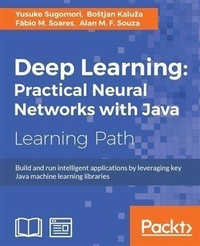
Deep Learning: Practical Neural Networks with Java
Build and run intelligent applications by leveraging key Java machine learning libraries
Published on 15. April 2025
744 pages
978-1-78847-171-8 (ISBN)
Description

No detailed description available for "Deep Learning: Practical Neural Networks with Java".
More details
Edition
Digital original
Language
English
Place of publication
Birmingham
United Kingdom
Target group
Professional and scholarly
US School Grade: College Graduate Student
Edition type
Digital original
File size
11,86 MB
ISBN-13
978-1-78847-171-8 (9781788471718)
Copyright in bibliographic data and cover images is held by Nielsen Book Services Limited or by the publishers or by their respective licensors: all rights reserved.
Schweitzer Classification
Other editions
Additional editions
Yusuke Sugomori | Bostjan Kaluza | Fabio M. Soares
Deep Learning: Practical Neural Networks with Java
Build and run intelligent applications by leveraging key Java machine learning libraries
Book
06/2017
Packt Publishing
€94.10
Shipment within 3-4 weeks
Persons
Souza Alan M. F. :
Alan M. F. Souza is computer engineer from Instituto de Estudos Superiores da Amazonia (IESAM). He holds a post-graduate degree in project management software and a master's degree in industrial processes (applied computing) from Universidade Federal do Para (UFPA). He has been working with neural networks since 2009 and has worked with Brazilian IT companies developing in Java, PHP, SQL, and other programming languages since 2006. He is passionate about programming and computational intelligence. Currently, he is a professor at Universidade da Amazonia (UNAMA) and a PhD candidate at UFPA. M. Soares Fabio :
Fbio M. Soares is currently a PhD candidate at the Federal University of Par (Universidade Federal do Par - UFPA), in northern Brazil. He is very passionate about technology in almost all fields, and designs neural network solutions since 2004 and has applied this technique in several fields like telecommunications, industrial process control and modeling, hydroelectric power generation, financial applications, retail customer analysis and so on. His research topics cover supervised learning for data-driven modeling. As of 2017, he is currently carrying on research projects with chemical process modeling and control in the aluminum smelting and ferronickel processing industries, and has worked as a lecturer teaching subjects involving computer programming and artificial intelligence paradigms. As an active researcher, he has also a number of articles published in English language in many conferences and journals, including four book chapters.Sugomori Yusuke :
Yusuke Sugomori is a creative technologist with a background in information engineering. When he was a graduate school student, he cofounded Gunosy with his colleagues, which uses machine learning and web-based data mining to determine individual users' respective interests and provides an optimized selection of daily news items based on those interests. This algorithm-based app has gained a lot of attention since its release and now has more than 10 million users. The company has been listed on the Tokyo Stock Exchange since April 28, 2015. In 2013, Sugomori joined Dentsu, the largest advertising company in Japan based on nonconsolidated gross profit in 2014, where he carried out a wide variety of digital advertising, smartphone app development, and big data analysis. He was also featured as one of eight "new generation" creators by the Japanese magazine Web Designing. In April 2016, he joined a medical start-up as cofounder and CTO.
Alan M. F. Souza is computer engineer from Instituto de Estudos Superiores da Amazonia (IESAM). He holds a post-graduate degree in project management software and a master's degree in industrial processes (applied computing) from Universidade Federal do Para (UFPA). He has been working with neural networks since 2009 and has worked with Brazilian IT companies developing in Java, PHP, SQL, and other programming languages since 2006. He is passionate about programming and computational intelligence. Currently, he is a professor at Universidade da Amazonia (UNAMA) and a PhD candidate at UFPA. M. Soares Fabio :
Fbio M. Soares is currently a PhD candidate at the Federal University of Par (Universidade Federal do Par - UFPA), in northern Brazil. He is very passionate about technology in almost all fields, and designs neural network solutions since 2004 and has applied this technique in several fields like telecommunications, industrial process control and modeling, hydroelectric power generation, financial applications, retail customer analysis and so on. His research topics cover supervised learning for data-driven modeling. As of 2017, he is currently carrying on research projects with chemical process modeling and control in the aluminum smelting and ferronickel processing industries, and has worked as a lecturer teaching subjects involving computer programming and artificial intelligence paradigms. As an active researcher, he has also a number of articles published in English language in many conferences and journals, including four book chapters.Sugomori Yusuke :
Yusuke Sugomori is a creative technologist with a background in information engineering. When he was a graduate school student, he cofounded Gunosy with his colleagues, which uses machine learning and web-based data mining to determine individual users' respective interests and provides an optimized selection of daily news items based on those interests. This algorithm-based app has gained a lot of attention since its release and now has more than 10 million users. The company has been listed on the Tokyo Stock Exchange since April 28, 2015. In 2013, Sugomori joined Dentsu, the largest advertising company in Japan based on nonconsolidated gross profit in 2014, where he carried out a wide variety of digital advertising, smartphone app development, and big data analysis. He was also featured as one of eight "new generation" creators by the Japanese magazine Web Designing. In April 2016, he joined a medical start-up as cofounder and CTO.
Content
- Cover
- Preface
- Table of Contents
- Module 1
- Chapter 1: Deep Learning Overview
- Transition of AI
- Things dividing a machine and human
- AI and deep learning
- Summary
- Chapter 2: Algorithms for Machine Learning - Preparing for Deep Learning
- Getting started
- The need for training in machine learning
- Supervised and unsupervised learning
- Machine learning application flow
- Theories and algorithms of neural networks
- Summary
- Chapter 3: Deep Belief Nets and Stacked Denoising Autoencoders
- Neural networks fall
- Neural networks' revenge
- Deep learning algorithms
- Summary
- Chapter 4: Dropout and Convolutional Neural Networks
- Deep learning algorithms without pre-training
- Dropout
- Convolutional neural networks
- Summary
- Chapter 5: Exploring Java Deep Learning Libraries - DL4J, ND4J, and More
- Implementing from scratch versus a library/framework
- Introducing DL4J and ND4J
- Implementations with ND4J
- Implementations with DL4J
- Summary
- Chapter 6: Approaches to Practical Applications - Recurrent Neural Networks and More
- Fields where deep learning is active
- The difficulties of deep learning
- The approaches to maximizing deep learning possibilities and abilities
- Summary
- Chapter 7: Other Important Deep Learning Libraries
- Theano
- TensorFlow
- Caffe
- Summary
- Chapter 8: What's Next?
- Breaking news about deep learning
- Expected next actions
- Useful news sources for deep learning
- Summary
- Module 2: Machine Learning in Java
- Chapter 1: Applied Machine Learning Quick Start
- Machine learning and data science
- Data and problem definition
- Data collection
- Data pre-processing
- Unsupervised learning
- Supervised learning
- Generalization and evaluation
- Summary
- Chapter 2: Java Libraries and Platforms for Machine Learning
- The need for Java
- Machine learning libraries
- Building a machine learning application
- Summary
- Chapter 3: Basic Algorithms - Classification, Regression, and Clustering
- Before you start
- Classification
- Regression
- Clustering
- Summary
- Chapter 4: Customer Relationship Prediction with Ensembles
- Customer relationship database
- Basic naive Bayes classifier baseline
- Basic modeling
- Advanced modeling with ensembles
- Summary
- Chapter 5: Affinity Analysis
- Market basket analysis
- Association rule learning
- The supermarket dataset
- Discover patterns
- Other applications in various areas
- Summary
- Chapter 6: Recommendation Engine with Apache Mahout
- Basic concepts
- Getting Apache Mahout
- Building a recommendation engine
- Content-based filtering
- Summary
- Chapter 7: Fraud and Anomaly Detection
- Suspicious and anomalous behavior detection
- Suspicious pattern detection
- Anomalous pattern detection
- Fraud detection of insurance claims
- Anomaly detection in website traffic
- Summary
- Chapter 8: Image Recognition with Deeplearning4j
- Introducing image recognition
- Image classification
- Summary
- Chapter 9: Activity Recognition with Mobile Phone Sensors
- Introducing activity recognition
- Collecting data from a mobile phone
- Building a classifier
- Summary
- Chapter 10: Text Mining with Mallet - Topic Modeling and Spam Detection
- Introducing text mining
- Installing Mallet
- Working with text data
- Topic modeling for BBC news
- E-mail spam detection
- Summary
- Chapter 11: What is Next?
- Machine learning in real life
- Standards and markup languages
- Machine learning in the cloud
- Web resources and competitions
- Summary
- References
- Module 3
- Chapter 1: Getting Started with Neural Networks
- Discovering neural networks
- Why artificial neural networks?
- From ignorance to knowledge - learning process
- Let the coding begin! Neural networks in practice
- The neuron class
- The NeuralLayer class
- The ActivationFunction interface
- The neural network class
- Time to play!
- Summary
- Chapter 2: Getting Neural Networks to Learn
- Learning ability in neural networks
- Learning paradigms
- The learning process
- Examples of learning algorithms
- Time to see the learning in practice!
- Amazing, it learned! Or, did it really? A further step - testing
- Summary
- Chapter 3: Perceptrons and Supervised Learning
- Supervised learning - teaching the neural net
- A basic neural architecture - perceptrons
- Multi-layer perceptrons
- Learning in MLPs
- Practical example 1 - the XOR case with delta rule and backpropagation
- Practical example 2 - predicting enrolment status
- Summary
- Chapter 4: Self-Organizing Maps
- Neural networks unsupervised learning
- Unsupervised learning algorithms
- Kohonen self-organizing maps
- Summary
- Chapter 5: Forecasting Weather
- Neural networks for regression problems
- Loading/selecting data
- Choosing input and output variables
- Preprocessing
- Empirical design of neural networks
- Summary
- Chapter 6: Classifying Disease Diagnosis
- Foundations of classification problems
- Logistic regression
- Neural networks for classification
- Disease diagnosis with neural networks
- Summary
- Chapter 7: Clustering Customer Profiles
- Clustering tasks
- Applied unsupervised learning
- Profiling
- Summary
- Chapter 8: Text Recognition
- Pattern recognition
- Neural networks in pattern recognition
- Summary
- Chapter 9: Optimizing and Adapting Neural Networks
- Common issues in neural network implementations
- Input selection
- Online retraining
- Adaptive neural networks
- Summary
- Chapter 10: Current Trends in Neural Networks
- Deep learning
- Deep architectures
- Implementing a hybrid neural network
- Summary
- References
- Bibliography
- Index
