

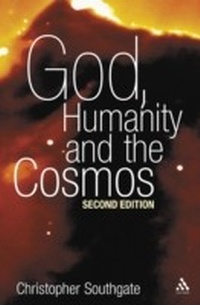
God, Humanity and the Cosmos
A Companion to the Science-Religion Debate
2nd Edition
Published on 29. October 2005
470 pages
978-0-567-48627-1 (ISBN)
Description

Contributors include:
Christopher Southgate
John Hedley Brooke
Celia Deane-Drummond
Paul D. Murray
Michael Robert Negus
Lawrence Osborn
Michael Poole
Jacqui Stewart
Fraser Watts
David Wilkinson
This fully revised and updated edition of God, Humanity and the Cosmos includes new chapters by John Hedley Brooke, Paul D. Murray and David Wilkinson.
In addition to a systematic exploration of contemporary perspectives in physics, evolutionary biology and psychology as they relate to theological descriptions of the universe, humanity and consciousness, the book now provides a thorough survey of the theological, philosophical and historical issues underpinning the science-religion debate.
Contributors also examine such issues as theological responses to the ecological crisis and to biotechnology; how science is treated and valued in education; and the relation of science to Islamic thought.
Dr Christopher Southgate is Lecturer in Theology at the University of Exeter.'
Christopher Southgate
John Hedley Brooke
Celia Deane-Drummond
Paul D. Murray
Michael Robert Negus
Lawrence Osborn
Michael Poole
Jacqui Stewart
Fraser Watts
David Wilkinson
This fully revised and updated edition of God, Humanity and the Cosmos includes new chapters by John Hedley Brooke, Paul D. Murray and David Wilkinson.
In addition to a systematic exploration of contemporary perspectives in physics, evolutionary biology and psychology as they relate to theological descriptions of the universe, humanity and consciousness, the book now provides a thorough survey of the theological, philosophical and historical issues underpinning the science-religion debate.
Contributors also examine such issues as theological responses to the ecological crisis and to biotechnology; how science is treated and valued in education; and the relation of science to Islamic thought.
Dr Christopher Southgate is Lecturer in Theology at the University of Exeter.'
More details
Edition
2nd edition
Language
English
Place of publication
London
United Kingdom
Publishing group
Bloomsbury Publishing PLC
ISBN-13
978-0-567-48627-1 (9780567486271)
Copyright in bibliographic data and cover images is held by Nielsen Book Services Limited or by the publishers or by their respective licensors: all rights reserved.
Schweitzer Classification
Other editions
Additional editions
Book
10/2005
2nd Edition
T.& T.Clark Ltd
€140.30
Shipment within 3-4 weeks
Person
Content
- Intro
- Contents
- List of figures
- List of tables
- List of exercises
- List of contributors
- How to use this book
- Foreword
- Editor's note and acknowledgements
- BOOK ONE
- 1. An introduction to the debate between science and religion
- Section A: Outlines of the debate (1.1-1.11)
- Section B: Three historical examples of tensions as science and theology developed (1.12-1.15)
- Section C: Key principles for developing theology in the light of science (1.16-1.20)
- 2. The significance of the theology of creation within Christian tradition: systematic considerations
- 2.1 What do we mean by the theology of creation?
- 2.2 Telling the story of creation
- 2.3 The creation narratives of Genesis 1-3
- 2.4 From Alpha to Omega: the theology of creation in the broader scriptural narrative
- 2.5 The development of the theology of creation within Christian tradition
- 2.6 Conclusion
- 3. Learning from the past
- 3.1 Introduction
- 3.2 Why history?
- 3.3 The concept of science, viewed historically
- 3.4 The problem of selectivity
- 3.5 Four master narratives
- 3.6 Mapping mutual relevance
- 3.7 Lesson from the past
- 3.8 Conclusion
- 4. Truth and reason in science and theology: points of tension, correlation and compatibility
- 4.1 Introduction
- Section A: Early twentieth century: the challenge of logical positivism (4.2-4.6)
- Section B: Mid-twentieth century: the unravelling of the positivist agenda (4.7-4.9)
- Section C: Latter part of the twentieth century: revolution, anarchy and resistance in scientific theory change, and the need for tempered postfoundationalist accounts of scientific and theological rationality (4.10-4.13)
- BOOK TWO
- 5. Theology and the New Physics
- 5.1 Introduction
- Section A: Classical physics and the Newtonian worldview (5.2-5.4)
- Section B: The rediscovery of time (5.5-5.9)
- Section C: The rediscovery of the observer (5.10-5.14)
- Section D: Modern cosmology and universal history (5.15-5.19)
- Section E: Modern cosmology and the rediscovery of purpose? (5.20-5.24)
- Section F: The rediscovery of complexity (5.25-5.28)
- 6. Theology and evolutionary biology
- 6.1 Introduction
- Section A: Human evolution (6.2-6.4)
- Section B: Darwin and Darwinism (6.5-6.7)
- Section C: Darwinism evolving (6.8-6.10)
- Section D: Reduction, reductionism and religion (6.11-6.13)
- 7. Psychology and theology
- 7.1 Introduction
- Section A: Human nature (7.2-7.7)
- Section B: Religion (7.8-7.12)
- BOOK THREE
- 8. Some resources for Christian theology in an ecological age
- 8.1 Introduction
- 8.2 Process thought
- 8.3 Questions of theodicy
- 8.4 The critique of patriarchy
- 8.5 Some models discussed
- 8.6 Recurrent motifs
- 8.7 Conclusion
- 9. Some resources for theological thinking on God and the world from outside the Christian tradition
- 9.1 Introduction
- 9.2 Two Jewish philosophers
- 9.3 The contributions of Eastern thought
- 9.4 Hindu metaphysics
- 9.5 Taoism
- 9.6 The contribution of Buddhism
- 9.7 The Gaia Hypothesis
- 9.8 Deep ecology
- 9.9 'New paradigm' thinking
- 9.10 Conclusion
- 10. A test case: divine action
- 10.1 Introduction
- 10.2 General comments
- 10.3 God 'edged out'?
- Section A: What God is doing: providence and miracle (10.4-10.12.1)
- Section B: What God has done: the history of the universe (10.13-10.19)
- Section C: What God will do (10.20)
- BOOK FOUR
- 11. Science and education
- 11.1 Introduction to Book Four
- 11.2 Science education and the sciencereligion debate
- 11.3 Meeting-points
- 11.4 Some educational questions
- 11.5 A modus operandi
- 11.7 Recent developments in England
- 12. Islam and science
- 12.1 Introduction
- 12.2 The concept of God
- 12.3 The religious dimensions of Islam
- 12.4 The universe and its Creator
- 12.5 The Golden Age of Islam
- 12.6 The Islamic paradigm of the universe
- 12.7 Islam and modern science
- 12.8 Identifying problems and recognizing points of agreement
- 12.9 Proposals for the regulation and Islamization of science
- 12.10 Islam and Darwinism
- 12.11 Conclusion
- 13. Technology and Christianity
- 13.1 Introduction
- 13.2 What is technology?
- 13.3 Is technology good or bad?
- 13.4 Technology and Christianity in the history of Western Europe
- 13.5 The technical ideal: does technology have inherent values?
- 13.6 The 'defining' role of technology
- 13.7 Does the origin of a technology have implications for its effects?
- 13.8 Relation to religious values: Mumford, Tillich and Reinhold Niebuhr
- 13.9 Ends and means: Ellul and William Temple
- 13.10 Current issues: technology and the information revolution
- 13.11 Two contemporary theologians' responses: Barbour and Susan White
- 13.12 Technosapiens
- 13.13 One technologist's reflection
- 13.14 Conclusion
- 14. Biotechnology: a new challenge to theology and ethics
- 14.1 What is biotechnology?
- 14.2 Genetic engineering in medicine
- 14.3 Genetic engineering and screening in humans
- 14.4 Genetic engineering in the production of food
- 14.5 What are the dangers?
- 14.6 Some hidden agendas
- 14.7 Public responses to genetic engineering
- 14.8 The possibility of human cloning
- 14.9 Theological issues
- 14.10 Ethical questions
- 14.11 A rediscovery of wisdom: some lessons from biotechnology
- 14.12 Conclusion
- BOOK FIVE
- 15. A look to the future
- 15.1 Introduction
- 15.2 One-way traffic
- 15.3 Looking to the future
- 15.4 Three key areas of scientific advance
- 15.5 Three theological projects
- 15.6 Physics
- 15.7 The integration of science, technology, religion and ethics
- Appendix: A note for teachers
- References and bibliography
- Index
- A
- B
- C
- D
- E
- F
- G
- H
- I
- J
- K
- L
- M
- N
- O
- P
- Q
- R
- S
- T
- U
- V
- W
- Y
- Z
