

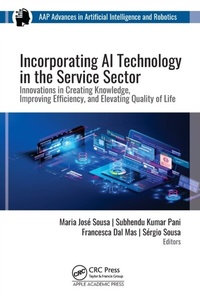
Incorporating AI Technology in the Service Sector
Innovations in Creating Knowledge, Improving Efficiency, and Elevating Quality of Life
1st Edition
Published on 12. March 2024
370 pages
978-1-000-85336-0 (ISBN)
Description

Due to advances in technology, particularly in artificial intelligence and robotics, the service sector is being reshaped, and AI may even be necessary for survival of the service industries. Innovations in digital technology lead to improving processes and, in many situations, are a solution to improving the efficiency and the quality of processes and services. This volume examines in depth how AI innovation is creating knowledge, improving efficiency, and elevating quality of life for millions of people and how it applies to the service industry. This volume addresses advances, issues, and challenges from several points of view from diverse service areas, including healthcare, mental health, finance, management, learning and education, and others. The authors demonstrate how service practices can incorporate the subareas of AI, such as machine learning, deep learning, blockchain, big data, neural networks, etc.
The diverse roster of chapter authors includes 48 scholars from different fields, (management, public policies, accounting, information technologies, engineering, medicine) along with executives and managers of private enterprises and public bodies in different sectors, from life sciences to healthcare. Several chapters also evaluate AI's application in service industries during the COVID-19 era.
This book, Incorporating AI Technology in the Service Sector: Innovations in Creating Knowledge, Improving Efficiency, and Elevating Quality of Life, provides professionals, administrators, educators, researchers, and students with useful perspectives by introducing new approaches and innovations for identifying future strategies for service sector companies.
The diverse roster of chapter authors includes 48 scholars from different fields, (management, public policies, accounting, information technologies, engineering, medicine) along with executives and managers of private enterprises and public bodies in different sectors, from life sciences to healthcare. Several chapters also evaluate AI's application in service industries during the COVID-19 era.
This book, Incorporating AI Technology in the Service Sector: Innovations in Creating Knowledge, Improving Efficiency, and Elevating Quality of Life, provides professionals, administrators, educators, researchers, and students with useful perspectives by introducing new approaches and innovations for identifying future strategies for service sector companies.
Reviews / Votes
"A timely and genuine tour de force of the current uses of AI in different service sectors. With lively examples from all corners of our world, it is showing how AI, especially robotics, is reshaping the service sector. From economical systems to education to life sciences and healthcare, the book examines in depth how AI innovation is creating knowledge, improving efficiency, and elevating quality of life for millions of people. . . . A precious read for anyone who is interested in learning the different applications of AI in all domains of our society, and I wholeheartedly recommend it as a must-read for those who want to explore the fascinating and diverse world of AI and machine learning."-From the Foreword by Haytham M. A. Kaafarani, MD, MPH, FACS, Associate Professor of Surgery, Harvard Medical School, USA"
More details
Series
Edition
1. Auflage
Language
English
Place of publication
London
United Kingdom
Publishing group
Taylor & Francis Ltd
Target group
College/higher education
Professional and scholarly
Illustrations
23 Tables, black and white; 39 Illustrations, black and white
ISBN-13
978-1-000-85336-0 (9781000853360)
Copyright in bibliographic data and cover images is held by Nielsen Book Services Limited or by the publishers or by their respective licensors: all rights reserved.
Schweitzer Classification
Other editions
Additional editions
Maria Jose Sousa | Subhendu Pani | Francesca dal Mas
Incorporating AI Technology in the Service Sector
Innovations in Creating Knowledge, Improving Efficiency, and Elevating Quality of Life
Book
03/2024
1st Edition
Apple Academic Press Inc.
€205.10
Shipment within 3-4 weeks
Persons
Maria Jose Sousa (PhD in Management) is a university professor with habilitation and a research fellow at ISCTE/Instituto Universitario de Lisboa, Portugal. Her research interests currently are public policies, information science, and innovation and management issues. She is a bestselling author of books on research methods, ICT, and people management and has co-authored over 100 articles and book chapters and published in several scientific journals (i.e., Journal of Business Research, Information Systems Frontiers, European Planning Studies, Systems Research and Behavioral Science, Computational and Mathematical Organization Theory, Future Generation Computer Systems, and others). She has also organized peer-reviewed international conferences and is a guest editor of several special issues from Elsevier and Springer publications. She has coordinated several European projects of innovation and is also an external expert of COST Association (European Cooperation in Science and Technology) and is former President of the ISO/TC 260-Human Resources Management, representing Portugal in the International Organization for Standardization.
Subhendu Kumar Pani, PhD, is Professor in the Department of Computer Science and Engineering, Krupajal Engineering College, Bhubaneswar, Odisha, India. He has more than 15 years of teaching and research experience. His research interests include data mining, big data analysis, web data analytics, fuzzy decision-making, and computational intelligence. He is the recipient of five researcher awards. In addition to research, he has guided many PhD students and MTech students. He has published over 50 international journal papers (many of which are Scopus indexed). His professional activities include roles as associate editor, editorial board member, and reviewer of various international journals. He is associated with a number of conferences and societies. He has more than 150 international publications, several authored books and edited books, and book chapters to his credit. He is a fellow of the Scientific Society of Advance Research and Social Change and a life member in many other professional organizations. Dr. Pani is also editor of the book series AAP Advances in Artificial Intelligence & Robotics.
Francesca Dal Mas, PhD, is a Senior Lecturer in Accounting at the Department of Management, Ca' Foscari University of Venice, Italy. She was formerly a Senior Lecturer in Strategy and Enterprise at the University of Lincoln, England. She was a visiting research fellow and guest lecturer at the University of Pavia, Italy; the Sapienza University of Rome, Italy; the Aoyama Gakuin University in Tokyo, Japan; the Hong Kong Polytechnic University, Hong Kong; the IHU-Institute for Image-Guided Surgery in Strasbourg, France; the Sharif University of Technology of Tehran, Iran, among others. Her research interests include healthcare management, intellectual capital, knowledge management, sustainability, digital transformation, and new business models. She has more than 100 publications on the above-mentioned topics. She is an international assessor for the MIKE (Most Innovative Knowledge Enterprise) for Italy and Iran. Dr. Dal Mas holds bachelor's and master's degrees in Business Administration from the University of Udine, Italy; a bachelor's degree in law from the University of Bologna, Italy; and a PhD in Managerial and Actuarial sciences from the Universities of Udine and Trieste, Italy.
Sergio Sousa, PhD, is a Programme Co-Director and Visiting Professor in the human resource management (HRM), business and psychology domains, with over 25 years' experience teaching in higher education in the United Kingdom and abroad. A Fellow of the Chartered Institute of Personnel and Development (CIPD) and a Fellow of the Higher Education Academy (HEA), he holds a PhD in Management, an MSc in Science and Technology, and a BA (Hons) in HRM and Organizational Psychology. He has specialized qualifications from the University of Cambridge, UK; INSEAD, France; Babson College, Massachusetts, US; and the University of Hertfordshire, UK. Concurrently, he has been working as a senior HR Director, working with several FTSE100, FT Global 500, and Fortune 500 companies. He has more than 20 years of international exposure at the management level in numerous business sectors in the scope of HRM, talent, and learning.
Subhendu Kumar Pani, PhD, is Professor in the Department of Computer Science and Engineering, Krupajal Engineering College, Bhubaneswar, Odisha, India. He has more than 15 years of teaching and research experience. His research interests include data mining, big data analysis, web data analytics, fuzzy decision-making, and computational intelligence. He is the recipient of five researcher awards. In addition to research, he has guided many PhD students and MTech students. He has published over 50 international journal papers (many of which are Scopus indexed). His professional activities include roles as associate editor, editorial board member, and reviewer of various international journals. He is associated with a number of conferences and societies. He has more than 150 international publications, several authored books and edited books, and book chapters to his credit. He is a fellow of the Scientific Society of Advance Research and Social Change and a life member in many other professional organizations. Dr. Pani is also editor of the book series AAP Advances in Artificial Intelligence & Robotics.
Francesca Dal Mas, PhD, is a Senior Lecturer in Accounting at the Department of Management, Ca' Foscari University of Venice, Italy. She was formerly a Senior Lecturer in Strategy and Enterprise at the University of Lincoln, England. She was a visiting research fellow and guest lecturer at the University of Pavia, Italy; the Sapienza University of Rome, Italy; the Aoyama Gakuin University in Tokyo, Japan; the Hong Kong Polytechnic University, Hong Kong; the IHU-Institute for Image-Guided Surgery in Strasbourg, France; the Sharif University of Technology of Tehran, Iran, among others. Her research interests include healthcare management, intellectual capital, knowledge management, sustainability, digital transformation, and new business models. She has more than 100 publications on the above-mentioned topics. She is an international assessor for the MIKE (Most Innovative Knowledge Enterprise) for Italy and Iran. Dr. Dal Mas holds bachelor's and master's degrees in Business Administration from the University of Udine, Italy; a bachelor's degree in law from the University of Bologna, Italy; and a PhD in Managerial and Actuarial sciences from the Universities of Udine and Trieste, Italy.
Sergio Sousa, PhD, is a Programme Co-Director and Visiting Professor in the human resource management (HRM), business and psychology domains, with over 25 years' experience teaching in higher education in the United Kingdom and abroad. A Fellow of the Chartered Institute of Personnel and Development (CIPD) and a Fellow of the Higher Education Academy (HEA), he holds a PhD in Management, an MSc in Science and Technology, and a BA (Hons) in HRM and Organizational Psychology. He has specialized qualifications from the University of Cambridge, UK; INSEAD, France; Babson College, Massachusetts, US; and the University of Hertfordshire, UK. Concurrently, he has been working as a senior HR Director, working with several FTSE100, FT Global 500, and Fortune 500 companies. He has more than 20 years of international exposure at the management level in numerous business sectors in the scope of HRM, talent, and learning.
Content
Introduction 1. Digital Transformations: Artificial Intelligence in the Services Sector 2. Global Innovation Policies: Framework for Developing an Innovative Culture Based on Artificial Intelligence 3. Knowledge Representation of Innovations in Learning Processes and Educational Policies: Infusing Artificial Intelligence and Blockchain Powers 4. Life Sciences Industry Blockchain Value Management, Investments, and Finance Impact Assessment: Global Questionnaire Survey of 1,524 Industry Professionals and Executives 5. The Commercial Relationship Between Universities and SMEs within the Big Data Sector: A Review of the Literature 6. Social Analytics and Artificial Intelligence in Tax Law 7. Is the Intelligent Participatory Budget (i-PB) the Next Generation of Democracy and Governance? 8. Artificial Intelligence and Healthcare Connection: A State-of-the-Art Discussion Among Academics and Practitioners 9. People Analytics and the COVID-19 Pandemic: How Empathy and Privacy Turned Out the Hot Topics 10. Paradigm Shift in Higher Education Model by Using Artificial Intelligence: Challenges and Future Perspectives in India and Oman 11. Machine Learning for Mental Health: Focus on Affective and Non-Affective Psychosis 12. Artificial Intelligence, Education, and Digital Economy in India 13. Artificial Intelligence and Clinical Decision-Making in Emergency Surgery: A Research Protocol. 14. Open Innovation in Healthcare During the COVID-19 Pandemic: The Case of 3d-Printed Venturi Valves 15. Organizational Change towards Servitization: Guiding Manufacturing Firms Through the Digital Transformation Process 16. Business Planning and Artificial Intelligence: Opportunities and Challenges for Accounting Firms in a Human-Centered Perspective
