

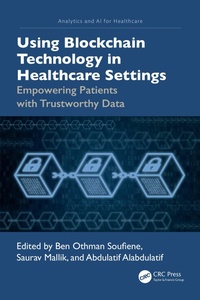
Using Blockchain Technology in Healthcare Settings
Empowering Patients with Trustworthy Data
1st Edition
Published on 24. March 2025
353 pages
978-1-040-31320-6 (ISBN)
Description

This book looks at the integration of blockchain technology in healthcare settings, focusing on its potential to address security and privacy concerns of medical applications. From fragmented electronic health records (EHRs) to data breaches and interoperability issues, innovative solutions are necessary to unlock the full potential of health information and prevent the recurrence of such issues.
Blockchain offers a promising framework for addressing these challenges. Its decentralized, tamper-resistant nature holds the key to building trust and transparency in healthcare data management. By leveraging blockchain technology, secure, interoperable systems empower patients to take control of their health information while facilitating a seamless collaboration among healthcare providers. Throughout this book, the authors explore the fundamental principles of blockchain technology and its applications within the healthcare landscape. From EHRs and patient consent management to pharmaceutical supply chains and clinical research, this book examines how blockchain can drive efficiency, enhance security, and ultimately improve patient outcomes.
This book is intended for a broad audience, including healthcare professionals, patients, policymakers, and anyone interested in the intersection of technology and healthcare.
Blockchain offers a promising framework for addressing these challenges. Its decentralized, tamper-resistant nature holds the key to building trust and transparency in healthcare data management. By leveraging blockchain technology, secure, interoperable systems empower patients to take control of their health information while facilitating a seamless collaboration among healthcare providers. Throughout this book, the authors explore the fundamental principles of blockchain technology and its applications within the healthcare landscape. From EHRs and patient consent management to pharmaceutical supply chains and clinical research, this book examines how blockchain can drive efficiency, enhance security, and ultimately improve patient outcomes.
This book is intended for a broad audience, including healthcare professionals, patients, policymakers, and anyone interested in the intersection of technology and healthcare.
More details
Series
Edition
1. Auflage
Language
English
Place of publication
London
United Kingdom
Publishing group
Taylor & Francis Ltd
Target group
College/higher education
Professional and scholarly
Illustrations
30 Tables, black and white; 30 Line drawings, black and white; 50 Halftones, black and white; 50 Illustrations, black and white
File size
4,58 MB
ISBN-13
978-1-040-31320-6 (9781040313206)
Copyright in bibliographic data and cover images is held by Nielsen Book Services Limited or by the publishers or by their respective licensors: all rights reserved.
Schweitzer Classification
Other editions
Additional editions
Ben Othman Soufiene | Saurav Mallik | Abdulatif Alabdulatif
Using Blockchain Technology in Healthcare Settings
Empowering Patients with Trustworthy Data
Book
03/2025
1st Edition
CRC Press
€207.20
Shipment within 10-20 days
Ben Othman Soufiene | Saurav Mallik | Abdulatif Alabdulatif
Using Blockchain Technology in Healthcare Settings
Empowering Patients with Trustworthy Data
Book
03/2025
1st Edition
CRC Press
€75.20
Shipment within 10-20 days

Using Blockchain Technology in Healthcare Settings
Empowering Patients with Trustworthy Data
Book
03/2025
CRC Press
Unfortunately, price unknown
Available (delivery time upon request)
Persons
Ben Othman Soufiene is an assistant professor of computer science at the University of Gabes, Tunisia. He earned a PhD in computer science at Manouba University in 2016 for his dissertation on "Secure Data Aggregation in Wireless Sensor Networks." He earned an MS degree at Monastir University in 2012. His research interests include the Internet of Medical Things, wireless body sensor networks, wireless networks, artificial intelligence, machine learning, and big data. He has coauthored more than 110 research articles with a Google H-index of 20.
Saurav Mallik (Member, IEEE) earned a PhD at Jadavpur University, Kolkata, India, in 2017. His postgraduate studies were conducted with the Machine Intelligence Unit, Indian Statistical Institute, Kolkata, India. He is a research scientist at the University of Arizona, USA. He previously held a postdoctoral fellow with Environmental Epigenetics, Harvard T. H. Chan School of Public Health, University of Texas Health Science Center, Houston, and with the Miller School of Medicine, University of Miami, USA. He has coauthored more than 150 research articles with a Google H-index of 20. His research interests include computational biology, bioinformatics, data mining, biostatistics, and pattern recognition.
Abdulatif Alabdulatif is an assistant professor at the School of Computer Science and Information Technology, Qassim University, Saudi Arabia. He earned a PhD in computer science at RMIT University, Australia, in 2018. He earned a BSc in computer science at Qassim University, Saudi Arabia, in 2008, and an MSc in computer science at RMIT University, Australia, in 2013. He has published more than 70 academic papers in prominent journals. His research interests include applied cryptography, cloud computing, and e-health.
Saurav Mallik (Member, IEEE) earned a PhD at Jadavpur University, Kolkata, India, in 2017. His postgraduate studies were conducted with the Machine Intelligence Unit, Indian Statistical Institute, Kolkata, India. He is a research scientist at the University of Arizona, USA. He previously held a postdoctoral fellow with Environmental Epigenetics, Harvard T. H. Chan School of Public Health, University of Texas Health Science Center, Houston, and with the Miller School of Medicine, University of Miami, USA. He has coauthored more than 150 research articles with a Google H-index of 20. His research interests include computational biology, bioinformatics, data mining, biostatistics, and pattern recognition.
Abdulatif Alabdulatif is an assistant professor at the School of Computer Science and Information Technology, Qassim University, Saudi Arabia. He earned a PhD in computer science at RMIT University, Australia, in 2018. He earned a BSc in computer science at Qassim University, Saudi Arabia, in 2008, and an MSc in computer science at RMIT University, Australia, in 2013. He has published more than 70 academic papers in prominent journals. His research interests include applied cryptography, cloud computing, and e-health.
Content
1. Applications of Blockchain Technology in the Global Healthcare System. 2. Blockchain Technology in Health Care. 3. Healthcare Monitoring System with Blockchain Technology Tracking Open Donations and Minimizing the Scope of Organ Trafficking. 4. Transforming Healthcare Services in South Asia: Leveraging Blockchain Technology. 5. Challenges and Future Directions of Blockchain Technology in Healthcare Settings. 6. Blockchain-Enabled Radiology: Transformative Potentials and Implementation Hurdles. 7. Introduction to Blockchain and Artificial Intelligence in Health Care. 8. Patient Empowerment through Secure Data Management. 9. Ensuring Data Privacy and Security with Blockchain in Health Care. 10. An Advanced Secure Medical File-Sharing System Based on IPFS and Blockchain Technology. 11. A Survey on Security Enhancements of Electronic Health Records through Blockchain Technology. 12. Blockchain for Halal Integrity in Health Care: Enhancing Compliance, Ensuring Benefits. 13. Nonprobabilistic Approach to Solve Multiobjective Optimization Model with Applications in Blockchain Technology. 14. Decentralizing Health: The Future of Blockchain in Health Care. 15. The Adoption of Blockchain Technology for Recruitment Practices in Healthcare Industries: A Systematic Review.
