

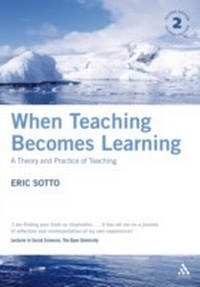
When Teaching Becomes Learning
A Theory and Practice of Teaching
2nd Edition
Published on 15. March 2007
332 pages
978-1-4411-3171-3 (ISBN)
Description

Intended to help anyone who teaches, this book has something of a cult following. Drawing on extensive teaching experience, the author presents a personal account of good practice, written in an engaging and accessible style and based on extensive scholarly sources.
Part I 'Learning' and Part II 'Teaching' complement one another, and the book as a whole offers an insight into how to teach in any set of circumstances. It does so without being prescriptive, instead helping teachers to think through their own problems and situations. As a result When Teaching Becomes Learning is a book to which teachers will return on countless occasions.
This edition has been updated throughout and now has 2 new chapters - Reflections of Educational Technology, and Why Teach? Chapters are now also divided up so they are each shorter and more user-friendly than before.
Part I 'Learning' and Part II 'Teaching' complement one another, and the book as a whole offers an insight into how to teach in any set of circumstances. It does so without being prescriptive, instead helping teachers to think through their own problems and situations. As a result When Teaching Becomes Learning is a book to which teachers will return on countless occasions.
This edition has been updated throughout and now has 2 new chapters - Reflections of Educational Technology, and Why Teach? Chapters are now also divided up so they are each shorter and more user-friendly than before.
Reviews / Votes
A must-read for anyone involved in teaching & learning. A coherent, clear, logical approach to the subject. Theory and practice harmoniously brought together and discussed. Full of useful advice and guidance to novices or experts alike based on longstanding experience and practice of the teaching profession. * Plato Kapranos, The University of Sheffield, UK * Occasionally one comes across a book which is a little gem and which has a great personal impact. When Teaching Becomes Learning by Eric Sotto is such a book. Based on his extensive personal experience Sotto offers an insight without being prescriptive into how teachers can contribute to better learning. * Medical Teacher, 2007 * It discusses methods of learning in a friendly, easy to understand manner ... it draws on familiar analogies, the author's experiences and even animal behaviour to highlight the points. This book highlights [how] an effective teacher knows not just the subject, but how to teach it in accordance with how learning actually happens. * Amazon.Com Books * This is a remarkable and delightful book, presented in a style reminiscent of a cross between Woody Allen and Ludwig Wittgenstein. Eric Sotto has not so much written as crafted it from a blend of his own experience and a wide knowledge of relevant psychological theory. * R A Becher, Professor of Education, University of Sussex, 1994 * ...You have been able to clarify for me, in readable and understandable language, many of the intuitive feelings I have had about teaching all these years but have been unable to articulate... Your book has also helped me to make sense out of all the conflicting cognitive theories used by psychologists, sociologists and philosophers... The personalised and anecdotal illustrations of the different points you wished to make were so useful to help understanding. * Blurb from reviewer, Letter to author from reader in Austria, 1994 * I am finding your book an inspiration... it has set me on a journey of reflection and reinterpretation of my own experiences of teaching and learning. * Blurb from reviewer, Letter from lecturer in Social Sciences, The Open University, 1995 *More details
Edition
2nd edition
Language
English
Place of publication
New York
United States
ISBN-13
978-1-4411-3171-3 (9781441131713)
Copyright in bibliographic data and cover images is held by Nielsen Book Services Limited or by the publishers or by their respective licensors: all rights reserved.
Schweitzer Classification
Other editions
Additional editions
Book
03/2007
2nd Edition
Continuum International Publishing Group Ltd.
€248.10
Shipment within 15-20 days
Book
03/2007
2nd Edition
Continuum International Publishing Group Ltd.
€61.90
Shipment within 15-20 days
Person
Eric Sotto is an experienced teacher and staff trainer, and has worked in the UK and internationally. He is a Chartered Psychologist, and is now mainly engaged in writing and psychotherapy.
Content
Preface to the Second Edition
Preface to the First Edition
Acknowledgements
Introduction
Part I Learning
1 Preliminaries
2 Motivation
3 Two Accounts of Learning
4 The Learning Process
5 Talking and Feeling
6 Perception
7 Where are the Answers?
8 Why Only Living Things Learn
9 Two Memories
10 Explaining and Experiencing
11 A Theory of Learning
Part II Teaching
12 The Transmission Method and an Alternative Approach
13 Research into Teaching
14 Clarity, Enthusiasm and Variety
15 Indirectness, Opportunities and Fit
16 Theory and Practice
17 Reflections of Educational Technology
18 Planning
19 Communicating and Participating
20 Interacting
21 Discussing
22 Difficult Lessons
23 Learning a New Approach
24 Variations on a Theme
25 Overview
26 Why Teach?
Notes and References
Index
Preface to the First Edition
Acknowledgements
Introduction
Part I Learning
1 Preliminaries
2 Motivation
3 Two Accounts of Learning
4 The Learning Process
5 Talking and Feeling
6 Perception
7 Where are the Answers?
8 Why Only Living Things Learn
9 Two Memories
10 Explaining and Experiencing
11 A Theory of Learning
Part II Teaching
12 The Transmission Method and an Alternative Approach
13 Research into Teaching
14 Clarity, Enthusiasm and Variety
15 Indirectness, Opportunities and Fit
16 Theory and Practice
17 Reflections of Educational Technology
18 Planning
19 Communicating and Participating
20 Interacting
21 Discussing
22 Difficult Lessons
23 Learning a New Approach
24 Variations on a Theme
25 Overview
26 Why Teach?
Notes and References
Index
