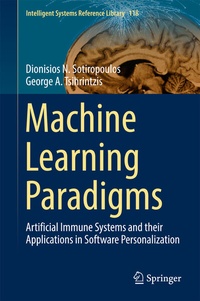
Machine Learning Paradigms
Description

The topic of this monograph falls within the, so-called, biologically motivated computing paradigm, in which biology provides the source of models and inspiration towards the development of computational intelligence and machine learning systems. Specifically, artificial immune systems are presented as a valid metaphor towards the creation of abstract and high level representations of biological components or functions that lay the foundations for an alternative machine learning paradigm. Therefore, focus is given on addressing the primary problems of Pattern Recognition by developing Artificial Immune System-based machine learning algorithms for the problems of Clustering , Classification and One-Class Classification . Pattern Classification , in particular, is studied within the context of the Class Imbalance Problem . The main source of inspiration stems from the fact that the Adaptive Immune System constitutes one of the most sophisticated biological systems that is exceptionally evolved in order to continuously address an extremely unbalanced pattern classification problem, namely, the self / non-self discrimination process. The experimental results presented in this monograph involve a wide range of degenerate binary classification problems where the minority class of interest is to be recognized against the vast volume of the majority class of negative patterns. In this context, Artificial Immune Systems are utilized for the development of personalized software as the core mechanism behind the implementation of Recommender Systems.
The book will be useful to researchers, practitioners and graduate students dealing with Pattern Recognition and Machine Learning and their applications in Personalized Software and Recommender Systems. It is intended for both the expert/researcher in these fields, as well as for the general reader in the field of Computational Intelligence and, more generally, Computer Science who wishes to learn more about the field of Intelligent Computing Systems and its applications. An extensive list of bibliographic references at the end of each chapter guides the reader to probe further into application area of interest to him/her.
More details
Other editions
Additional editions