

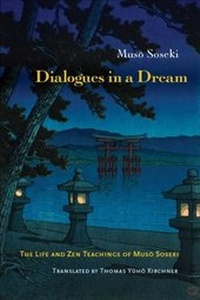
Dialogues in a Dream
The Life and Zen Teaching of Muso Soseki
1st Edition
Published on 16. June 2015
448 pages
978-1-61429-268-5 (ISBN)
Description

Drawing on his encyclopaedic knowledge, one of the most famous masters in the history of Zen leads us on a grand tour of Buddhist theology in all its timeless relevance.
Muso Soseki, the renowned fourteenth century Zen master, is today most known for developing the art of traditional Japanese Zen gardening. Even more impressive is his creation of the institutional structure for all Japanese Buddhist temples, which still in use today.
Dialogues in a Dream is one of the many projects Soseki took on in this final period of his life. Written in the guise of a conversation between Soseki and the shogun, the work covers the breadth of Buddhist philosophy and practice, and includes insightful discussions of prayer, mediation, and the place of study in religious life. His penetrating analysis deepens our appreciation of even the simplest Buddhist practices.
Acclaimed scholar Thomas Yuho Kirchner painstakingly translates this classic text into English.
Muso Soseki, the renowned fourteenth century Zen master, is today most known for developing the art of traditional Japanese Zen gardening. Even more impressive is his creation of the institutional structure for all Japanese Buddhist temples, which still in use today.
Dialogues in a Dream is one of the many projects Soseki took on in this final period of his life. Written in the guise of a conversation between Soseki and the shogun, the work covers the breadth of Buddhist philosophy and practice, and includes insightful discussions of prayer, mediation, and the place of study in religious life. His penetrating analysis deepens our appreciation of even the simplest Buddhist practices.
Acclaimed scholar Thomas Yuho Kirchner painstakingly translates this classic text into English.
More details
Other editions
Additional editions
Book
06/2015
Wisdom Publications,U.S.
€22.00
Article not available at the moment
Persons
Muso Soseki (1275?1351) was a Rinzai Zen Buddhist monk and teacher, and a calligraphist, poet and garden designer. The most famous monk of his time, he is also known as Muso Kokushi ("national Zen teacher"), a honorific conferred to him by Emperor Go-Daigo.
Thomas Yuho Kirchner was born in Baltimore, Maryland, in 1949. He went to Japan in 1969 to attend Waseda University in Tokyo for a year, after which he remained in Japan to study Buddhism. He spent three years training under Yamada Mumon as a lay monk at Shofuku-ji before receiving ordination in 1974. Following ordination he practiced under Minato Sodo Roshi at Kencho-ji in Kamakura and Kennin-ji in Kyoto. Following graduate studies in Buddhism at Otani University he worked at the Nanzan Institute for Religion and Culture in Nagoya and subsequently at the Hanazono University International Research Institute for Zen Buddhism. He presently lives at Tenryu-ji in Arashiyama, Kyoto. Among his publications are the Record of Linji, Dialogues in a Dream, and Entangling Vines.
Thomas Yuho Kirchner was born in Baltimore, Maryland, in 1949. He went to Japan in 1969 to attend Waseda University in Tokyo for a year, after which he remained in Japan to study Buddhism. He spent three years training under Yamada Mumon as a lay monk at Shofuku-ji before receiving ordination in 1974. Following ordination he practiced under Minato Sodo Roshi at Kencho-ji in Kamakura and Kennin-ji in Kyoto. Following graduate studies in Buddhism at Otani University he worked at the Nanzan Institute for Religion and Culture in Nagoya and subsequently at the Hanazono University International Research Institute for Zen Buddhism. He presently lives at Tenryu-ji in Arashiyama, Kyoto. Among his publications are the Record of Linji, Dialogues in a Dream, and Entangling Vines.
Content
- Cover
- Title
- Copyright
- Table of Contents
- Publisher's Acknowledgment
- Introduction
- Dialogues in a Dream
- Part I
- 1. Prosperity in the Present Life
- 2. The Way of the Buddha, the Way of the World
- 3. The True Meaning of Prosperity
- 4. Renouncing Avarice
- 5. Prosperity and the Search for the Way
- 6. The Merits of the Buddhas and Bodhisattvas
- 7. Divine Protection
- 8. Prayer as an Upaya
- 9. Shingon Esoteric Rituals
- 10. Praying for Influential Supporters
- 11. Praying for Good Fortune in Future Lives
- 12. Advanced in Wisdom, Advanced in Compassion
- 13. The Three Types of Compassion
- 14. Mahayana Compassion
- 15. The True Meaning of Kaji and Kito Rituals
- 16. Offerings to Worldly Monks
- 17. Buddhism and Government
- 18. Demon-Work
- 19. Conceit
- 20. Dualistic Attachment and Buddhist Practice
- 21. Zazen-Induced Breakdowns
- 22. Dealing with Demonic Obstructions
- 23. Subduing Demons with No-Mind
- Part II
- 24. The Profound Wisdom of Original Nature
- 25. Wisdom as an Impediment
- 26. Scholarly Understanding and Profound Wisdom
- 27. The Parable of the Raft
- 28. Deluded Thinking and Profound Wisdom
- 29. Stop Deluded Thinking
- 30. Words and Deluded Thinking
- 31. Nonpractice Is the Greatest Delusion
- 32. Koan Practice
- 33. Returning to Original Well-Being
- 34. Scholarly Understanding and True Practice
- 35. Fundamental Wisdom and Acquired Wisdom
- 36. Intent and Words
- 37. Bodhidharma's Intent
- 38. The Importance of Practice
- 39. Practice over Understanding
- 40. Bodhicitta
- 41. Reducing Worldly Passions
- 42. Practicing with Worldly Feelings
- 43. To See Things as Illusion Is Not the Ultimate
- 44. Enlightenment
- 45. Detachment Is Not Enlightenment
- 46. Judging Right and Wrong
- 47. The Effects of Practice
- 48. The True Meaning of Zazen
- 49. True Practice
- 50. The Striving of Nonstriving
- 51. The Abstruse Teaching of the Zen School
- 52. Direct Indication of Original Nature
- 53. Direct Guidance
- 54. The Use of Koans
- 55. Master Zhaozhou Said "Wu!
- 56. Cultivation and Worldly Activities
- 57. The Buddha Law and Worldly Affairs
- 58. "Letting Go" in the Zen School
- 59. Original Nature and Supernatural Powers
- 60. Signs at the Time of Death
- Part III
- 61. The Ground of Original Nature
- 62. Buddha-Nature and the Ground of Original Nature
- 63. The True Form of the Ground of Original Nature
- 64. Attaining the Ground of Original Nature
- 65. The True Mind
- 66. The Eternal Soul and the One Mind
- 67. True Mind and Deluded Mind
- 68. The Two Foundations of the True Mind
- 69. Dependent Origination and Spontaneous Arising
- 70. Mind and Nature
- 71. Delusion and Truth
- 72. Ordinary People and Sages
- 73. The Eye of the Buddha
- 74. Hinayana and Mahayana, Provisional and True
- 75. Capacities
- 76. The Mysterious Principle of the Separate Transmission
- 77. The Five Houses of the Zen School
- 78. The Reason for Praise and Censure
- 79. The True Meaning of the Buddha's Teachings
- 80. Doctrine and Zen
- 81. Teaching through Principle, Teaching through Devices
- 82. Easy Practice, Difficult Practice
- 83. Fully Revealed and Partially Revealed Teachings
- 84. The Fully Revealed Mahayana Nenbutsu
- 85. The Correct Practice and the Other Practices
- 86. The True Meaning of Praise and Censure
- 87. Keen Students, Dull Students
- 88. Zen and the Precepts
- 89. Meditation in the Zen School
- 90. Recognizing the True Dharma
- 91. A Separate Transmission Outside the Teachings
- 92. Regarding the Publication of These Exchanges
- 93. A Koan Given to Ashikaga
- Postscript by Zhuxian Fanxian
- Postscript to the Revised Edition
- Notes
- Index
- About the Translator
- About Wisdom
- More Books from Wisdom Publications
