

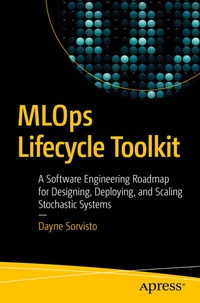
MLOps Lifecycle Toolkit
Description

This book is aimed at practitioners of data science, with consideration for bespoke problems, standards, and tech stacks between industries. It will guide you through the fundamentals of technical decision making, including planning, building, optimizing, packaging, and deploying end-to-end, reliable, and robust stochastic workflows using the language of data science.
MLOps Lifecycle Toolkit walks you through the principles of software engineering, assuming no prior experience. It addresses the perennial "why" of MLOps early, along with insight into the unique challenges of engineering stochastic systems. Next, you'll discover resources to learn software craftsmanship, data-driven testing frameworks, and computer science. Additionally, you will see how to transition from Jupyter notebooks to code editors, and leverage infrastructure and cloud services to take control of the entire machine learning lifecycle. You'll gain insight into the technical and architectural decisions you're likely to encounter, as well as best practices for deploying accurate, extensible, scalable, and reliable models. Through hands-on labs, you will build your own MLOps "toolkit" that you can use to accelerate your own projects. In later chapters, author Dayne Sorvisto takes a thoughtful, bottom-up approach to machine learning engineering by considering the hard problems unique to industries such as high finance, energy, healthcare, and tech as case studies, along with the ethical and technical constraints that shape decision making.
After reading this book, whether you are a data scientist, product manager, or industry decision maker, you will be equipped to deploy models to production, understand the nuances of MLOps in the domain language of your industry, and have the resources for continuous delivery and learning.
What You Will Learn
- Understand the principles of software engineering and MLOps
- Design an end-to-endmachine learning system
- Balance technical decisions and architectural trade-offs
- Gain insight into the fundamental problems unique to each industry and how to solve them
Who This Book Is For
Data scientists, machine learning engineers, and software professionals.More details
Other editions
Additional editions
Person
Dayne Sorvisto
has a Master of Science degree in Mathematics and Statistics and became an expert in MLOps. He started his career in data science before becoming a software engineer. He has worked for tech start-ups and has consulted for Fortune 500 companies in diverse industries including energy and finance. Dayne has previously won awards for his research including Industry Track Best Paper Award. Dayne has also written about security in MLOps systems for Dell EMC's Proven Professional Knowledge Sharing platform and has contributed to many of the open-source projects he uses regularly.
Content
Chapter 1: Introduction to Machine Learning Engineering.- Chapter 2: Developing Stochastic Systems.- Chapter 3: Tools for Data Science Developers.- Chapter 4: Infrastructure for MLOps.- Chapter 5, Building Training Pipelines.- Chapter 6: Building Inference Pipelines.- Chapter 7: Deploying Stochastic Systems.- Chapter 8: Data Ethics.- Chapter 9: Case Studies By Industry.
