

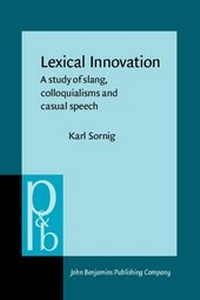
Lexical Innovation
A study of slang, colloquialisms and casual speech
1st Edition
Published on 1. January 1981
X, 117 pages
978-90-272-8080-0 (ISBN)
Description

In addition to borrowing from various foreign sources, the main origins of slang terms are the activation and revitalization of existing morphological and lexical material. Metaphorical manipulation of lexical items, as the main device used for the production of slangisms, shows remarkable similarities in languages otherwise quite different from each other. Slang is analyzed as a kind of substandard language variation which any full-fledged language is bound to develop because it is experimental in that it is born from insubordination and protest against the stress experienced in the speech communities of large cities and is always characterized by that element of playfulness which is the hallmark of creative language in general.
More details
Other editions
Additional editions
Book
01/1981
John Benjamins Publishing Co
€72.08
Shipment within 10-15 days
Content
- LEXICAL INNOVATION A Study of Slang, Colloquialisms and Casual Speech
- Editorial page
- Title page
- Copyright page
- Table of contents
- 0. BY WAY OF INTRODUCTION
- 1. SUBSTANDARD LANGUAGE
- 1.1 Borrowings : foreign sources
- 1.2 Loans from other sociolects or dialects
- 1.3 The fascination of antiquity
- 1.3.1. Slang-Etymologies
- 1.3.2. Eclipse of etymological memory
- 1.3.3. Creative misunderstanding: folk-etymology
- 1.4 Ascendance and decline
- 1.5. Meaning reception and semantic shift
- 1.6. The ephemerity of slangisms
- 1.7. Neologisms
- 2. STRUCTURES AND MANIPULATIONS
- 2.1.Dissimitative morphophonemic manipulations
- 2.2. Assimilative/associative manipulations
- 2.2.1. Rhyming and alliteration
- 2.2.2. Reduplication
- 2.3. Onomatopoeia and morphophonologioal symbolization (LautSymbolik)
- 2.4. Revitalisation and activation of the morpheme potential
- 2.5. Proper names and generic nouns
- 2.6. Intensifiers
- 2.7 Invectives and expletives
- 2.8. Syntagms
- 3. SLANG, AND THE UNIVERSE OF METAPHORICAL LANGUAGE
- 3.1. Contiguity relations
- 3.1.1. Pars pro toto
- 3.1.2. Other contiguity relations
- 3.1.3. Absurdities, great and small
- 3.1.4. Animal and plant metaphors
- 3.1.5. Lexical paraphrases of metaphors
- 3.2. Reduction vs. extension of semantic content: quantitative manipulations
- 3.3. Qualitative manipulations: euphemisms and pejoratives
- 3.4. Componential re-arrangement: focusing and shifting of semantic features
- 3.4.1. Semantic (metaphorical) activation
- 3.4.2. Antonyms
- 3.5. "Fertile" semantic areas
- 3.5.1. The lexicon of the human body
- a) Parts of the body
- b) Bodily functions, sexual and otherwise
- 3.5.2. Eating and drinking, alcohol, cigarettes etc
- 3.5.3. Mental and physical deficiencies, diseases, and death
- 3.5.4. Money, payment, and insolvency
- 3.5.5. Other areas
- 3.6. Metaphorical parallelism
- 3.7. Downright absurdities
- 4. SOME REASONS FOR VARIABILITY: RULES AND THEIR USERS
- 4.1. Oral communication
- 4.2. Rule-abiding and rule-transcending linguistic behaviour
- 4.3. Subcultures under innovational stress and their languages
- 4.4. Persuasive Language
- 4.5. The poeticity of slang
- 4.6. Language born from fear: language taboo
- 4.7. Pathological and developmental linguistic deficiencies
- 5. SOME PURPOSES: DISTANCE, PARODY, RE-INTERPRETATION AND RE-EVALUATION
- 5.1. The evaluation of reality by re-interpretation and re-naming
- 5.2. Stigmatized language variants: innovative deviation
- 5.3. Emotionali zation and the Promethean principle of innovation
- 5.4. Aggressiveness and Fun
- 5.5. Language as a toy, a game
- 5,5,1. Linguistic playfulness: a universal
- 5.5.2. Punning
- 5.5.3. Masquerading Foreignness: Maccavonisms
- 5.5.4. Nonsense, delightful and powerful
- 5.5.5. Nonsense, literary
- 5.5.6. New sense created by nonsense
- 5.6. The insufficient translatability of connotations
- 5.7. Conventionalization in the making
- FOOTNOTES
- REFERENCES
