

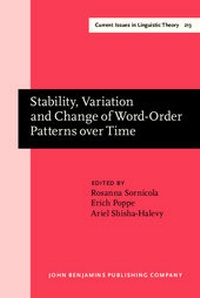
Stability, Variation and Change of Word-Order Patterns over Time
1st Edition
Published on 21. December 2000
XXXII, 323 pages
978-90-272-8471-6 (ISBN)
Description

The issue of permanence and change of word-order patterns has long been debated in both historical linguistics and structural theories. The interest in this theme has been revamped by contemporary research in typology with its emphasis on correlation or 'harmonies' of structures of word-order as explicative principles of both synchronic and diachronic processes. The aim of this book is to stimulate a critical reconsideration of perspectives and methods in the study of continuities and discontinuities of word-order patterns. Bringing together contributions by specialists of various theoretical backgrounds and with expertise in different language families or groups (Caucasian, Hamito-Semitic, and - among Indo-European - Hittite, Greek, Celtic, Germanic, Slavonic, Romance), the book addresses issues like the notions of stability, variation and change of word-order and their interrelations, the interplay of syntactic and pragmatic factors, and the role of internal and external factors in synchronic and diachronic dynamics of word-order. The book contains a selection of papers presented at a workshop held at the XIII International Conference on Historical Linguistics (Düsseldorf, August 1997) and additonal invited contributions.
More details
Other editions
Additional editions
Rosanna Sornicola | Erich Poppe | Ariel Shisha-Halevy
Stability, Variation and Change of Word-Order Patterns over Time
Edited by Rosanna Sornicola, Erich Poppe and Ariel Shisha-Halevy
Book
12/2000
John Benjamins Publishing Co
€132.50
Shipment within 10-15 days
Persons
Content
- STABILITY, VARIATION AND CHANGE OF WORD-ORDER PATTERNS OVER TIME
- Editorial page
- Title page
- Copyright page
- Table of contents
- ACKNOWLEDGEMENTS
- INTRODUCTION
- REFERENCES
- PART I. STYLISTIC AND PRAGMATIC PRINCIPLES IN STABILITY, VARIATION AND CHANGE
- LA FORMATION DES PRINCIPES DE L'ORDRE DES MOTS DU RUSSE MODERNE EN TANT QUE PROBLEME DE STYLISTIQUE LITTERAIRE ET DE LINGUISTIQUE
- 0.Introduction
- 1.Naissance du russe moderne
- 2.La théorie des "Trois styles
- 3.Le problème de la phrase russe
- 4.La structure linéaire et prosodique de la phrase nouvelle
- 4.1 Les hésitations sur les principes nouveaux
- 5.Ordre des mots et prosodie dans la phrase russe contemporaine
- 6.Les rôles pragmatiques en russe
- 7.Ordre des mots et oralité
- ABSTRACT
- BIBLIOGRAPHIE
- FROM VSO TO SVO?WORD ORDER AND REAR EXTRAPOSITION IN COPTIC
- 0. Historical introduction
- 1. The SVO-order in Coptic
- 2. VSO-constructions
- 3. Rear extraposition : a multifunctional feature
- 4. The nci-construction as rheme
- 5. Topic and focus
- 6. Prosodic length and informational weight
- 7. Irregular uses of the nci-extraposition
- 8. Conclusion
- REFERENCES
- CONSTITUENT ORDER IN MIDDLE WELSH THE STABILITY OF THE PRAGMATIC PRINCIPLE
- 1. The data, and some preliminaries
- 2. Functional analysis - the pragmatic principle in performance
- 2.1 Topicalization
- 2.2 Sentence-initial verbs
- 2.3 Cleft-constructions
- 2.4 Left-dislocation
- 3. The synchronic stability of the pragmatic principle
- 4. Conclusion
- ABBREVIATIONS
- REFERENCES
- PART II. STABILITY AND DIACHRONY
- STABILITY AGAINST THE ODDS? THE SURVIVAL OF VERB FINAL ORDER IN AKKADIAN
- 0. Introduction
- 1. The facts: word order patterns in Babylonian Akkadian
- 2. Change because of disintegration of the case system?
- 3. Change because of inconsistency and parsing problems
- 3.1 OV and postposed relative clauses
- 3.2 Complements and adverbial clauses
- 4. Conclusion
- REFERENCES PRIMARY SOURCES
- SECONDARY SOURCES
- STABILITY IN CLAUSAL/PHRASAL PATTERN CONSTITUENT SEQUENCING: 4000 YEARS OF EGYPTIAN (WITH SOME THEORETICAL REFLECTIONS, ALSO ON CELTIC)
- 1. Egyptian
- 2. Some idiosyncrasies
- 3. Word order: stability and variation over time
- 4. Excurse: word order in Celtic
- 5. Egyptian patterning
- 5.1 Nexus types: no specific SDF
- 5.2 The nucleus /expansion (determinatum /determinans) Grundrichtung in noun phrases. SDF: evolution of the nuclear determinators
- loss of the syntactic category 'adjective'
- 5.3 Negators
- 5.4 The causative conjugation
- 5.5 The cleft sentence and other focussing constructions
- 5.6 The rhematic (predicative) adjective
- 5.7 Nominal-Sentence Patterning
- 5.8 Sentence prosody - enclitic placement: cyclic shift of low-stress slotting
- REFERENCES
- STABILITY, VARIATION AND CHANGE IN WORD ORDER SOME EVIDENCE FROM THE ROMANCE LANGUAGES
- 0. Introduction
- 1. Criteria for determining stability, variation and change in WO across time
- 2. Flexibility over time in transitive structures in the Romance languages
- 3. Discontinuity or minor temporary fluctuations ?
- 4. How old is the SVO trend?
- REFERENCES PRIMARY SOURCES
- SECONDARY SOURCES
- PART III. REANALYSIS, GRAMMATICALIZATION AND CHANGE
- REANALYSIS IN WORD ORDER STABILITY AND CHANGE
- 0. Introduction
- 1. Reanalysis
- 2. Word order change
- 3. Structural change
- 3.1 The Old Norse subject
- 3.2 Ergative constructions
- 4. A problem
- 4.1 The output of reanalysis
- 4.2 Modularity and change
- 5. Conclusion
- REFERENCES
- WORD ORDER HARMONIES AND WORD ORDER CHANGE IN GEORGIAN
- 0. Introduction
- 1. Old Georgian
- 2. Modern Georgian
- 3. Construction reanalysis
- 3.1 Auxiliary and verb
- 3.2 The comparative construction
- 3.3 Conclusions
- 4. Borrowing as an alternative explanation
- 5. Conclusion
- APPENDIX
- ABBREVIATIONS USED FOR GLOSSING EXAMPLES
- REFERENCES
- WORD ORDER AND THE FIRST PERSON IMPERATIVE
- 0. Introduction
- 1. Person-differentiated imperatives and the first person imperative
- 1.1 English let as a person-neutral imperative marker
- 1.2 Dative-argument verbs with speaker-benefactive uses
- 1.3 The suffixal first person imperative of oldest Indo-European Hittit
- 2. Older Indo-European prayer requests
- 2.1 Suffixing strategies for prayer requests
- 2.2 Lexical and (quasi-)auxiliary "give
- 3. Summary and conclusions
- REFERENCES
- PART IV. VARIATION AND CHANGE
- VARIANT ORDER OF SURFACE SEGMENTABLES ON THE BORDER BETWEEN MORPHOLOGY AND SYNTAX THE CASE OF PRERADICAL VERBAL MORPHOLOGY IN KARTVELIAN
- 0. Introduction
- 1. Overview of Kartvelian
- 2. Examples of variant morpheme ordering
- 2.1 Old and Early Middle Georgian
- 2.2 Mingrelian
- 2.3 Svan
- 3. Summary and conclusions
- REFERENCES PRIMARY SOURCES
- SECONDARY SOURCES
- WORD ORDER STABILITY AND CHANGE FROM A SOCIOLINGUISTIC PERSPECTIVE THE CASE OF EARLY MODERN WELSH
- 1. Sociolinguistic variation and word order theory
- 2. 'Top-down' vs. 'bottom up ' approaches to word order description
- 3. Case study: absolute-initial verb order in Early Modern Welsh
- 3.1 Historical overview
- 3.2 Word order variation in Early Modern Welsh
- 3.3 Accounting for the variation: competition between AIV order and other constructions
- 3.4 The role of stylistic choice in the extension of AIV order
- 4. Implications of the data for sociolinguistic theory
- 4.1 The sociolinguistic nature of the variation
- 4.2 Word order variation and pragmatic meaning
- 5. Implications for word order description and word order change
- 6. Conclusion
- ABBREVIATIONS USED FOR GLOSSING EXAMPLES
- REFERENCES PRIMARY SOURCES
- SECONDARY SOURCES
- CONVERGENCE AND DIVERGENCE IN THE DEVELOPMENT OF THE GREEK AND LATIN CLITIC PRONOUNS
- 0. Introduction
- 1. Ancient Greek and Latin
- 2. Biblical Greek and Latin (and beyond)
- 3. Modern Greek and Romance
- 4. Conclusion
- REFERENCES
- TWO WORD ORDER PATTERNS IN THE HISTORY OF ENGLISH: STABILITY, VARIATION AND CHANGE
- 0. Introduction
- 1. The order of direct and indirect object in English: a diachronic survey
- 2. The order of direct object and verb in English: a diachronic survey
- 3. Word order change and competing grammars
- REFERENCES PRIMARY SOURCES
- SECONDARY SOURCES
- GENITIVE CONSTRUCTIONS IN EARLY MODERN ENGLISH NEW EVIDENCE FROM A CORPUS ANALYSIS
- 0. Introduction
- 1. Historical development
- 2. Corpus analysis: 1400-1630
- 2.1 Distribution of genitive constructions
- 3. Genitive functions
- 3.1 Classification of genitive functions
- 3.2 Analysis and results
- 4. Animacy
- 5. Topicality/Idefiniteness
- 6. Conclusion
- REFERENCES PRIMARY SOURCES
- SECONDARY SOURCES
- INDEX OF NAMES
- INDEX OF SUBJECTS
- INDEX OF LANGUAGES
