

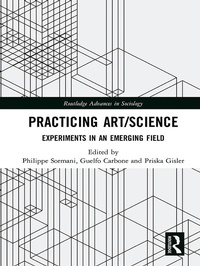
Practicing Art/Science
Experiments in an Emerging Field
1st Edition
Published on 11. July 2018
268 pages
978-1-351-70808-1 (ISBN)
Description

Over the last two decades, multiple initiatives of transdisciplinary collaboration across art, science, and technology have seen the light of day. Why, by whom, and under what circumstances are such initiatives promoted? What does their experimental character look like - and what can be learned, epistemologically and institutionally, from probing the multiple practices of "art/science" at work?
In answer to the questions raised, Practicing Art/Science contrasts topical positions and insightful case studies, ranging from the detailed investigation of "art at the nanoscale" to the material analysis of Leonardo's Mona Lisa and its cracked smile. In so doing, this volume brings to bear the "practice turn" in science and technology studies on the empirical investigation of multifaceted experimentation across contemporary art, science, and technology in situ. Against the background of current discourse on "artistic research," the introduction not only explains the particular relevance of the "practice turn" in STS to tackle the interdisciplinary task at hand, but offers also a timely survey of varying strands of artistic experimentation.
In bringing together ground-breaking studies from internationally renowned scholars and upcoming researchers in sociology, art theory and artistic practice, as well as history and philosophy of science, Practicing Art/Science will be essential reading for practitioners and professionals in said fields, as well as postgraduate students and representatives of higher education and research policy more broadly.
In answer to the questions raised, Practicing Art/Science contrasts topical positions and insightful case studies, ranging from the detailed investigation of "art at the nanoscale" to the material analysis of Leonardo's Mona Lisa and its cracked smile. In so doing, this volume brings to bear the "practice turn" in science and technology studies on the empirical investigation of multifaceted experimentation across contemporary art, science, and technology in situ. Against the background of current discourse on "artistic research," the introduction not only explains the particular relevance of the "practice turn" in STS to tackle the interdisciplinary task at hand, but offers also a timely survey of varying strands of artistic experimentation.
In bringing together ground-breaking studies from internationally renowned scholars and upcoming researchers in sociology, art theory and artistic practice, as well as history and philosophy of science, Practicing Art/Science will be essential reading for practitioners and professionals in said fields, as well as postgraduate students and representatives of higher education and research policy more broadly.
More details
Series
Edition
1. Auflage
Language
English
Place of publication
London
United Kingdom
Publishing group
Taylor & Francis Ltd
Target group
College/higher education
Illustrations
52 Halftones, black and white
ISBN-13
978-1-351-70808-1 (9781351708081)
Copyright in bibliographic data and cover images is held by Nielsen Book Services Limited or by the publishers or by their respective licensors: all rights reserved.
Schweitzer Classification
Other editions
Additional editions
Philippe Sormani | Guelfo Carbone | Priska Gisler
Practicing Art/Science
Experiments in an Emerging Field
Book
02/2020
1st Edition
Routledge
€68.50
Shipment within 15-20 days
Philippe Sormani | Guelfo Carbone | Priska Gisler
Practicing Art/Science
Experiments in an Emerging Field
Book
07/2018
1st Edition
Routledge
€215.41
Shipment within 10-20 days
Persons
Philippe Sormani is Board member of the Science and Technology Studies Lab at the University of Lausanne, Switzerland; and affiliated researcher at the Institut Marcel Mauss, EHESS, in Paris, France
Guelfo Carbone holds a PhD in Philosophy and History of Philosophy (Sapienza University of Rome), and is a member of the Editorial Board of the philosophical Journal "Polemos. Materiali di filosofia e critica sociale".
Priska Gisler is head of the research cluster Intermediality at University of the Arts, Bern, Switzerland, and board member of the Swiss Artistic Research Network (SARN).
Guelfo Carbone holds a PhD in Philosophy and History of Philosophy (Sapienza University of Rome), and is a member of the Editorial Board of the philosophical Journal "Polemos. Materiali di filosofia e critica sociale".
Priska Gisler is head of the research cluster Intermediality at University of the Arts, Bern, Switzerland, and board member of the Swiss Artistic Research Network (SARN).
Content
Introduction: Experimenting with 'Art/Science'?
Guelfo Carbone, Priska Gisler, Philippe Sormani
Part I: Positions
Chapter 1
Engaging Performative Contradiction: Introducing the rhetorics of practice and method to artist researchers
Mick Wilson
Chapter 2
Contemporary Art as a New Paradigm? An Artistic Revolution in Light of the History of Science
Nathalie Heinich
Chapter 3
Writing practices as experimental arenas at universities of the arts
Priska Gisler
Part II: Practices
Chapter 4
Material Play and Artistic Renderings: The Production of Essentially Useless Nanotechnology
Michael Lynch
Chapter 5
Probing the art/science binary: Notes on the experimental achievement of shared perception
Dirk vom Lehn
Chapter 6
From Heterogeneity to Hybridity? Working and Living in Arts-based Research
Bernhard Boehm
Chapter 7
Artworks in and as Practices: The Relevance of Particulars
Yael Kreplak
Chapter 8
On the discrepancy between objects and things: An ecological approach
Fernando Dominguez Rubio
Part III: Implications
Chapter 9
Re-Programmed Art: Overcoming Obsolescence and Opening up Programmed and Kinetic Artworks
Serena Cangiano, Davide Fornari, Azalea Seratoni
Chapter 10
Back to the Future. Bogomir Ecker's Tropfsteinmaschine as a thought experiment in stone
Johanne Mohs
Chapter 11
Epistemics and Aesthetics of Experimentation: Towards a Hybrid Heuristics?
Hans-Joerg Rheinberger
Guelfo Carbone, Priska Gisler, Philippe Sormani
Part I: Positions
Chapter 1
Engaging Performative Contradiction: Introducing the rhetorics of practice and method to artist researchers
Mick Wilson
Chapter 2
Contemporary Art as a New Paradigm? An Artistic Revolution in Light of the History of Science
Nathalie Heinich
Chapter 3
Writing practices as experimental arenas at universities of the arts
Priska Gisler
Part II: Practices
Chapter 4
Material Play and Artistic Renderings: The Production of Essentially Useless Nanotechnology
Michael Lynch
Chapter 5
Probing the art/science binary: Notes on the experimental achievement of shared perception
Dirk vom Lehn
Chapter 6
From Heterogeneity to Hybridity? Working and Living in Arts-based Research
Bernhard Boehm
Chapter 7
Artworks in and as Practices: The Relevance of Particulars
Yael Kreplak
Chapter 8
On the discrepancy between objects and things: An ecological approach
Fernando Dominguez Rubio
Part III: Implications
Chapter 9
Re-Programmed Art: Overcoming Obsolescence and Opening up Programmed and Kinetic Artworks
Serena Cangiano, Davide Fornari, Azalea Seratoni
Chapter 10
Back to the Future. Bogomir Ecker's Tropfsteinmaschine as a thought experiment in stone
Johanne Mohs
Chapter 11
Epistemics and Aesthetics of Experimentation: Towards a Hybrid Heuristics?
Hans-Joerg Rheinberger
