

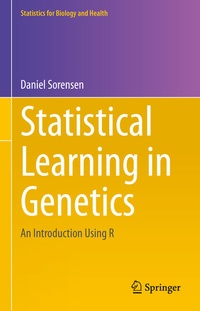
Statistical Learning in Genetics
An Introduction Using R
1st Edition
Published on 19. September 2023
XVI, 693 pages
978-3-031-35851-7 (ISBN)
Description

This book provides an introduction to computer-based methods for the analysis of genomic data. Breakthroughs in molecular and computational biology have contributed to the emergence of vast data sets, where millions of genetic markers for each individual are coupled with medical records, generating an unparalleled resource for linking human genetic variation to human biology and disease. Similar developments have taken place in animal and plant breeding, where genetic marker information is combined with production traits. An important task for the statistical geneticist is to adapt, construct and implement models that can extract information from these large-scale data. An initial step is to understand the methodology that underlies the probability models and to learn the modern computer-intensive methods required for fitting these models. The objective of this book, suitable for readers who wish to develop analytic skills to perform genomic research, is to provide guidance to take this first step.
This book is addressed to numerate biologists who typically lack the formal mathematical background of the professional statistician. For this reason, considerably more detail in explanations and derivations is offered. It is written in a concise style and examples are used profusely. A large proportion of the examples involve programming with the open-source package R. The R code needed to solve the exercises is provided. The MarkDown interface allows the students to implement the code on their own computer, contributing to a better understanding of the underlying theory.
Part I presents methods of inference based on likelihood and Bayesian methods, including computational techniques for fitting likelihood and Bayesian models. Part II discusses prediction for continuous and binary data using both frequentist and Bayesian approaches. Some of the models used for prediction are also used for gene discovery. The challenge is to find promising genes without incurring a large proportion of false positive results. Therefore, Part II includes a detour on False Discovery Rate assuming frequentist and Bayesian perspectives. The last chapter of Part II provides an overview of a selected number of non-parametric methods. Part III consists of exercises and their solutions.
Daniel Sorensen holds PhD and DSc degrees from the University of Edinburgh and is an elected Fellow of the American Statistical Association. He was professor of Statistical Genetics at Aarhus University where, at present, he is professor emeritus.
This book is addressed to numerate biologists who typically lack the formal mathematical background of the professional statistician. For this reason, considerably more detail in explanations and derivations is offered. It is written in a concise style and examples are used profusely. A large proportion of the examples involve programming with the open-source package R. The R code needed to solve the exercises is provided. The MarkDown interface allows the students to implement the code on their own computer, contributing to a better understanding of the underlying theory.
Part I presents methods of inference based on likelihood and Bayesian methods, including computational techniques for fitting likelihood and Bayesian models. Part II discusses prediction for continuous and binary data using both frequentist and Bayesian approaches. Some of the models used for prediction are also used for gene discovery. The challenge is to find promising genes without incurring a large proportion of false positive results. Therefore, Part II includes a detour on False Discovery Rate assuming frequentist and Bayesian perspectives. The last chapter of Part II provides an overview of a selected number of non-parametric methods. Part III consists of exercises and their solutions.
Daniel Sorensen holds PhD and DSc degrees from the University of Edinburgh and is an elected Fellow of the American Statistical Association. He was professor of Statistical Genetics at Aarhus University where, at present, he is professor emeritus.
More details
Other editions
Additional editions
Book
09/2023
Springer
€171.19
Article exhausted; check for reprint
Person
Daniel Sorensen
holds PhD and DSc degrees from the University of Edinburgh and is an elected Fellow of the American Statistical Association. He was professor of Statistical Genetics at Aarhus University where, at present, he is professor emeritus.
Content
- 1. Overview. -
Part I Fitting Likelihood and Bayesian Models.
- 2. Likelihood. - 3. Computing the Likelihood. - 4. Bayesian Methods. - 5. McMC in Practice. -
Part II Prediction.
- 6. Fundamentals of Prediction. - 7. Shrinkage Methods. - 8. Digression on Multiple Testing: False Discovery Rates. - 9. Binary Data. - 10. Bayesian Prediction and Model Checking. - 11. Nonparametric Methods: A Selected Overview. -
Part III Exercises and Solutions.
- 12. Exercises. - 13. Solution to Exercises.
