

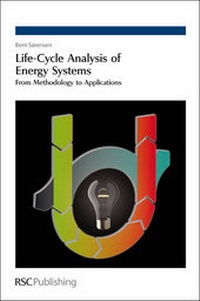
Life-Cycle Analysis of Energy Systems
From Methodology to Applications
1st Edition
Published on 6. June 2011
348 pages
978-1-84973-286-4 (ISBN)
Description

Life-cycle assessment of new energy solutions plays an important role in discussions about global warming mitigation options and the evaluation of concrete energy production and conversion installations.
This book starts by describing the methodology of life-cycle analysis and life-cycle assessment of new energy solutions. It then goes on to cover, in detail, a range of applications to individual energy installations, national supply systems, and to the global energy system in a climate impact context. Coverage is not limited to issues related to commercial uses by consultants according to ISO norms. It also emphasizes life-cycle studies as an open-ended scientific discipline embracing economic issues of cost, employment, equity, foreign trade balances, ecological sustainability, and a range of geo-political and social issues.
A wealth of applications are described and a discussion on the results obtained in each study is included. Example areas are fossil and nuclear power plants, renewable energy systems, and systems based on hydrogen or batteries as energy carriers. The analysis is continued to the end-users of energy, where energy use in transportation, industry and home are scrutinized for their life-cycle impacts. Biofuel production and the combustion of firewood in home fireplaces and stoves are amongst the issues discussed.
A central theme of the book is global warming. The impacts of greenhouse gas emissions are meticulously mapped at a depth far beyond that of the IPCC reports. A novel and surprising finding is that more lives will be saved than lost as a direct consequence of a warmer climate. After a 2?C increase in temperature, the reduction in death rates in areas with cold winters would outweigh the increase in the death rates in hot climates. However, this is only one of several impacts from greenhouse gases, and the remaining ones are still overwhelmingly negative. The fact that some population groups may benefit from higher temperatures (notably the ones most responsible for greenhouse gas emissions) whilst others (who did not contribute much to the problem) suffer is one of the main points of the book.
The book is suitable as a university textbook and as a reference source for engineers, managers and public bodies responsible for planning and licensing.
This book starts by describing the methodology of life-cycle analysis and life-cycle assessment of new energy solutions. It then goes on to cover, in detail, a range of applications to individual energy installations, national supply systems, and to the global energy system in a climate impact context. Coverage is not limited to issues related to commercial uses by consultants according to ISO norms. It also emphasizes life-cycle studies as an open-ended scientific discipline embracing economic issues of cost, employment, equity, foreign trade balances, ecological sustainability, and a range of geo-political and social issues.
A wealth of applications are described and a discussion on the results obtained in each study is included. Example areas are fossil and nuclear power plants, renewable energy systems, and systems based on hydrogen or batteries as energy carriers. The analysis is continued to the end-users of energy, where energy use in transportation, industry and home are scrutinized for their life-cycle impacts. Biofuel production and the combustion of firewood in home fireplaces and stoves are amongst the issues discussed.
A central theme of the book is global warming. The impacts of greenhouse gas emissions are meticulously mapped at a depth far beyond that of the IPCC reports. A novel and surprising finding is that more lives will be saved than lost as a direct consequence of a warmer climate. After a 2?C increase in temperature, the reduction in death rates in areas with cold winters would outweigh the increase in the death rates in hot climates. However, this is only one of several impacts from greenhouse gases, and the remaining ones are still overwhelmingly negative. The fact that some population groups may benefit from higher temperatures (notably the ones most responsible for greenhouse gas emissions) whilst others (who did not contribute much to the problem) suffer is one of the main points of the book.
The book is suitable as a university textbook and as a reference source for engineers, managers and public bodies responsible for planning and licensing.
More details
Edition
1. Auflage
Language
English
Place of publication
Cambridge
United Kingdom
Target group
College/higher education
Professional and scholarly
ISBN-13
978-1-84973-286-4 (9781849732864)
DOI
10.1039/9781849732864
Copyright in bibliographic data and cover images is held by Nielsen Book Services Limited or by the publishers or by their respective licensors: all rights reserved.
Schweitzer Classification
Other editions
Additional editions
Book
06/2011
Royal Society of Chemistry
€180.50
Shipment within 3-4 weeks
Person
Bent Sorensen received a Ph.D. in Physics from the Niels Bohr Institute in Copenhagen and a Diploma in Advanced Management from INSEAD in Fontainebleau. He has published some 20 books and 600 scientific articles, notably in the fields of energy and environmental science, history, and policy studies. He is Professor Emeritus at Roskilde University and has formerly held academic positions at universities in Berkeley, Yale, Golden, Kyoto, Grenoble and Sydney. He has been an advisor and committee chairman for the OECD, national governments and UN agencies including the IPCC as lead author on climate change mitigation. He received the Australian-European Eminent Scholar Award and the European Solar Prize and was, in 1989, knighted by the Danish Queen.
Content
Introduction;
PART I: METHODOLOGY;
Life-cycle analysis (LCA);
From life-cycle analysis to life-cycle assessment;
Energy system definitions;
PART II: APPLICATIONS;
Applying LCA to individual systems;
Applying LCA to energy supply chains;
System-wide applications;
LCA case studies of a national energy system;
LCA case studies of global scenarios for future energy systems;
PART III: WRAPPING UP;
Lessons learned and future development of LCA method
PART I: METHODOLOGY;
Life-cycle analysis (LCA);
From life-cycle analysis to life-cycle assessment;
Energy system definitions;
PART II: APPLICATIONS;
Applying LCA to individual systems;
Applying LCA to energy supply chains;
System-wide applications;
LCA case studies of a national energy system;
LCA case studies of global scenarios for future energy systems;
PART III: WRAPPING UP;
Lessons learned and future development of LCA method
