

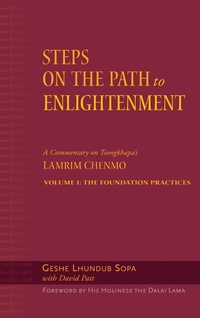
Steps on the Path to Enlightenment
A Commentary on Tsongkhapa's Lamrim Chenmo, Volume 1: The Foundation Practices
Published on 15. June 2004
608 pages
978-0-86171-773-6 (ISBN)
Description

Steps on the Path to Englightenment: The Foundation Practices marks the first volume of a much-anticipated, comprehensive commentary on the Lamrim Chenmo by the renowned Buddhist scholar, Geshe Sopa.
This landmark commentary on what is perhaps the most elegant Tibetan presentation of the Buddhist path offers a detailed overview of Buddhist philosophy, especially invaluable to those wanting to enact the wisdom of the Buddha in their lives.
In the Lamrim Chenmo, Tsongkhapa explains the path in terms of the three levels of practitioners: those of small capacity who seek happiness in future lives, those of medium capacity who seek liberation from the cycle of suffering, and those of great capacity who seek full enlightenment in order to benefit all beings. This volume covers the topics common to the first level: Tsongkhapa's explanations of the role of the teacher, his exhortation to take the essence of human existence, the contemplation of death and future lives, and going for the refuge.
Given his vast knowledge and his experience in both Tibetan and Western contexts, Geshe Sopa is the ideal commentator of this work for the modern student of Tibetan Buddhism.
This landmark commentary on what is perhaps the most elegant Tibetan presentation of the Buddhist path offers a detailed overview of Buddhist philosophy, especially invaluable to those wanting to enact the wisdom of the Buddha in their lives.
In the Lamrim Chenmo, Tsongkhapa explains the path in terms of the three levels of practitioners: those of small capacity who seek happiness in future lives, those of medium capacity who seek liberation from the cycle of suffering, and those of great capacity who seek full enlightenment in order to benefit all beings. This volume covers the topics common to the first level: Tsongkhapa's explanations of the role of the teacher, his exhortation to take the essence of human existence, the contemplation of death and future lives, and going for the refuge.
Given his vast knowledge and his experience in both Tibetan and Western contexts, Geshe Sopa is the ideal commentator of this work for the modern student of Tibetan Buddhism.
More details
Other editions
Additional editions
Geshe Lhundup Sopa | David Patt
Steps on the Path to Enlightenment: Commentary on Tsongkhapa's Lamrim Chenmo v. 1
Book
06/2004
Wisdom Publications,U.S.
€47.22
Article not available at the moment
Persons
Born in the Tsang region of Tibet in 1923, Geshe Lhundub Sopa was both a spiritual master and a respected academic. He rose from a humble background to complete his geshe studies at Sera Je Monastic University in Lhasa with highest honors and was privileged to serve as a debate opponent for the Dalai Lama's own geshe examination in 1959. He moved to New Jersey in the United States in 1963 and in 1967 began teaching in the Buddhist Studies program at the University of Wisconsin-Madison. In 1975 he founded the Deer Park Buddhist Center in Oregon, Wisconsin, site of the Dalai Lama's first Kalachakra initiation granted in the West. He was the author of several books in English, including the five-volume comprehensive teaching Steps on the Path to Enlightenment. Geshe Lhundub Sopa passed away on August 28, 2014, at the age of 91. His Holiness the Dalai Lama composed a prayer of request for the swift return of Geshe Sopa.
His Holiness the Dalai Lama is the spiritual leader of the Tibetan people, a Nobel Peace Prize recipient, and a beacon of inspiration for Buddhists and non-Buddhists alike. He has persistently reached out across religious and political lines and has engaged in dialogue with scientists in his mission to advance peace and understanding in the world. In doing so, he embodies his motto, "My religion is kindness."
David Patt received his PhD in Buddhist Studies from the University of Wisconsin-Madison and is the author of A Strange Liberation: Tibetan Lives in Chinese Hands. He recently served as executive director of the Dzogchen Foundation.
Beth Newman received her PhD in South Asian Languages and Literature from the University of Wisconsin-Madison. She teaches at Ringling School of Art and Design in Sarasota, Florida, and is the translator of The Tale of the Incomparable Prince.
His Holiness the Dalai Lama is the spiritual leader of the Tibetan people, a Nobel Peace Prize recipient, and a beacon of inspiration for Buddhists and non-Buddhists alike. He has persistently reached out across religious and political lines and has engaged in dialogue with scientists in his mission to advance peace and understanding in the world. In doing so, he embodies his motto, "My religion is kindness."
David Patt received his PhD in Buddhist Studies from the University of Wisconsin-Madison and is the author of A Strange Liberation: Tibetan Lives in Chinese Hands. He recently served as executive director of the Dzogchen Foundation.
Beth Newman received her PhD in South Asian Languages and Literature from the University of Wisconsin-Madison. She teaches at Ringling School of Art and Design in Sarasota, Florida, and is the translator of The Tale of the Incomparable Prince.
Content
- Intro
- Table of Contents
- Foreword
- Editor's Preface
- Editor's Homage
- Introduction
- Prologue
- 1 AtiYa: The Source of the Lamrim Tradition
- 2 The Greatness of the Teaching
- 3 How to Listen to and Explain the Teachings
- 4 Relying on the Spiritual Teacher
- 5 The Meditation Session
- 6 Refuting Misconceptions about Practice
- 7 A Human Life of Leisure and Opportunity
- 8 The Three Types of Persons
- 9 Mindfulness of Death
- 10 Reflecting on Your Future Life
- 11 Going to the Three Jewels for Refuge
- 12 The Precepts of Refuge
- Appendix 1: Outline of the Text
- Appendix 11: The Refuge Field*
- Glossary
- Endnotes
- Bibliography
- Index
