

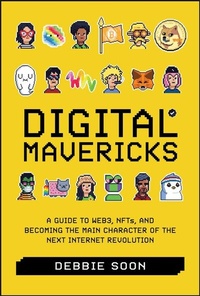
Digital Mavericks
Description

Build a new life and career while shaping our digital future with NFTs and blockchain technology
In Digital Mavericks: A Guide to Web3, NFTs, and Becoming the Main Character in the Next Internet Revolution, founder, NFT collector, and tech entrepreneur Debbie Soon delivers an exciting and eye-opening exploration of the seismic changes and tremendous opportunities that can be found at the intersection of creativity and technology. You'll learn about how blockchain technology and non-fungible tokens (NFTs) are challenging the way we think about our careers and discover inspirational stories behind the personal triumphs and challenges experienced by successful artists, entrepreneurs, and technologists.
This book is a career guide for the new age of the Internet, a world being reshaped by blockchain technology. Despite the countless fortunes Web3 has already created, it remains a space subject to both criticism and skepticism. Digital Mavericks is an easy-to-follow roadmap for those eager to play a part in shaping the future of our increasingly digital world. You'll also find:
- In-depth interviews and stories from movers and shakers in the space such as entrepreneur Randi Zuckerberg, digital art collector Cozomo de Medici, AI artist Claire Silver, technologist Jesse Pollak, and many more.
- An explanation of the evolution of the Internet, the basics of how Web3 works and is being used today, and its historical significance at this moment in time.
- A step-by-step guide on how best to enter and navigate the Web3 space, from understanding and transferring your skillset to finding your community and staying level-headed through the noise.
- Predictions for the future and how we can best prepare ourselves for the impact of regulatory changes and generative AI on blockchain adoption.
An inspiring and insightful take on the Wild West of Web3, Digital Mavericks will prove invaluable for anyone interested in understanding the biggest technological revolution of our generation and how we can all work together in transforming the way we interact, transact, and collaborate with one another.
More details
Other editions
Additional editions
Person
DEBBIE SOON is an entrepreneur, digital art collector, and advocate for increased representation in arts and technology. She is the co-founder and co-CEO of HUG, an inclusive global onchain creative community of 35,000+ members. Debbie is passionate about the future of consumer businesses, and has spent over 10 years investing in and building companies across sports, media, and ecommerce both from the US and her home country of Singapore.
digitalmavericks.xyz
Content
Introduction xi
Part 1 Viva la Revolución 1
Chapter 1 Growing Up with the Internet 3
Meet a Maverick: Randi Zuckerberg
Chapter 2 Taking Back Control 17
Meet a Maverick: Foodmasku
Chapter 3 Of Sliced Bread and Paper 31
Meet a Maverick: Jesse Pollak
Part 2 How to Become a Maverick 47
Chapter 4 Step 1: Identify Your Glow Stick Moment 49
Meet a Maverick: Latashá Copyrighted Material
Chapter 5 Step 2: Understand and Hold On to Your Why 63
Meet a Maverick: Matt Medved and Alejandro Navia
Chapter 6 Step 3: Get Your Hands Dirty 77
Meet a Maverick: Shavonne Wong
Chapter 7 Step 4: Transfer Your Skills 91
Meet a Maverick: Jimena Buena Vida
Chapter 8 Step 5: Join a Cabal or Make Your Own 105
Meet a Maverick: Zeneca
Chapter 9 Step 6: Embrace the Chaos 119
Meet a Maverick: Cozomo de' Medici
Chapter 10 Step 7: Craft and Commit to a Ritual 133
Meet a Maverick: Micah Johnson
Part 3 A New Era 149
Chapter 11 The Robots Are Coming 151
Meet a Maverick: Claire Silver
Chapter 12 A Promised Land of False Starts 165
Meet a Maverick: Li Jin
Chapter 13 Diversity, Equity, and the Inclusiverse 177
Meet a Maverick: Larisa Barbu
Conclusion 189
Glossary 193
Notes 201
Resources 207
Acknowledgments 213
About the Author 217
Index 219
Introduction
It is the year 2018. The movie Crazy Rich Asians is released, becoming the most successful studio romantic comedy in nearly a decade at the US box office. Asians all over the world rejoice - after all, this is the first movie with an all-Asian cast coming out of Hollywood since 1993, and what a successful one at that.
For me, the movie quite literally hit home. Set in Singapore, Crazy Rich Asians was the first thing in the then-30 years of my life that gave the world a frame of reference for what it was like to live and grow up there. As heavily glamorized as the movie was, the picture it painted of Singapore was an undeniable improvement over what many others had until then assumed to be "some part of China."
The Singapore the world knows today resembles little of what I remember growing up in the '80s. Many landmarks that adorn our postcards (do people still send those anymore?) or tourism commercials were built in the last 10-15 years. In fact, I distinctly remember coming back for summer break while studying in college abroad, only to be completely taken aback by what looked like a spaceship perched precariously across three towering buildings. That architectural wonder turned out to be a Vegas-style integrated resort called Marina Bay Sands, and consisted of a casino, hotel, and shopping mall. It would later become a defining part of the city's skyline in years to come, with many of us forgetting that even the land it sits on was a result of man-made intervention (Figure 1).
Yet, as modern and technologically advanced Singapore appears to be, it still upholds socially conservative values, where free speech is considered a Western ideal and privilege that one chooses to pursue at their own peril. Locals are deterred from patronizing the aforementioned casino by being charged an entry levy, while the Singapore government has just started wrapping its head around the decriminalization of gay sex (same-sex marriage remains very much prohibited).
Figure 1 Marina Bay Sands.
Source: Hu Chen/UnSplash
I speak about Singapore so much partly because it has shaped so much of who I am - I was born and raised, and have established most of my career here, despite having since moved to Los Angeles after a pandemic-inspired move. But also because Singapore, a city-state of just 280 square miles with zero natural resources and a mere 59 years of history, epitomizes the spell-binding tension that has stemmed from a constant need to progress and innovate itself out of irrelevance.
Whether we know it yet, we as humans are in the crosshairs of a similar tension. In fact, we may very well be at the juncture of having to reinvent ourselves out of oblivion. The continued advances of blockchain1 technology and now artificial intelligence (AI) represents a real threat that could easily render our place in the workforce, and by extension society, vulnerable. Yet, only a few of us are willing to confront that inevitability, let alone reflect upon our roles in that new reality - be that in the next 1, 5, or 10 years.
Those of us who do are what I like to refer to as mavericks - and more precisely, digital mavericks.
Taking risks, breaking the rules, and being a maverick have always been important but today they are more crucial than ever.
- Gary Hamel, American management consultant
Today, I consider myself very much in the good company of fellow digital mavericks. Despite buying my first cryptocurrency2 in the spring of 2019, it wasn't till the end of 2021 that I started getting intrigued about Web3 (a term used to describe a new evolution of the Internet powered by blockchain technology), and in particular non-fungible tokens3 (NFTs). This was considered late by many - I wasn't an early collector of CryptoPunks or Bored Ape Yacht Club, nor did I really care to be. I was just intrigued by what I saw as an undeniable movement toward the purchasing, consuming, and owning of digital goods. After reading a New York Magazine article published in November 2021 titled "A Normie's Guide to Becoming a Crypto Person,"4 I decided to get my feet wet by resurrecting my presence on X (formerly known as Twitter, and where the last tweet I had posted was probably in 2012), since that was where all the "crypto people" resided online.
According to the New York Magazine article, it was uncool to use my real name or my real photo on Twitter. I found and purchased an NFT of an avatar I liked - a witchy character with a crescent-shaped talisman and covetable long flowing black hair from an NFT collection called Crypto Coven. I also adopted the user handle safronova (Figure 2).
Safronova is actually the last name of a Russian volleyball player that I had seen once on TV during the 2004 Summer Olympics - liking how it sounded (it's a few letters away from the word supernova, which I was particularly fond of due to the song "Champagne Supernova" by British rock band Oasis), I ended up using it as a gaming handle in my teenage years. While I had not gamed for a while, it felt befitting to bring it back as a pseudonym in an environment where it seemed many assumed alternate identities.
Figure 2 My very first NFT.
From there, I started to pen Twitter threads, sharing my learnings and takeaways about Web3, while also joining communities housed in Discord servers and making new friends over the Internet. It was in Discord that I met my now cofounder Randi Zuckerberg (as my witchy Internet self), the creator of Facebook Live as well as multiple-time Tony Award-winning Broadway producer - more on that later.
Together, we are building a company called HUG, a social platform for a new generation of blockchain-curious artists to showcase and sell their work (both on and off the blockchain), while connecting with each other and one-of-a-kind opportunities. Today, we are home to tens of thousands of artists across more than 160 different countries.
Through HUG, I am fortunate to work and interact with artists daily. Not only am I surrounded and inspired by creativity every single day, but I also get to see and experience firsthand how blockchain technology is evolving and creating new opportunities for these creators turned creative entrepreneurs.
Building on the front lines of Web3 is both empowering and lonely. There are days when it feels as if I am leading the charge in a revolution against Big Tech, seizing back control for the proletariat of everyday creators through the promise of true ownership. Most days, not only does the road ahead feel like June Gloom5 in LA - most of the people in my personal life and even those I am advocating for (i.e. artists who have not yet dived into the world of NFTs) have little idea of what I do. "What the heck is an NFT anyway?" they say. "Isn't crypto just full of scammers?"
Like many other books written about Web3, Digital Mavericks is a time capsule, simply because of how much this space is about to evolve. That said, this is also an intentional snapshot of all the risk-takers who are making history as we speak.
There's a saying widely attributed to Winston Churchill that goes, "History is written by the victors." In my mind, that has never been a fair representation of what history is or should be (Mr. Miles, my high school history teacher, will be proud). Moreover, this characterization feels exceedingly unfair for something like Web3 - a technology, but more importantly a movement that is so deeply rooted in and driven by community. In fact, years down the road, my wish is for us to come out the other end fixated less on who's won and who's lost, but more so on what we have learned and on the change that we have fought for and inspired.
By the end of this book, I hope that you will have a deeper understanding of what Web3 is, why you should care, and why there are so many of us here breaking rules and challenging the status quo. More importantly, I also hope to convince you that you too have a place in this revolution if you choose to participate.
Do not get me wrong - Web3 is not perfect, be it the technology, the culture, how it is branded, and more. What I do know is that we are still early, yes - even in 2024, despite the first cryptocurrency (Bitcoin!) being created in 2009 and the first NFT being minted6 (meaning, to be created on the blockchain) in 2014. I do not know about you, but I believe that anytime you are early to something is an opportunity to choose the role you would like to play, as well as shape the experience you'd like to have within it.
There is an equally high probability that after reading this you may think that Web3 and everything it entails (blockchain technology, crypto, NFTs, etc.) is not for you. You may even decide that you want nothing to do with it (even though my personal belief is that it will become ingrained in our lives without us realizing it). That's okay too.
Digital Mavericks is also meant to be an anthology - a collection of stories about everyday people like myself who have discovered a new sense of purpose and calling since encountering Web3. And while the whole idea of being on the cutting edge of emerging tech has been a huge part of that, I think you...
