

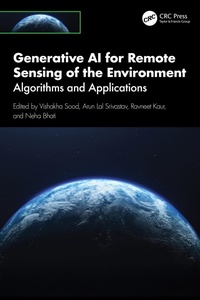
Generative AI for Remote Sensing of the Environment
Algorithms and Applications
1st Edition
Published on 14. April 2026
324 pages
978-1-040-56232-1 (ISBN)
Description

This book explores the cutting-edge integration of generative artifical intelligence (AI) techniques to enhance environmental remote sensing, providing a comprehensive guide from foundational algorithms to practical applications. It explains how advanced AI technology can be used to improve the way we monitor and understand the environment from a distance, such as through satellites or drones. It starts with an explanation of basic algorithms behind generative AI and gradually moves to complex algorithms, showing how they can be applied to real-world environmental issues, such as tracking climate change, monitoring deforestation, and predicting natural disasters.
Features
Includes real-world examples and case studies showing how generative AI improves environmental monitoring.
Provides step-by-step explanations of algorithms and their implementation.
Explains complex concepts in simple and easy-to-understand language and introduces strategies to address environmental challenges using AI-driven solutions.
Offers cutting-edge research and advancements in AI and remote sensing, including the application of generative AI models like GANs and VAEs.
Applies to diverse fields such as urban planning, agriculture, and disaster management.
Discusses ethical considerations and challenges when integrating AI with remote sensing.
This book is for researchers and practitioners in environmental monitoring, urban planning, agriculture, and disaster management using remote sensing technologies and AI to address environmental challenges and sustainability. It is also intended for university professors, graduate, and postgraduate students in environmental science, geospatial analysis, computer science, and data science working on projects related to AI and remote sensing.
Features
Includes real-world examples and case studies showing how generative AI improves environmental monitoring.
Provides step-by-step explanations of algorithms and their implementation.
Explains complex concepts in simple and easy-to-understand language and introduces strategies to address environmental challenges using AI-driven solutions.
Offers cutting-edge research and advancements in AI and remote sensing, including the application of generative AI models like GANs and VAEs.
Applies to diverse fields such as urban planning, agriculture, and disaster management.
Discusses ethical considerations and challenges when integrating AI with remote sensing.
This book is for researchers and practitioners in environmental monitoring, urban planning, agriculture, and disaster management using remote sensing technologies and AI to address environmental challenges and sustainability. It is also intended for university professors, graduate, and postgraduate students in environmental science, geospatial analysis, computer science, and data science working on projects related to AI and remote sensing.
More details
Edition
1. Auflage
Language
English
Place of publication
London
United Kingdom
Publishing group
Taylor & Francis Ltd
Target group
College/higher education
Professional and scholarly
Illustrations
37 Tables, black and white; 17 Line drawings, color; 38 Line drawings, black and white; 22 Halftones, color; 17 Halftones, black and white; 39 Illustrations, color; 55 Illustrations, black and white
File size
49,70 MB
ISBN-13
978-1-040-56232-1 (9781040562321)
Copyright in bibliographic data and cover images is held by Nielsen Book Services Limited or by the publishers or by their respective licensors: all rights reserved.
Schweitzer Classification
Other editions
Additional editions
Vishakha Sood | Arun Lal Srivastav | Ravneet Kaur
Generative AI for Remote Sensing of the Environment
Algorithms and Applications
Book
04/2026
1st Edition
CRC Press
€160.50
Shipment within 15-20 days
Persons
Dr. Vishakha Sood is working as a Scientist at the Indian Institute of Technology, Ropar, Punjab under the Women Scientist Scheme (WOS-A) by the Department of Science and Technology (DST), Govt. of India. She is also the founder of a company named Aiotronics Automation Pvt.Ltd. She has more than 10 years of academic and research experience and received her PhD in Electronics and Communication Engineering from Chitkara University, Punjab in 2020. She has authored more than 15 SCI-indexed articles and SCOPUS indexed book chapters and holds many inventions. Her research interests include satellite sensors, remote sensing, and digital image analysis. She is IEEE Senior Member and active member of various societies such as Indian Society of Remote Sensing (ISRS), and European Geoscience Union (EGU), among others.
Dr Arun Lal Srivastav is an Associate Professor at Chitkara University School of Engineering and Technology in Himachal Pradesh, India. He received his PhD from the Indian Institute of Technology (BHU), Varanasi in water treatment. His research interests include water quality surveillance, climate change, water treatment, river ecosystem, soil health maintenance, etc. He has published over 100 research papers in various prestigious journals and has edited several books. He received the prestigious Teachers Associateship for Research Excellence (TARE) Fellowship and holds 12 patents on multidisciplinary topics granted by the Government of India.
Ravneet Kaur is working at the Chandigarh University, India and is pursuing her Ph.D. in Computer Science Engineering from Punjabi University, Patiala, Punjab, India. She has more than 15 years of research and teaching experience from Shaheed Udham Singh College of Engineering and Technology, India and Continental Institute of Engineering and Technology, India, and has authored SCI and Scopus Indexed articles and holds several patents. Her area of interest includes image analysis, machine learning, and deep learning.
Neha Bhati is a Research Associate at Flexxited, Bangalore, contributing to pioneering research in Remote Sensing, the Internet of Things (IoT), Machine Learning and Deep Learning. She is a reviewer of journal articles and conference papers.
Dr Arun Lal Srivastav is an Associate Professor at Chitkara University School of Engineering and Technology in Himachal Pradesh, India. He received his PhD from the Indian Institute of Technology (BHU), Varanasi in water treatment. His research interests include water quality surveillance, climate change, water treatment, river ecosystem, soil health maintenance, etc. He has published over 100 research papers in various prestigious journals and has edited several books. He received the prestigious Teachers Associateship for Research Excellence (TARE) Fellowship and holds 12 patents on multidisciplinary topics granted by the Government of India.
Ravneet Kaur is working at the Chandigarh University, India and is pursuing her Ph.D. in Computer Science Engineering from Punjabi University, Patiala, Punjab, India. She has more than 15 years of research and teaching experience from Shaheed Udham Singh College of Engineering and Technology, India and Continental Institute of Engineering and Technology, India, and has authored SCI and Scopus Indexed articles and holds several patents. Her area of interest includes image analysis, machine learning, and deep learning.
Neha Bhati is a Research Associate at Flexxited, Bangalore, contributing to pioneering research in Remote Sensing, the Internet of Things (IoT), Machine Learning and Deep Learning. She is a reviewer of journal articles and conference papers.
Content
Section A: Introduction to Gen AI. 1. Introduction To Generative AI And Its Role in Remote Sensing. 2. Core Concepts of Understanding Generative AI Algorithms and Models. 3. The Use of Generative AI in Environmental Remote Sensing. 4. Vision-Language Models in Remote Sensing: Balancing Geospatial Intelligence with Ethical and Responsible AI Practices. 5. Advanced Large Language Models for Satellite Image Processing. 6. Tools and Software Essential Resources for AI Integration. Section B: Applications and Case Studies of Gen AI in Remote Sensing. 7. Remote Sensing Satellite Datasets, Preprocessing Techniques, and Tools for Agricultural Land Cover Classification. 9. Implementing Artificial Intelligence-Based Algorithms for Sustainable Environmental Monitoring. 10. Data Preparation, Collecting, Cleaning, and Managing Datasets in Generative AI. 11. High-Resolution Soil Erosion Mapping for the Narmada Basin: A RUSLE-Google Earth Engine Synergy. 12. AI Integration in Agriculture: Tools, Software, and Frameworks for Sustainable Farming. 13. Agriculture Using Generative AI for Crop Management. Section C: Resources, Challenges, and the Future of Gen AI in Remote Sensing. 14. Harnessing AI to Unveil the Future: Modelling and Forecasting Climate Change Effects. 15. Real-World Applications, Success Stories, and Industry Insights. 16. Challenges with Practical Solutions and Case Studies. 17. Future Trends Innovations in AI and Remote Sensing.
