

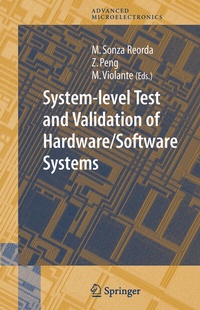
System-level Test and Validation of Hardware/Software Systems
Description

New manufacturing technologies have made possible the integration of entire systems on a single chip. This new design paradigm, termed system-on-chip (SOC), together with its associated manufacturing problems, represents a real challenge for designers.
SOC is also reshaping approaches to test and validation activities. These are beginning to migrate from the traditional register-transfer or gate levels of abstraction to the system level. Until now, test and validation have not been supported by system-level design tools so designers have lacked the infrastructure to exploit all the benefits stemming from the adoption of the system level of abstraction. Research efforts are already addressing this issue.
This monograph provides a state-of-the-art overview of the current validation and test techniques by covering all aspects of the subject including:
- modeling of bugs and defects;
- stimulus generation for validation and test purposes (including timing errors;
- design for testability.
More details
Other editions
Additional editions
Persons
Matteo Sonza Reorda is the leader of the computer-aided design group of the Dipartimento di Automatica e Informatica, Politecnico di Torino. Zebo Peng is Professor of the chair in Computer Systems and Director of the Embedded Systems Laboratory at Linköping University.
