

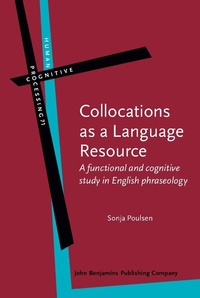
Collocations as a Language Resource
A functional and cognitive study in English phraseology
1st Edition
Published on 8. April 2022
364 pages
978-90-272-5798-7 (ISBN)
Description

Are collocations problems or solutions to problems? If you take the perspective of the foreign learner, as in traditional phraseology, they are certainly challenging, and they have therefore been categorized as arbitrary, or even defective, deviations from an assumed norm of full compositionality. This is a paradox because their ubiquity in language and their importance for language proficiency are undisputed. The book provides a critical review of the traditional phraseological approach to collocations with its classical categories and its roots in structural and generative linguistics as well as traditional Russian phraseology. Instead, it proposes a theory of collocations as an independent functional domain, no longer characterized as "odd comings-together of words" that are neither fully compositional nor fully idiomatic. It fills a research gap and should appeal to phraseologists and cognitive linguists as well as psycholinguists, neurolinguists, corpus linguists, PhD-students and other advanced students of linguistics who are interested in exploring collocations as a language resource and may be interested in contributing to it.
More details
Other editions
Additional editions
Sonja Poulsen
Collocations as a Language Resource
A functional and cognitive study in English phraseology
Book
04/2022
John Benjamins Publishing Co
€123.50
Shipment within 10-15 days
Content
- Intro
- Collocations as a Language Resource
- Editorial page
- Title page
- Copyright page
- Table of contents
- Preface and acknowledgements
- List of figures
- List of tables
- Chapter 1. Introduction
- 1.1 An outline of the traditional phraseological approach to collocations
- 1.2 What is a 'collocation'?
- 1.3 Problems of categorization in the traditional approach
- 1.4 Motivation for a functional and cognitive approach
- 1.5 What should a theory of collocations account for?
- 1.6 A brief overview of the book
- Chapter 2. The foundations of the phraseological approach
- 2.1 Theoretical influences on phraseology
- 2.1.1 A practical concern: Teaching English as a foreign language
- 2.1.2 Firthian linguistics
- 2.1.3 Underlying assumptions
- 2.1.4 Russian phraseology
- 2.1.5 A cognitive strand
- 2.2 The categorization of collocations in the phraseological approach
- 2.2.1 Collocations as syntactic units
- 2.2.2 Institutionalization
- 2.2.3 The absence of full compositionality
- 2.2.4 Restricted compositionality as a criterial feature
- 2.2.5 Analysability, compositionality and the literal/figurative distinction
- 2.3 Summary and conclusions
- Chapter 3. Collocations in a functional and cognitive framework
- 3.1 What is 'cognitive' and what is 'functional' about language?
- 3.2 Methodological issues
- 3.2.1 Corpus studies, frequency, and prototypicality
- 3.2.2 Linguistic evidence of cognitive routines
- 3.2.3 Synchronic evidence of diachronic processes
- 3.3 Introduction to the empirical part
- 3.3.1 Research questions and motivation
- 3.3.2 Design of case study
- 3.3.3 A general presentation of the data
- 3.4 Case study: Break an appointment
- 3.4.1 How to approach the analysis of a complex category
- 3.4.2 The internal structure of break
- 3.4.3 The internal structure of appointment
- 3.4.4 The integration of break and appointment
- 3.5 Summary of findings related to research questions
- 3.5.1 To what extent are conventional and entrenched collocations like other composite structures?
- 3.5.2 In what respects are conventional and entrenched collocations special?
- 3.5.3 Can conventional and entrenched collocations be characterized in terms of salience?
- 3.5.4 Do verbs in conventional and entrenched collocations function as support verbs, and does this imply grammaticalization?
- 3.5.5 Concluding remarks on research questions
- Chapter 4. Collocations as a language resource: Winding up
- 4.1 Evaluation of methodology
- 4.2 Theoretical implications
- 4.3 Much more to do
- References
- Dictionaries, text books and general reference books
- Databases
- Name index
- Subject index
