

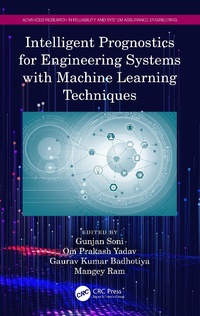
Intelligent Prognostics for Engineering Systems with Machine Learning Techniques
1st Edition
Published on 22. September 2023
260 pages
978-1-000-95410-4 (ISBN)
Description

The text discusses the latest data-driven, physics-based, and hybrid approaches employed in each stage of industrial prognostics and reliability estimation. It will be a useful text for senior undergraduate, graduate students, and academic researchers in areas such as industrial and production engineering, electrical engineering, and computer science.
The book
Discusses basic as well as advance research in the field of prognostics
Explores integration of data collection, fault detection, degradation modeling and reliability prediction in one volume
Covers prognostics and health management (PHM) of engineering systems
Discusses latest approaches in the field of prognostics based on machine learning
The text deals with tools and techniques used to predict/ extrapolate/ forecast the process behavior, based on current health state assessment and future operating conditions with the help of Machine learning. It will serve as a useful reference text for senior undergraduate, graduate students, and academic researchers in areas such as industrial and production engineering, manufacturing science, electrical engineering, and computer science.
The book
Discusses basic as well as advance research in the field of prognostics
Explores integration of data collection, fault detection, degradation modeling and reliability prediction in one volume
Covers prognostics and health management (PHM) of engineering systems
Discusses latest approaches in the field of prognostics based on machine learning
The text deals with tools and techniques used to predict/ extrapolate/ forecast the process behavior, based on current health state assessment and future operating conditions with the help of Machine learning. It will serve as a useful reference text for senior undergraduate, graduate students, and academic researchers in areas such as industrial and production engineering, manufacturing science, electrical engineering, and computer science.
More details
Series
Edition
1. Auflage
Language
English
Place of publication
London
United Kingdom
Publishing group
Taylor & Francis Ltd
Target group
College/higher education
Product notice
Reflowable
Illustrations
64 Tables, black and white; 122 Line drawings, black and white; 11 Halftones, black and white; 112 Illustrations, color; 21 Illustrations, black and white
ISBN-13
978-1-000-95410-4 (9781000954104)
Copyright in bibliographic data and cover images is held by Nielsen Book Services Limited or by the publishers or by their respective licensors: all rights reserved.
Schweitzer Classification
Other editions
Additional editions
Gunjan Soni | Om Prakash Yadav | Gaurav Kumar Badhotiya
Intelligent Prognostics for Engineering Systems with Machine Learning Techniques
Book
12/2024
1st Edition
CRC Press
€87.00
Shipment within 10-20 days
Gunjan Soni | Om Prakash Yadav | Gaurav Kumar Badhotiya
Intelligent Prognostics for Engineering Systems with Machine Learning Techniques
Book
09/2023
1st Edition
CRC Press
€186.20
Shipment within 10-20 days
Persons
Gunjan Soni holds a BE from University of Rajasthan, MTech from IIT, Delhi, and PhD from Birla Institute of Technology and Science, Pilani, in 2012. He is presently working as an assistant professor in Department of Mechanical Engineering, Malaviya National Institute of Technology, Jaipur, Rajasthan, India. He has over 17 years of teaching experience at undergraduate and graduate levels. His areas of research interest are predictive maintenance and digital technology applications in supply chain management. He has published more than 80 papers in peer-reviewed journals including Journal of Business Research, Expert System with Applications, IEEE Transactions on Engineering Management, Production Planning and Control, Supply Chain Management: An International Journal, Annals of Operations Research, Computers and Industrial Engineering, International Journal of Logistics Research and Applications, etc. He is guest editor of special issues in journals like International Journal of Logistics Management, Sustainability, International Journal of Intelligent Enterprise, etc.
Om Prakash Yadav is a professor and Duin Endowed Fellow in the Department of Industrial and Manufacturing Engineering at North Dakota State University, Fargo. He holds a PhD in Industrial Engineering from Wayne State University, MS in Industrial Engineering from National Institute of Industrial Engineering Mumbai (India), and BS in Mechanical Engineering from Malaviya National Institute of Technology, Jaipur (India). His research interests include reliability modeling and analysis, risk assessment, design optimization, robust design, and manufacturing systems analysis. The research work of his group has been published in high-quality journals such as Reliability Engineering and Systems Safety, Journal of Risk and Reliability, Quality and Reliability Engineering International, and Engineering Management Journal. He has published over 130 papers in peer-reviewed journals and conference proceedings in the area of quality, reliability, product development, and operations management. Dr. Yadav is a recipient of the 2015 and 2018 IISE William A.J. Golomski best paper awards. He is currently a member of IISE, ASQ, SRE, and INFORMS.
Gaurav Kumar Badhotiya is currently an assistant professor in the Faculty of Management Studies, Marwadi University, Rajkot, Gujarat, India. He holds a PhD in Industrial Engineering and MTech in Manufacturing System Engineering from Malaviya National Institute of Technology, Jaipur, Rajasthan, India. His BTech is in Production and Industrial Engineering from the University College of Engineering, Kota, Rajasthan, India. Dr. Gaurav's research interests are inclined toward areas in operations and supply chain management, such as supply chain resilience, production planning, circular economy, and sustainability. He has published more than 50 research articles in various peer-reviewed international journals, book chapters, and conferences proceedings. He is an editorial board member of International Journal of Mathematical, Engineering and Management Sciences. He has organized two Scopus Indexed International Conferences and a Faculty Development Program on Research Methodology and Data Analysis.
Mangey Ram holds a Ph.D. degree major in Mathematics and minor in Computer Science from G.B. Pant University of Agriculture and Technology, Pantnagar, India (2008). He is currently a research professor at Graphic Era (Deemed to be University), Dehradun, India, and a visiting professor at Peter the Great St. Petersburg Polytechnic University, Saint Petersburg, Russia. He is editor in chief of International Journal of Mathematical, Engineering and Management Sciences, Journal of Reliability and Statistical Studies, and Journal of Graphic Era University; series editor of six book series with Elsevier, CRC Press-A Taylor and Frances Group, Walter De Gruyter Publisher Germany, and River Publishers, and a guest editor and associate editor with various journals. He has published 300-plus publications (journal articles/books/book chapters/conference articles) in IEEE, Taylor & Francis, Springer Nature, Elsevier, Emerald, World Scientific, and many other national and international journals and conferences. Also, he has published more than 60 books (authored/edited) with international publishers like Elsevier, Springer Nature, CRC Press-A Taylor and Frances Group, Walter De Gruyter Publisher Germany, and River Publishers. His fields of research are reliability theory and applied mathematics. Dr. Ram is a senior member of the IEEE, senior life member of Operational Research Society of India, Society for Reliability Engineering, Quality and Operations Management in India, and Indian Society of Industrial and Applied Mathematics. He has been a member of the organizing committee of a number of international and national conferences, seminars, and workshops.
Om Prakash Yadav is a professor and Duin Endowed Fellow in the Department of Industrial and Manufacturing Engineering at North Dakota State University, Fargo. He holds a PhD in Industrial Engineering from Wayne State University, MS in Industrial Engineering from National Institute of Industrial Engineering Mumbai (India), and BS in Mechanical Engineering from Malaviya National Institute of Technology, Jaipur (India). His research interests include reliability modeling and analysis, risk assessment, design optimization, robust design, and manufacturing systems analysis. The research work of his group has been published in high-quality journals such as Reliability Engineering and Systems Safety, Journal of Risk and Reliability, Quality and Reliability Engineering International, and Engineering Management Journal. He has published over 130 papers in peer-reviewed journals and conference proceedings in the area of quality, reliability, product development, and operations management. Dr. Yadav is a recipient of the 2015 and 2018 IISE William A.J. Golomski best paper awards. He is currently a member of IISE, ASQ, SRE, and INFORMS.
Gaurav Kumar Badhotiya is currently an assistant professor in the Faculty of Management Studies, Marwadi University, Rajkot, Gujarat, India. He holds a PhD in Industrial Engineering and MTech in Manufacturing System Engineering from Malaviya National Institute of Technology, Jaipur, Rajasthan, India. His BTech is in Production and Industrial Engineering from the University College of Engineering, Kota, Rajasthan, India. Dr. Gaurav's research interests are inclined toward areas in operations and supply chain management, such as supply chain resilience, production planning, circular economy, and sustainability. He has published more than 50 research articles in various peer-reviewed international journals, book chapters, and conferences proceedings. He is an editorial board member of International Journal of Mathematical, Engineering and Management Sciences. He has organized two Scopus Indexed International Conferences and a Faculty Development Program on Research Methodology and Data Analysis.
Mangey Ram holds a Ph.D. degree major in Mathematics and minor in Computer Science from G.B. Pant University of Agriculture and Technology, Pantnagar, India (2008). He is currently a research professor at Graphic Era (Deemed to be University), Dehradun, India, and a visiting professor at Peter the Great St. Petersburg Polytechnic University, Saint Petersburg, Russia. He is editor in chief of International Journal of Mathematical, Engineering and Management Sciences, Journal of Reliability and Statistical Studies, and Journal of Graphic Era University; series editor of six book series with Elsevier, CRC Press-A Taylor and Frances Group, Walter De Gruyter Publisher Germany, and River Publishers, and a guest editor and associate editor with various journals. He has published 300-plus publications (journal articles/books/book chapters/conference articles) in IEEE, Taylor & Francis, Springer Nature, Elsevier, Emerald, World Scientific, and many other national and international journals and conferences. Also, he has published more than 60 books (authored/edited) with international publishers like Elsevier, Springer Nature, CRC Press-A Taylor and Frances Group, Walter De Gruyter Publisher Germany, and River Publishers. His fields of research are reliability theory and applied mathematics. Dr. Ram is a senior member of the IEEE, senior life member of Operational Research Society of India, Society for Reliability Engineering, Quality and Operations Management in India, and Indian Society of Industrial and Applied Mathematics. He has been a member of the organizing committee of a number of international and national conferences, seminars, and workshops.
Content
Chapter 1: A Bibliometric Analysis of Research on Tool Condition Monitoring
Jeetesh Sharma, M.L. Mittal, Gunjan Soni
1.1 Introduction
1.2 Data Collection and Research Methodology
1.3 Bibliometric Analysis
1.4 Conclusion
Chapter 2: Predicting Restoration Factor for Different Maintenance Types
Neeraj Kumar Goyal, Tapash Kumar Das, Namrata Mohanty
2.1 Introduction
2.2 Proposed Model
2.3 Case Study
2.4 Conclusion
Chapter 3: Measurement and Modeling of Cutting Tool Temperature during Dry Turning Operation of DSS
P. Kumar, O.P.Yadav
3.1. Introduction
3.2. Materials and methods
3.3. Results and discussion
3.4. Empirical Modeling
3.5. Conclusions
Chapter 4: Leaf disease recognition: Comparative Analysis of Various Convolutional Neural Network Algorithms
Vikas Kumar Roy, Ganpati Kumar Roy, Vasu Thakur, Nikhil Baliyan, Nupur Goyal
4.1 Introduction
4.2 Literature Review
4.3 Dataset
4.4 Methodology
4.5 Results and discussion
4.6 Conclusion
Chapter 5: On the Validity of Parallel Plate Assumption for Modelling Leakage Flow past Hydraulic Piston-Cylinder Configurations
Rishabh Gupta, Jatin Prakash, Ankur Miglani, Pavan Kumar Kankar
5.1 Introduction
5.2 The Leakage Flow Models
5.3 Results and discussion
5.4 Concluding remarks
Chapter 6: Development of a hybrid MGWO-optimized Support vector machine approach for tool wear estimation
N. Rajpurohit, Jeetesh Sharma, M. L. Mittal
6.1 Introduction
6.2 Materials and methods
6.3 Results and discussion
6.4 Conclusion and future work
Chapter 7: The Energy Consumption Optimization Using Machine Learning Technique in Electrical Arc Furnaces (EAF)
Rishabh Dwivedi, Ashutosh Mishra, Devesh Kumar, Amitkumar Patil
7.1 Introduction:
7.2 Literature Review
7.3 Methodology
7.4 Result and Discussion
7.4.1Managerial Implications
7.5 Conclusion Limitations and Future scope
Chapter 8: PID based ANN control of Dynamic Systems
A. Kharola
8.1 Introduction
8.2 Mathematical modeling of inverted double pendulum
8.3 PID based ANN control of Inverted double pendulum System
8.4 Simulation & Results Comparison
8.5 Conclusion
Chapter 9: Fatigue Damage Prognosis of Offshore Piping
A. Keprate, N. Bagalkot
9.1 Introduction
9.2 Understanding Piping Fatigue
9.3 Fatigue Damage Prognosis
9.4 Case Study
9.5 Conclusion
Chapter 10: Minimization of Joint Angle Jerk for Industrial Manipulator based on Prognostic Behaviour
Vaishnavi J, Bharat Singh, Ankit Vijayvargiya, Rajesh Kumar
10.1 Introduction
10.2 System Description
10.3 Algorithms and Objective functions
10.3.1 Objective Function
10.3.2 Modified Objective Function
10.3.3 Particle Swarm Optimization (PSO)
10.4 Results and Discussion
10.5 Conclusion
Chapter 11: Estimation of bearing remaining useful life using exponential degradation model and random forest algorithm
Pawan, Jeetesh Sharma, M. L. Mittal
11.1 Introduction
11.2 The proposed RUL estimate approach
11.3 Experimental result and Discussion
11.4 Conclusion
Chapter 12: Machine Learning-based Predictive Maintenance for Diagnostics and Prognostics of Engineering Systems
Ramnath Prabhu Bam, Rajesh S. Prabhu Gaonkar, Clint Pazhayidam George
12.1 Introduction and Overview
12.2 Diagnostics and Prognostics based on Predictive Maintenance
12.3 Machine Learning for Predictive Maintenance
12.4 Machine learning-based Predictive Maintenance in Engineering Systems
12.5 Summary
Jeetesh Sharma, M.L. Mittal, Gunjan Soni
1.1 Introduction
1.2 Data Collection and Research Methodology
1.3 Bibliometric Analysis
1.4 Conclusion
Chapter 2: Predicting Restoration Factor for Different Maintenance Types
Neeraj Kumar Goyal, Tapash Kumar Das, Namrata Mohanty
2.1 Introduction
2.2 Proposed Model
2.3 Case Study
2.4 Conclusion
Chapter 3: Measurement and Modeling of Cutting Tool Temperature during Dry Turning Operation of DSS
P. Kumar, O.P.Yadav
3.1. Introduction
3.2. Materials and methods
3.3. Results and discussion
3.4. Empirical Modeling
3.5. Conclusions
Chapter 4: Leaf disease recognition: Comparative Analysis of Various Convolutional Neural Network Algorithms
Vikas Kumar Roy, Ganpati Kumar Roy, Vasu Thakur, Nikhil Baliyan, Nupur Goyal
4.1 Introduction
4.2 Literature Review
4.3 Dataset
4.4 Methodology
4.5 Results and discussion
4.6 Conclusion
Chapter 5: On the Validity of Parallel Plate Assumption for Modelling Leakage Flow past Hydraulic Piston-Cylinder Configurations
Rishabh Gupta, Jatin Prakash, Ankur Miglani, Pavan Kumar Kankar
5.1 Introduction
5.2 The Leakage Flow Models
5.3 Results and discussion
5.4 Concluding remarks
Chapter 6: Development of a hybrid MGWO-optimized Support vector machine approach for tool wear estimation
N. Rajpurohit, Jeetesh Sharma, M. L. Mittal
6.1 Introduction
6.2 Materials and methods
6.3 Results and discussion
6.4 Conclusion and future work
Chapter 7: The Energy Consumption Optimization Using Machine Learning Technique in Electrical Arc Furnaces (EAF)
Rishabh Dwivedi, Ashutosh Mishra, Devesh Kumar, Amitkumar Patil
7.1 Introduction:
7.2 Literature Review
7.3 Methodology
7.4 Result and Discussion
7.4.1Managerial Implications
7.5 Conclusion Limitations and Future scope
Chapter 8: PID based ANN control of Dynamic Systems
A. Kharola
8.1 Introduction
8.2 Mathematical modeling of inverted double pendulum
8.3 PID based ANN control of Inverted double pendulum System
8.4 Simulation & Results Comparison
8.5 Conclusion
Chapter 9: Fatigue Damage Prognosis of Offshore Piping
A. Keprate, N. Bagalkot
9.1 Introduction
9.2 Understanding Piping Fatigue
9.3 Fatigue Damage Prognosis
9.4 Case Study
9.5 Conclusion
Chapter 10: Minimization of Joint Angle Jerk for Industrial Manipulator based on Prognostic Behaviour
Vaishnavi J, Bharat Singh, Ankit Vijayvargiya, Rajesh Kumar
10.1 Introduction
10.2 System Description
10.3 Algorithms and Objective functions
10.3.1 Objective Function
10.3.2 Modified Objective Function
10.3.3 Particle Swarm Optimization (PSO)
10.4 Results and Discussion
10.5 Conclusion
Chapter 11: Estimation of bearing remaining useful life using exponential degradation model and random forest algorithm
Pawan, Jeetesh Sharma, M. L. Mittal
11.1 Introduction
11.2 The proposed RUL estimate approach
11.3 Experimental result and Discussion
11.4 Conclusion
Chapter 12: Machine Learning-based Predictive Maintenance for Diagnostics and Prognostics of Engineering Systems
Ramnath Prabhu Bam, Rajesh S. Prabhu Gaonkar, Clint Pazhayidam George
12.1 Introduction and Overview
12.2 Diagnostics and Prognostics based on Predictive Maintenance
12.3 Machine Learning for Predictive Maintenance
12.4 Machine learning-based Predictive Maintenance in Engineering Systems
12.5 Summary
