

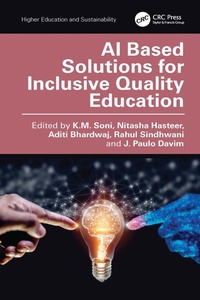
AI Based Solutions for Inclusive Quality Education
Published on 30. September 2025
158 pages
978-1-040-41974-8 (ISBN)
Description

AI Based Solutions for Inclusive Quality Education helps readers discover practical AI tools for diverse learning styles and abilities, fostering inclusivity in education and maximizing the individual potential of students and educators. It provides cutting-edge solutions designed to remove barriers due to accessibility and create an equitable classroom. Through practical applications and case studies, the book explores the power of AI in creating personalized learning pathways and methods of engagement in the classroom while emphasizing that the human touch, with empathy and critical thinking, remains central to the learning process. It addresses concerns about the ethical development and deployment of AI in education.
Features
Discusses a topic that is at the forefront of concerns in the education sector with the disruptive impact of advances in AI
Provides explanations for specific AI platforms and tools, along with their features and applications in education
Includes case studies and discusses inclusivity and the lessons learned from each AI application
Explains how to ethically handle bias, privacy and transparency in AI-based solutions in education
Serves as a comprehensive guide for educators, policymakers and technology developers interested in the power of AI in educational environments
This book serves as a timely reference in the current era of AI tools and education. It is written for those who work in the education sector, as well as researchers, academicians, undergraduate and graduate students, those involved with undergraduate teaching in critical thinking and problem-solving for information systems, information technology, computer science and engineering and all teaching institutions where AI tools have been or will be introduced.
Features
Discusses a topic that is at the forefront of concerns in the education sector with the disruptive impact of advances in AI
Provides explanations for specific AI platforms and tools, along with their features and applications in education
Includes case studies and discusses inclusivity and the lessons learned from each AI application
Explains how to ethically handle bias, privacy and transparency in AI-based solutions in education
Serves as a comprehensive guide for educators, policymakers and technology developers interested in the power of AI in educational environments
This book serves as a timely reference in the current era of AI tools and education. It is written for those who work in the education sector, as well as researchers, academicians, undergraduate and graduate students, those involved with undergraduate teaching in critical thinking and problem-solving for information systems, information technology, computer science and engineering and all teaching institutions where AI tools have been or will be introduced.
More details
Series
Language
English
Place of publication
London
United Kingdom
Publishing group
Taylor & Francis Ltd
Target group
College/higher education
Professional and scholarly
Illustrations
7 Tables, black and white; 13 Line drawings, black and white; 13 Illustrations, black and white
File size
7,54 MB
ISBN-13
978-1-040-41974-8 (9781040419748)
Copyright in bibliographic data and cover images is held by Nielsen Book Services Limited or by the publishers or by their respective licensors: all rights reserved.
Schweitzer Classification
Other editions
Additional editions
K.M. Soni | Nitasha Hasteer | Aditi Bhardwaj
AI Based Solutions for Inclusive Quality Education
Book
09/2025
1st Edition
CRC Press
€132.60
Shipment within 10-20 days
Persons
K.M. Soni is a Professor at Amity School of Engineering & Technology, Dy. Dean (Eng. & Tech.), In-charge of Ph.D. Dept. AUUP. He has over 25 years of teaching, research, and academic administrative experience. He has authored several books on Circuits and Systems, Signals and Systems, and Advanced Control Systems etc. He has authored over 50 technical research papers in refereed conferences and journals and has served as a Reviewer, Programme Committee Member, and Session Chair of National & International Conferences in India and abroad. He is an Assessor of the National Assessment and Accreditation Council (NAAC), Govt. of India. His current research interests are in Power Electronics, Power Systems, Advanced Control Systems, Signal Processing, IoT, Artificial Intelligence, Education Technology, and other related areas.
Nitasha Hasteer is a Professor & Head of the Information Technology Department, and Deputy Director (Academics) at the Amity School of Engineering & Technology, Amity University Uttar Pradesh. She holds a Ph.D. in Computer Science & Engineering and has over 24 years of teaching, research, and consultancy experience across academia and industry. Her primary research interests lie in Education Technology, Crowdsourced Software Development, Software Project Management, and Process Modeling using Multi-Criteria Decision-Making Techniques. Dr. Hasteer has made significant contributions to these fields, publishing more than 80 research papers in renowned international journals & conferences and has served on the editorial boards of several high-impact international conferences and journals.
Aditi Bhardwaj is an Assistant Professor in the Computer Science and Engineering Department at Amity University, Noida Uttar Pradesh. With over five years of teaching and research experience, Dr. Bhardwaj has established herself as a respected authority in Artificial Intelligence and Machine Learning. Her research contributions have been widely published by IEEE, Elsevier, Taylor & Francis etc. She has been an editor and co-editor of various books published by different publishers.
Rahul Sindhwani is an Assistant Professor at the Indian Institute of Management, Sambalpur- Odisha, India. With over 10 years of experience in teaching and research, he has made significant contributions to the academic community through his research work, which has been published in highly regarded journals. His expertise lies in the areas of Decision Science, Quantitative Techniques, Sustainability, Operations Management, etc.
J. Paulo Davim is a Professor at the Department of Mechanical Engineering of the University of Aveiro, Portugal. He has more than 30 years of teaching and research experience in Manufacturing, Materials, Mechanical and Industrial Engineering, Engineering Education and Higher Education for Sustainability. Presently, he is an Editorial Board member of 30 international journals, has published as editor and co-editor more than 125 books and as author and co-author more than 10 books, 80 book chapters and 400 articles in journals and conferences.
Nitasha Hasteer is a Professor & Head of the Information Technology Department, and Deputy Director (Academics) at the Amity School of Engineering & Technology, Amity University Uttar Pradesh. She holds a Ph.D. in Computer Science & Engineering and has over 24 years of teaching, research, and consultancy experience across academia and industry. Her primary research interests lie in Education Technology, Crowdsourced Software Development, Software Project Management, and Process Modeling using Multi-Criteria Decision-Making Techniques. Dr. Hasteer has made significant contributions to these fields, publishing more than 80 research papers in renowned international journals & conferences and has served on the editorial boards of several high-impact international conferences and journals.
Aditi Bhardwaj is an Assistant Professor in the Computer Science and Engineering Department at Amity University, Noida Uttar Pradesh. With over five years of teaching and research experience, Dr. Bhardwaj has established herself as a respected authority in Artificial Intelligence and Machine Learning. Her research contributions have been widely published by IEEE, Elsevier, Taylor & Francis etc. She has been an editor and co-editor of various books published by different publishers.
Rahul Sindhwani is an Assistant Professor at the Indian Institute of Management, Sambalpur- Odisha, India. With over 10 years of experience in teaching and research, he has made significant contributions to the academic community through his research work, which has been published in highly regarded journals. His expertise lies in the areas of Decision Science, Quantitative Techniques, Sustainability, Operations Management, etc.
J. Paulo Davim is a Professor at the Department of Mechanical Engineering of the University of Aveiro, Portugal. He has more than 30 years of teaching and research experience in Manufacturing, Materials, Mechanical and Industrial Engineering, Engineering Education and Higher Education for Sustainability. Presently, he is an Editorial Board member of 30 international journals, has published as editor and co-editor more than 125 books and as author and co-author more than 10 books, 80 book chapters and 400 articles in journals and conferences.
Content
1. Transformative Power of Artificial Intelligence in the Educational Context. 2. Leveraging AI to Foster Inclusive Quality Education in Higher Educational Institutes. 3. AI and Inclusive Education: Enhancing Equity, Engagement, and Excellence. 4. Artificial Intelligence Tools for Instructors and Learners to Optimize the Teaching and Learning Processes. 5. Artificial Intelligence - A Digital Architect for Curriculum Development. 6. Artificial Intelligence Based Automated Instructor Feedback System for Education and Research. 7. Enhancing Teacher Preparation for Integrating Computational Thinking through Unplugged Activities: Utilizing Learning Styles and MBTI Personality Types. 8. Revolutionizing AI for Breaking Down Barriers in Education for Children with Special Needs.
