

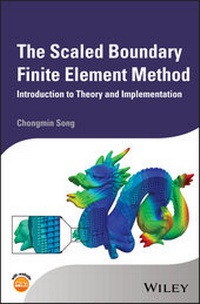
The Scaled Boundary Finite Element Method
Description

This reliable resource, complete with MATLAB, is an easy-to-understand introduction to the fundamental principles of the scaled boundary finite element method. It establishes the theory of the scaled boundary finite element method systematically as a general numerical procedure, providing the reader with a sound knowledge to expand the applications of this method to a broader scope. The book also presents the applications of the scaled boundary finite element to illustrate its salient features and potentials.
The Scaled Boundary Finite Element Method: Introduction to Theory and Implementation covers the static and dynamic stress analysis of solids in two and three dimensions. The relevant concepts, theory and modelling issues of the scaled boundary finite element method are discussed and the unique features of the method are highlighted. The applications in computational fracture mechanics are detailed with numerical examples. A unified mesh generation procedure based on quadtree/octree algorithm is described. It also presents examples of fully automatic stress analysis of geometric models in NURBS, STL and digital images.
* Written in lucid and easy to understand language by the co-inventor of the scaled boundary element method
* Provides MATLAB as an integral part of the book with the code cross-referenced in the text and the use of the code illustrated by examples
* Presents new developments in the scaled boundary finite element method with illustrative examples so that readers can appreciate the significant features and potentials of this novel method--especially in emerging technologies such as 3D printing, virtual reality, and digital image-based analysis
The Scaled Boundary Finite Element Method: Introduction to Theory and Implementation is an ideal book for researchers, software developers, numerical analysts, and postgraduate students in many fields of engineering and science.
More details
Other editions
Additional editions
Person
Chongmin Song, PhD, is a Professor of Civil Engineering and the Acting Director of the Centre for Infrastructure Engineering and Safety at the University of New South Wales, Australia. He is a Member of the General Council of the Asia-Pacific Association of Computational Mechanics (APCOM) and an Executive Member of the Australian Association for Computational Mechanics (AACM). Professor Song is also the co-author of Finite-Element Modelling of Unbounded Media.
Content
Preface xv
Acknowledgements xix
About the Companion Website xxi
1 Introduction 1
1.1 Numerical Modelling 1
1.2 Overview of the Scaled Boundary Finite Element Method 6
1.3 Features and Example Applications of the Scaled Boundary Finite Element Method 10
1.3.1 Linear Elastic Fracture Mechanics: Crack Terminating at Material Interface 11
1.3.2 Automatic Mesh Generation Based on Quadtree/Octree 13
1.3.3 Treatment of Non-matching Meshes 14
1.3.4 Crack Propagation 17
1.3.5 Adaptive Analysis 17
1.3.6 TransientWave Scattering in an Alluvial Basin 19
1.3.7 Automatic Image-based Analysis 19
1.3.7.1 Two-dimensional Elastoplastic Analysis of Cast Iron 20
1.3.7.2 Three-dimensional Concrete Specimen 22
1.3.8 Automatic Analysis of STL Models 24
1.4 Summary 26
Part I Basic Concepts and MATLAB Implementation of the Scaled Boundary Finite Element Method in Two Dimensions 27
2 Basic Formulations of the Scaled Boundary Finite Element Method 31
2.1 Introduction 31
2.2 Modelling of Geometry in Scaled Boundary Coordinates 31
2.2.1 S-domains: Scaling Requirement on Geometry, Scaling Centre and Scaling of Boundary 31
2.2.2 S-elements: Boundary Discretization of S-domains 37
2.2.3 Scaled Boundary Transformation 40
2.2.3.1 Scaled Boundary Coordinates 40
2.2.3.2 Coordinate Transformation of Partial Derivatives 42
2.2.3.3 Geometrical Properties in Scaled Boundary Coordinates 44
2.3 Governing Equations of Linear Elasticity in Scaled Boundary Coordinates 50
2.4 Semi-analytical Representation of Displacement and Strain Fields 51
2.5 Derivation of the Scaled Boundary Finite Element Equation by the Virtual Work Principle 53
2.5.1 Virtual Displacement and Strain Fields in Scaled Boundary Coordinates 54
2.5.2 Nodal Force Functions 54
2.5.3 The Scaled Boundary Finite Element Equation 55
2.6 Computer Program Platypus: Coefficient Matrices of an S-element 63
2.6.1 Element Coefficient Matrices of a 2-node Line Element 63
2.6.2 Assembly of Coefficient Matrices of an S-element 67
3 Solution of the Scaled Boundary Finite Element Equation by Eigenvalue Decomposition 73
3.1 Solution Procedure for the Scaled Boundary Finite Element Equations in Displacement 73
3.2 Pre-conditioning of Eigenvalue Problems 77
3.3 Computer Program Platypus: Solution of the Scaled Boundary Finite Element Equation of a Bounded S-element by the Eigenvalue Method 78
3.4 Assembly of S-elements and Solution of Global System of Equations 84
3.4.1 Assembly of S-elements 84
3.4.2 Surface Tractions 85
3.4.3 Enforcing Displacement Boundary Conditions 87
3.5 Computer Program Platypus: Assembly and Solution 87
3.5.1 Assembly of Global Stiffness Matrix 87
3.5.2 Assembly of Load Vector 95
3.5.3 Solution of Global System of Equations 96
3.5.4 Utility Functions 97
3.6 Examples of Static Analysis Using Platypus 102
3.7 Evaluation of Internal Displacements and Stresses of an S-element 111
3.7.1 Integration Constants and Internal Displacements 111
3.7.2 Strain/Stress Modes and Strain/Stress Fields 112
3.7.3 Shape Functions of Polygon Elements Modelled as S-elements 114
3.8 Computer Program Platypus: Internal Displacements and Strains 114
3.9 Body Loads 132
3.10 Dynamics and Vibration Analysis 135
3.10.1 Mass Matrix and Equation of Motion 135
3.10.2 Natural Frequencies and Mode Shapes 140
3.10.3 Response History Analysis Using the Newmark Method 143
4 Automatic Polygon Mesh Generation for Scaled Boundary Finite Element Analysis 149
4.1 Introduction 149
4.2 Basics of Geometrical Representation by Signed Distance Functions 150
4.3 Computer Program Platypus: Generation of Polygon S-elementMesh 154
4.3.1 Mesh Data Structure 157
4.3.2 Centroid of a Polygon 165
4.3.3 Converting a TriangularMesh to an S-elementMesh 166
4.3.4 Use of Polygon Meshes Generated by PolyMesher in a Scaled Boundary Finite Element Analysis 171
4.3.5 Dividing Edges of Polygons into Multiple Elements 172
4.4 Examples of Scaled Boundary Finite Element Analysis Using Platypus 175
4.4.1 A Deep Beam 178
4.4.1.1 Static Analysis 186
4.4.1.2 Modal Analysis 189
4.4.1.3 Response History Analysis 190
4.4.1.4 Pure Bending of a Beam: 2 Line Elements on an Edge of Polygons 190
4.4.2 A Circular Hole in an Infinite Plane Under Remote Uniaxial Tension 193
4.4.3 An L-shaped Panel 197
4.4.3.1 Static Analysis 203
4.4.3.2 Modal Analysis 204
4.4.3.3 Response History Analysis 207
5 Modelling Considerations in the Scaled Boundary Finite Element Analysis 209
5.1 Effect of Location of Scaling Centre on Accuracy 209
5.2 Mesh Transition 212
5.2.1 Local Mesh Refinement 212
5.2.2 Rapid Mesh Transition 214
5.2.3 Effect of Nonuniformity of Line Element Length on the Boundary of S-elements 216
5.3 Connecting Non-matching Meshes of Multiple Domains 218
5.3.1 Computer Program Platypus: Combining Two Non-matching Meshes 220
5.3.2 Computer Program Platypus: Modelling of a Problem by Multiple Domains with Non-matching Meshes 223
5.3.3 Examples 225
5.4 Modelling of Stress Singularities 234
Part II Theory and Applications of the Scaled Boundary Finite Element Method 237
6 Derivation of the Scaled Boundary Finite Element Equation in Three Dimensions 239
6.1 Introduction 239
6.2 Scaling of Boundary 239
6.3 Boundary Discretization of an S-domain 242
6.3.1 Isoparametric Quadrilateral Elements 243
6.3.1.1 Four-node Quadrilateral Element 243
6.3.1.2 Quadrilateral Element of Variable Number of Nodes 245
6.3.2 Isoparametric Triangular Elements 246
6.3.2.1 Three-node Triangular Elements 247
6.3.2.2 Six-node Triangular Elements 248
6.4 Scaled Boundary Transformation of Geometry 249
6.5 Geometrical Properties in Scaled Boundary Coordinates 253
6.6 Governing Equations of Elastodynamics with Geometry in Scaled Boundary Coordinates 257
6.7 Derivation of the Scaled Boundary Finite Element Equation by the Galerkin's Weighted Residual Technique 259
6.7.1 Displacement, Strain Fields and Nodal Force Functions in Scaled Boundary Coordinates 259
6.7.2 The Scaled Boundary Finite Element Equation 262
6.8 Unified Formulations in Two andThree Dimensions 267
6.9 Formulation of the Scaled Boundary Finite Element Equation as a System of First-order Differential Equations 268
6.10 Properties of Coefficient Matrices 269
6.10.1 Coefficient Matrices [E0] and [M0] 270
6.10.2 Coefficient Matrix [E2] 270
6.10.3 Matrix [Zp] 271
6.11 Linear Completeness of the Scaled Boundary Finite Element Solution 272
6.11.1 Constant Displacement Field 272
6.11.2 Linear Displacement Field 273
6.12 Scaled Boundary Finite Element Equation in Stiffness 278
7 Solution of the Scaled Boundary Finite Element Equation in Statics by Schur Decomposition 281
7.1 Introduction 281
7.2 Basics of Matrix Exponential Function 283
7.3 Schur Decomposition 287
7.3.1 Introduction 287
7.3.2 Treatment of the Diagonal Block of Eigenvalues of 0 288
7.4 Solution Procedure for a Bounded S-element by Schur Decomposition 291
7.4.1 Transformation of the Scaled Boundary Finite Element Equation 291
7.4.2 Enforcing the Boundary Condition at the Scaling Centre 292
7.4.3 Determining the Solution for Displacement and Nodal Force Functions 294
7.4.4 Determining the Static Stiffness Matrix 295
7.5 Solution of Displacement and Stress Fields of an S-element 295
7.5.1 Integration Constants 295
7.5.2 Stress Modes and Stresses on the Boundary 296
7.6 Block-diagonal Schur Decomposition 297
7.7 Solution Procedure by Block-diagonal Schur Decomposition 303
7.7.1 General Solution of the Scaled Boundary Finite Element Equation 303
7.7.1.1 [Zp] Having No Eigenvalues of Zero 304
7.7.1.2 [Zp] Having Eigenvalues of Zero 304
7.7.2 Solution for Bounded S-elements 305
7.7.3 Solution for Unbounded S-elements 307
7.7.3.1 [Zp] Having No Eigenvalues of Zero 307
7.7.3.2 [Zp] Having Eigenvalues of Zero 308
7.8 Displacements and Stresses of an S-element by Block-diagonal Schur Decomposition 310
7.8.1 Integration Constants and Displacement Fields 310
7.8.2 Stress Modes and Stress Fields 311
7.8.3 Shape Functions of Polytope Elements 312
7.9 Body Loads 313
7.10 Mass Matrix 315
7.11 Remarks 317
7.12 Examples 319
7.12.1 Circular Cavity in Full-plane 319
7.12.2 Bi-materialWedge 322
7.12.3 Interface Crack in Anisotropic Bi-material Full-plane 325
7.13 Summary 327
8 High-order Elements 329
8.1 Lagrange Interpolation 330
8.2 One-dimensional Spectral Elements 333
8.2.1 Shape Functions 334
8.2.2 Numerical Integration of Element Coefficient Matrices 337
8.2.2.1 Gauss-Legendre Quadrature 337
8.2.2.2 Gauss-Lobatto-Legendre Quadrature 338
8.3 Two-dimensional Quadrilateral Spectral Elements 341
8.3.1 Shape Functions 341
8.3.2 Integration of Element Coefficient Matrices by Gauss-Lobatto-Legendre Quadrature 342
8.4 Examples 344
8.4.1 A Cantilever Beam Subject to End Loading 345
8.4.2 A Circular Hole in an Infinite Plate 347
8.4.3 An L-shaped Panel 349
8.4.4 A 3D Cantilever Beam Subject to End-shear Loading 351
8.4.5 A Pressurized Hollow Sphere 352
9 Quadtree/Octree Algorithm of Mesh Generation for Scaled Boundary Finite Element Analysis 355
9.1 Introduction 355
9.1.1 Mesh Generation 355
9.1.2 The Quadtree/Octree Algorithm 357
9.2 Data Structure of S-element Meshes 360
9.3 Quadtree/Octree Mesh Generation of Digital Images 361
9.3.1 Illustration of Quadtree Decomposition of Two-dimensional Images by an Example 361
9.3.2 Octree Decomposition 366
9.4 Solutions of S-elements with the Same Pattern of Node Configuration 370
9.4.1 Two-dimensional S-elements 370
9.4.2 Three-dimensional S-elements 372
9.5 Examples of Image-based Analysis 374
9.5.1 A 2D Concrete Specimen 374
9.5.2 A 3D Concrete Specimen 376
9.6 Quadtree/Octree Mesh Generation for CAD Models 378
9.6.1 Quadtree/Octree Grid 380
9.6.2 Trimming of Boundary Cells 381
9.7 Examples Using Quadtree/Octree Meshes of CAD Models 383
9.7.1 Square Body with Multiple Holes 384
9.7.2 An Evolving Void in a Square Body 385
9.7.3 Adaptive Analysis of an L-shaped Panel 386
9.7.4 A Mechanical Part 387
9.7.5 STL Models 389
9.8 Remarks 394
10 Linear Elastic Fracture Mechanics 395
10.1 Introduction 395
10.2 Basics of Fracture Analysis: Asymptotic Solutions, Stress Intensity Factors, and the T-stress 397
10.2.1 Crack in Homogeneous Isotropic Material 397
10.2.2 Interfacial Cracks between Two Isotropic Materials 401
10.2.3 Interfacial Cracks between Two AnisotropicMaterials 402
10.2.4 Multi-materialWedges 405
10.3 Modelling of Singular Stress Fields by the Scaled Boundary Finite Element Method 406
10.4 Stress Intensity Factors and the T-stress of a Cracked Homogeneous Body 407
10.5 Definition and Evaluation of Generalized Stress Intensity Factors 416
10.6 Examples of Highly Accurate Stress Intensity Factors and T-stress 432
10.6.1 A Single Edge-cracked Rectangular Body Under Tension 433
10.6.2 A Single Edge-cracked Rectangular Body Under Bending 435
10.6.3 A Centre-cracked Rectangular Body Under Tension 437
10.6.4 A Double Edge-cracked Rectangular Body Under Tension 438
10.6.5 A Single Edge-cracked Rectangular Body Under End Shearing 439
10.7 Modelling of Crack Propagation 440
10.7.1 Modelling of Crack Paths by Polygon Meshes 442
10.7.2 Modelling of Crack Paths by Quadtree Meshes 443
10.7.3 Examples of Crack PropagationModelling 444
10.7.3.1 Fatigue Crack Propagation Using Polygon Mesh 444
10.7.3.2 Crack Propagation in a Beam with Three Holes 447
Appendix A Governing Equations of Linear Elasticity 449
A.1 Three-dimensional Problems 449
A.1.1 Strain 449
A.1.2 Stress and Equilibrium Equation 450
A.1.3 Stress-strain Relationship and Material Elasticity Matrix 451
A.1.4 Boundary Conditions 453
A.2 Two-dimensional Problems 454
A.2.1 Elasticity Matrix in Plane Stress 455
A.2.2 Elasticity Matrix in Plane Strain 456
A.3 Unified Expressions of Governing Equations 457
Appendix B Matrix Power Function 459
B.1 Definition of Matrix Power Function 459
B.2 Application to Solution of System of Ordinary Differential Equations 460
B.3 Computation of Matrix Power Function by Eigenvalue Method 461
Bibliography 463
Index 475
1
Introduction
1.1 Numerical Modelling
The advances in numerical modelling techniques and computer technology during the past few decades have transformed the analysis and design of many types of engineering structures. Today, numerical simulations as an integral part of Computer-Aided Engineering (CAE) are routinely performed in civil engineering, mechanical engineering, aerospace and other industries.
Many problems in engineering and science are formulated as field problems by mathematical models in terms of field variables, such as displacements, potentials, etc. The mathematical models consist of governing differential equations to describe physical laws (such as equilibrium and compatibility in a stress analysis), material constitutive models and boundary conditions enforced on the problem domains. Classical methods of engineering analysis are often based on analytical solutions to the mathematical model. The analytical solutions are expressed as mathematical functions and can be evaluated at any locations of interest. However, analytical solutions are available only for very simple problems. For many engineering problems, considerable simplifications have to be made in order to apply the classical analysis methods. This often leads to over-conservative designs.
Numerical modelling techniques have been developed to analyse complex engineering problems. In the numerical modelling of a field problem, the mathematical model is solved by a numerical method. A common feature of the numerical methods is the use of mesh discretization to divide a complex problem domain into a set of discrete pieces. Simple formulations are constructed on each piece and assembled together. The mathematical model of a field problem is approximated by a system of algebraic equations with unknowns at a finite number of discrete points. The solution generally converges to the exact solution with the increasing number of discrete points. Numerical methods rely on computers for number crunching.
The finite element method (Bathe, 1996; Cook et al., 2002; Reddy, 2005; Zienkiewicz et al., 2005, to name a few) is probably the most popular and powerful numerical method for the stress analysis of solids and structures. In the standard finite element method, a problem domain is discretized into a set of discrete subdomains called elements. The edges of the elements have to conform to the boundary of the problem domain. The shapes of the elements are limited to a few simple ones. They are triangles and quadrilaterals (i.e. polygons with 3 or 4 edges) in two dimensions, and tetrahedrons, pyramid, wedge and hexahedra (i.e. polyhedra with faces) in three dimensions. These elementary shapes allow the development of simple element solution. Typically, the solution within an element is approximated locally by piecewise polynomials, which leads to extremely efficient procedures (e.g. for numerical integration) suited to number crunching by computers. Element formulations are constructed as algebraic equations by satisfying the governing differential equations in a weak form. Assembling the element equations according to the element connectivity leads to a global system of algebraic equations that can be solved by known solution techniques.
The finite element method is highly versatile and widely applicable in numerical modelling largely due to the simplicity in formulating element equations. Nowadays, many commercial software packages implementing the finite element method are available. Finite element analysis is widely performed in many disciplines of engineering and science. However, the conventional finite element method faces challenges when applied to certain classes of engineering problems. Examples pertinent to the contents of this book include the problems involving dynamic responses of unbounded domains, strain/stress singularities and moving boundaries. In addition, the simple shapes and formulations of finite elements place a heavy burden on mesh generation, which often requires frequent human interventions.
In the numerical model of a structure under an earthquake action, the supporting soil is often simplified as an unbounded domain extending to infinity in comparison with the dimension of the structure. A so-called radiation condition, which states that no energy be radiated from infinity towards the structure, has to be enforced. Direct application of the finite element method would be computationally expensive as the size of the finite elements is limited by the frequency/wavelength of interest. Various techniques such as the viscous boundary, viscous-spring boundary, etc. have been developed for use with finite elements to overcome this limitation. The boundary element method, which satisfies the radiation condition by a fundamental solution, is another attractive alternative in the modelling of unbounded domains.
In the application of linear elastic fracture mechanics to evaluate the propagation of a crack in a brittle material, the stress field around the crack tip is of primary interest. Based on the theory of elasticity, stress/strain singularities exist at the crack tip. The standard finite element analysis of cracks suffers from slow convergence as the polynomial basis functions of standard finite elements do not resemble the singular functions in the strain and stress solutions. The same happens when modelling interface cracks and multi-material corners of composite materials. To achieve accurate solutions, a large number of elements are required around a singularity point. This further increases the burden on mesh generation. Additional post-processing techniques, such as path-independent integrals, are often required to extract the stress intensity factors and other parameters for engineering design.
In engineering practice, structural designs are routinely performed on Computer- Aided Design (CAD) systems. The geometry of a design is commonly described by Non-Uniform Rational B-Splines (NURBS). To perform a finite element analysis, a mesh that conforms to the boundary of the geometric model has to be generated. For computational efficiency considerations, the element size gradation is indispensable. Automatic mesh generation from CAD models has been an active research subject and various meshing techniques have been developed (Watson, 1981; Yerry and Shephard, 1984; Löhner and Parikh, 1988; Blacker and Meyers, 1993, to name a few). Generally speaking, a triangular/tetrahedral mesh is easier to generate automatically than a quadrilateral/hexahedral mesh, while quadrilateral/hexahedral elements are more advantageous in a finite element analysis. Nowadays, an automatic mesh generator is an indispensable feature of any popular commercial finite element software package. However, the generation of a high-quality finite element mesh conforming to the boundary very often requires tedious human interventions in practical engineering computations. The process can be cumbersome and time-consuming. Furthermore, continuous remeshing is highly desirable in some types of analysis. Examples include the modelling of moving boundaries that result from crack propagation or phase transition in matter, adaptive analysis that aims to automatically achieve a specified accuracy in an optimal way, and topology optimization. Robust and efficient remeshing is a challenging task in a finite element analysis.
Various numerical methods have been proposed recently to overcome the above shortcomings of the finite element method in solving practical engineering problems. One major trend is to develop numerical methods that reduce the meshing burden, especially the human efforts and interventions required in the mesh generation. Many novel numerical methods have been proposed. Notable examples include the various meshfree methods (Lucy, 1977; Belytschko et al., 1994; Atluri and Zhu, 1998), extended/generalized finite element methods (Moës et al., 1999), the finite cell method (Parvizian et al., 2007), and isogeometric analysis (Hughes et al., 2005) to name a few. A comprehensive review of the recent rapid developments in this area is a daunting task beyond the scope of this book.
Advances in digital technology have led to the development and increasing popularity of other file formats than NURBS to describe the geometries of objects. Two notable examples are the STL (STereoLithography) format and the digital image.
- The STL format is widely used in 3D printing and rapid prototyping (Bassoli et al., 2007; Rengier et al., 2010). It is now widely supported by CAD systems. The popularity of the STL format is largely attributed to its extreme simplicity: the boundary of a geometric model is represented by a list of unstructured triangular facets. However, this simple format allows the existence of ill-shaped, overlapped or self-intersecting facets and holes on the boundary. These defects, albeit small in size, are incompatible with the finite element method.
- Digital images are increasingly being applied in engineering and science. Various digital imaging technologies, such as X-ray computed tomography (X-ray CT) scans, magnetic resonance imaging (MRI) and ultrasound have become available with a rapid increase in resolution. For example, the meso-structure of a material can be acquired non-destructively by X-ray CT. A digital image is composed of pixels in 2D and voxels in 3D. The geometry is represented by the colour intensity of the pixels/voxels. The algorithms developed for the automatic mesh generation of...
