

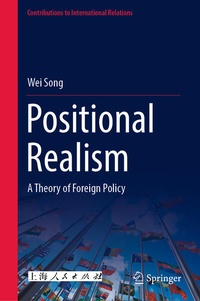
Positional Realism
Description

This book adopts the rationalist research path to bring forward an innovative theory of foreign policy, and the central question is: How can we define the overall national interests of great powers appropriately and thus help states make consistent and rational grand strategies? The answer can't be found among existing Foreign Policy Analysis and other theoretical research. In this book, Positional Realism is proposed as a new theory to define the overall national interests from the power position and order position perspectives and specify the four kinds of positional interests of hegemonic states, contending states, potential contending states, and non-contending states. Different great powers have different positional power and order objectives. Based on these positional interests, Positional Realism brings different foreign policy hypotheses and suggestions. The book also examines the six great powers in the nineteenth century to verify these hypotheses and finds that PositionalRealism can not only convincingly explain the success or failure of their acts, but also give useful and important directions for strategy making of great powers.
More details
Other editions
Additional editions
Persons
Song Wei is a professor of international relations at Renmin University of China. He got Master in Peking University and Ph.D. both in Peking University and Waseda University of Japan. From 2009 to 2015, he was an associate professor of Peking University. He was selected as a member of the Distinguished Young Scholar program in 2017 and became the chair of the Department of International Politics at Renmin University of China.
He has published three books: International Relations Theory: from political thoughts to social science (Shanghai Educational Publishing House, 2011), which received the Second Prize of Excellent Achievement of Philosophy and Social Science in Beijing; Defending the Hegemonic interests: American Strategy towards regional integration from 1945-2005 (Peking University Press, 2014); and Positional Realism: A Theory of Foreign Policy (Shanghai People's Publishing House, 2021). He is also theprimary translator of three textbooks or classics: International Politics on the World Stage ( John Rouke); The Culture of National Security (Peter J. Katzenstein); How Enemies Become Friends: The Sources of Stable Peace (Charles Kupchan). He has published over 70 articles on the top Chinese journals of international relations, including World Economics and Politics , The Journal of International Studies , and Quarterly Journal of International Politics .
Content
Chapter 1. Introduction: The Significance and Research Path of Theory of Foreign Policy.- Chapter 2. The Existing Research on Foreign Policy and Their Limitation.- Chapter 3. Position Realism as a Theory of Foreign Policy.- Chapter 4. International Structure and Order in the 19 Century.- Chapter 5. Defending Hegemonic Interest: British Foreign Policy.- Chapter 6. Germany and Russia: Contending States or Potential Contending States?.- Chapter 7. America and France: The Foreign Policies of Potential Contending States.- Chapter 8. The Foreign Policy of The Austro-Hungarian Empire as a Non-contending State.- Chapter 9. Conclusion: The Summary and Prospect of Positional Realism.
