

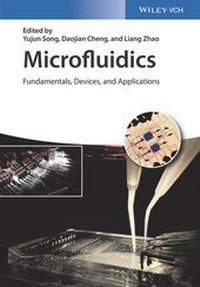
Microfluidics
Fundamentals, Devices, and Applications
1st Edition
Published on 4. January 2018
544 pages
978-3-527-80065-0 (ISBN)
Description

The first book offering a global overview of fundamental microfluidics and the wide range of possible applications, for example, in chemistry, biology, and biomedical science.
As such, it summarizes recent progress in microfluidics, including its origin and development, the theoretical fundamentals, and fabrication techniques for microfluidic devices. The book also comprehensively covers the fluid mechanics, physics and chemistry as well as applications in such different fields as detection and synthesis of inorganic and organic materials.
A useful reference for non-specialists and a basic guideline for research scientists and technicians already active in this field or intending to work in microfluidics.
As such, it summarizes recent progress in microfluidics, including its origin and development, the theoretical fundamentals, and fabrication techniques for microfluidic devices. The book also comprehensively covers the fluid mechanics, physics and chemistry as well as applications in such different fields as detection and synthesis of inorganic and organic materials.
A useful reference for non-specialists and a basic guideline for research scientists and technicians already active in this field or intending to work in microfluidics.
More details
Other editions
Additional editions
Book
02/2018
1st Edition
Wiley-VCH
€192.00
Article exhausted; check different version

Yu Song | Daojian Cheng | Liang Zhao
Microfluidics - Fundamental, Devices and Applications
Software
01/2018
Wiley-VCH
€247.83
No shipping information available
Persons
Yujun Song is a professor in School of Mathematics and Physics at USTB in Beijing, China, focusing on synthesis, interface structure control and application of metal-based nanohybrids using microfluidic process and template-assisted growth process. Having obtained his PhD degrees in Materials Science and Engineering from Beijing University of Chemical Technology, he spent 5 years at Louisiana State University in microfluidics and bio-nanotechnology, 2 years working at Old Dominion University in surface plasmon resonance and biotechnology, 7 years working at Beihang University in microfluidic synthesis and template-assisted growth process. He also spent one year working at University of Toronto as a visiting professor working on fabrication of hybrid semiconductor nanowire thin films, before taking up his present appointment at USTB.
Daojian Cheng is Professor at Department of Chemical Engineering, Beijing University of Chemical Technology, China. He has been named a Fellow of the Royal Society of Chemistry. He obtained his Ph.D. Degree in Chemical Engineering from Beijing University of Chemical Technology in 2008. During 2008-2010, he worked as a Postdoctoral Research Fellow at Université Libre de Bruxelles, Belgium. Currently he has interests in theoretical study, computational design and experimental synthesis of metal clusters and nanoalloys as catalysts for renewable clean energy and environmental protection applications.
Liang Zhao is Assistant Professor at University of Science and Technology Beijing. Before that, he worked at Peking University as a postdoctoral associate (2010-2013). He received his PhD in Nanjing University in 2009. In 2014-2015, he was a visiting researcher in UC Berkeley, Prof. Luke Lee?s group. His research currently focuses on developing new microfluidic device which can be easily used to study cell patterning, tumor metastasis, tumor-stoma interactions, and organ on chip. He also works on single cell RNA-Seq in integrated microfluidic platform, which may bring some valuable merits such as high throughput and efficiency comparing with conventional way of molecular biology.
Daojian Cheng is Professor at Department of Chemical Engineering, Beijing University of Chemical Technology, China. He has been named a Fellow of the Royal Society of Chemistry. He obtained his Ph.D. Degree in Chemical Engineering from Beijing University of Chemical Technology in 2008. During 2008-2010, he worked as a Postdoctoral Research Fellow at Université Libre de Bruxelles, Belgium. Currently he has interests in theoretical study, computational design and experimental synthesis of metal clusters and nanoalloys as catalysts for renewable clean energy and environmental protection applications.
Liang Zhao is Assistant Professor at University of Science and Technology Beijing. Before that, he worked at Peking University as a postdoctoral associate (2010-2013). He received his PhD in Nanjing University in 2009. In 2014-2015, he was a visiting researcher in UC Berkeley, Prof. Luke Lee?s group. His research currently focuses on developing new microfluidic device which can be easily used to study cell patterning, tumor metastasis, tumor-stoma interactions, and organ on chip. He also works on single cell RNA-Seq in integrated microfluidic platform, which may bring some valuable merits such as high throughput and efficiency comparing with conventional way of molecular biology.
Content
Preface and acknowledgement
1.Introduction: The Origin, Current Status and Future of Microfluidics
2.Fundamental Concepts and Physics in Microfluidics
3.Microfluidic Devices: Fabrication and Surface Modification
4.Numerical Simulation in Microfluidics and the Introduction of the Related Software
5.Digital microfluidics systems: principles, configurations, techniques, and applications
6.Microfluidics for Chemical Analysis
7.Microfluidics for Disease Diagnosis
8.Microfluidic Devices for Isolation
of Circulating Tumor Cells (CTCs)
9.Gene expression analysis on microfluidic device
10.Computational Microfluidics Applied to Drug Delivery in Pulmonary and Arterial Systems
11.Microfluidic Synthesis of Organics
12.Microfluidic approaches for design of multifunctional polymeric microparticles: from simple emulsions to complex particles
13.Synthesis of magnetic nanomaterials
14.Microfluidic Synthesis of Metallic Nanomaterials
15.Microfluidic Synthesis of Composites and Hybrids
16.Microfluidic Synthesis of MOFs and MOF Based Membranes
17.Prospective for Microfluidics
flux of component i temperature gradient along x-direction, K/m magnetic field strength local shear velocity ~?D ionic screening cloud of width × cross product ? vector differential operator a speed of sound A cross-section area of the flow A1 cross-section areas A1 A2 cross-section areas A2 AIP American Institute of Physics Ar Archimedes number At Atwood number Bi Biot number Bo Bond number Br Brinkman number c total molar concentration (equation (2.19)) C concentration of the species (equation (2.9)) c light speed (equation (2.97)) Ca capillary number Ce centrifuge number Cfr friction coefficient ci molar concentration of component i CP constant pressure heat capacity CV constant volume heat capacity d collision diameter of molecules D diffusion coefficient (cm2/s) (equation (2.14)) D diffusion coefficient of the species (equation (2.92)) DAB diffusivity of A in B De diffusion coefficient in gas or liquid filling the pore (equation (2.16)) De Dean number Dh hydraulic diameter Di diffusivity of the ions Dij Maxwell-Stefan diffusivity DRIE deep reactive ion etching E = -?fe local applied electrical filed strength E// local electric strength E bulk modulus elasticity (N/m2 (Pa)) E electric field E spacing distance (x) dependent electric field strength (equation (2.82)) Ec Eckert number EDL electrical double-layer Ek Ekman number Eo Eötvös number Eu Euler number F magnitude of this force FEP fluorinated ethylene propylene Fmix extent efficiency of mixing two fluids next to each other accomplished only through diffusion Fo Fourier number Fr Froude number FrR rotating Froude number Fs shear force g acceleration of gravity Ga Galileo number Gr Grashof number Gz Graetz number h fluid depth (equation (2.30)) h(r) displacement of the interface h height Hg Hagen number I beam intensity I0 intensity of the incident light ICEK induced-charge electrokinetic ICEO induced-charge electro-osmosis IOP Institute of Physics J0 zero-th order Bessel function Ja Jakob number Jx net flux k wavenumber of the laser beam Kn Knudsen number krCL/D Damköhler number L characteristic length L separation between electrodes (equation (2.94)) La Laplace number LC liquid crystal Le Lewis number LLCP linear liquid crystal polymer m mass of molecule M molecular weight (equation (2.8)) M molar mass (g/mol) (equation (2.14)) Ma Marangoni number MB molar mass of solvent B Mo Morton number n the number of components N Avogardro number ñ outward unit normal on surface n0 bulk concentration of ions n1 refractive index Nu Nusselt number P static pressure (equation (2.32)) P difference in pressure inside (Pi) and outside (Po) of the bubble (equation (2.68)) p pressure (atm) P pressure gradient P beam power threshold Pe Péclet Number PEEK polyaryl etheretherketone Pr Prandtl number Q volumetric flow rate q''x heat density along x-direction, W/m2 R gas constant (equation (2.1)) R and T normal incidence for weak deformations with linearized curvatures (equation (2.99)) R(?2, ?1) classical reflection r internal radius (equation (2.33)) r average distance of the liquid (equation (2.79)) r distance from the center to the laser beam Ra Rayleigh number Re Reynolds number Ri Richardson number Ro Rossby number Rx and Ry radii of curvature in all axes parallel to the surface Sc Schmidt number Sh Sherwood number SH source or a sink of heat St Strouhal number Sta Stanton number Ste Stefan number Stk Stokes number T(?2, ?1) transmission Fresnel coefficients in electromagnetic energy = 1- R(?2, ?1) = T absolute temperature T0 reference temperature (K) T1 absolute temperature T2 absolute temperature Ta Taylor Number TMAs tubular microactuators u/y rate of shear deformation or shear...
1.Introduction: The Origin, Current Status and Future of Microfluidics
2.Fundamental Concepts and Physics in Microfluidics
3.Microfluidic Devices: Fabrication and Surface Modification
4.Numerical Simulation in Microfluidics and the Introduction of the Related Software
5.Digital microfluidics systems: principles, configurations, techniques, and applications
6.Microfluidics for Chemical Analysis
7.Microfluidics for Disease Diagnosis
8.Microfluidic Devices for Isolation
of Circulating Tumor Cells (CTCs)
9.Gene expression analysis on microfluidic device
10.Computational Microfluidics Applied to Drug Delivery in Pulmonary and Arterial Systems
11.Microfluidic Synthesis of Organics
12.Microfluidic approaches for design of multifunctional polymeric microparticles: from simple emulsions to complex particles
13.Synthesis of magnetic nanomaterials
14.Microfluidic Synthesis of Metallic Nanomaterials
15.Microfluidic Synthesis of Composites and Hybrids
16.Microfluidic Synthesis of MOFs and MOF Based Membranes
17.Prospective for Microfluidics
Abbreviations
flux of component i temperature gradient along x-direction, K/m magnetic field strength local shear velocity ~?D ionic screening cloud of width × cross product ? vector differential operator a speed of sound A cross-section area of the flow A1 cross-section areas A1 A2 cross-section areas A2 AIP American Institute of Physics Ar Archimedes number At Atwood number Bi Biot number Bo Bond number Br Brinkman number c total molar concentration (equation (2.19)) C concentration of the species (equation (2.9)) c light speed (equation (2.97)) Ca capillary number Ce centrifuge number Cfr friction coefficient ci molar concentration of component i CP constant pressure heat capacity CV constant volume heat capacity d collision diameter of molecules D diffusion coefficient (cm2/s) (equation (2.14)) D diffusion coefficient of the species (equation (2.92)) DAB diffusivity of A in B De diffusion coefficient in gas or liquid filling the pore (equation (2.16)) De Dean number Dh hydraulic diameter Di diffusivity of the ions Dij Maxwell-Stefan diffusivity DRIE deep reactive ion etching E = -?fe local applied electrical filed strength E// local electric strength E bulk modulus elasticity (N/m2 (Pa)) E electric field E spacing distance (x) dependent electric field strength (equation (2.82)) Ec Eckert number EDL electrical double-layer Ek Ekman number Eo Eötvös number Eu Euler number F magnitude of this force FEP fluorinated ethylene propylene Fmix extent efficiency of mixing two fluids next to each other accomplished only through diffusion Fo Fourier number Fr Froude number FrR rotating Froude number Fs shear force g acceleration of gravity Ga Galileo number Gr Grashof number Gz Graetz number h fluid depth (equation (2.30)) h(r) displacement of the interface h height Hg Hagen number I beam intensity I0 intensity of the incident light ICEK induced-charge electrokinetic ICEO induced-charge electro-osmosis IOP Institute of Physics J0 zero-th order Bessel function Ja Jakob number Jx net flux k wavenumber of the laser beam Kn Knudsen number krCL/D Damköhler number L characteristic length L separation between electrodes (equation (2.94)) La Laplace number LC liquid crystal Le Lewis number LLCP linear liquid crystal polymer m mass of molecule M molecular weight (equation (2.8)) M molar mass (g/mol) (equation (2.14)) Ma Marangoni number MB molar mass of solvent B Mo Morton number n the number of components N Avogardro number ñ outward unit normal on surface n0 bulk concentration of ions n1 refractive index Nu Nusselt number P static pressure (equation (2.32)) P difference in pressure inside (Pi) and outside (Po) of the bubble (equation (2.68)) p pressure (atm) P pressure gradient P beam power threshold Pe Péclet Number PEEK polyaryl etheretherketone Pr Prandtl number Q volumetric flow rate q''x heat density along x-direction, W/m2 R gas constant (equation (2.1)) R and T normal incidence for weak deformations with linearized curvatures (equation (2.99)) R(?2, ?1) classical reflection r internal radius (equation (2.33)) r average distance of the liquid (equation (2.79)) r distance from the center to the laser beam Ra Rayleigh number Re Reynolds number Ri Richardson number Ro Rossby number Rx and Ry radii of curvature in all axes parallel to the surface Sc Schmidt number Sh Sherwood number SH source or a sink of heat St Strouhal number Sta Stanton number Ste Stefan number Stk Stokes number T(?2, ?1) transmission Fresnel coefficients in electromagnetic energy = 1- R(?2, ?1) = T absolute temperature T0 reference temperature (K) T1 absolute temperature T2 absolute temperature Ta Taylor Number TMAs tubular microactuators u/y rate of shear deformation or shear...
