

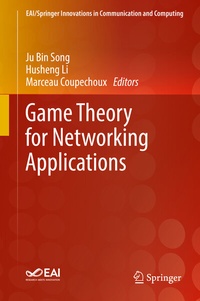
Game Theory for Networking Applications
Description

This book provides recent results of game theory for networking applications. The contributors address the major opportunities and challenges in applying traditional game theory as well as intelligent game theory to the understanding and designing of modern network systems, with emphasis on both new analytical techniques and novel application scenarios. After an overview of game theory for networks, the book narrows in on game theory in communications, game theory in wireless networks, and game theory applications. The book features contributions from researchers and professionals around the world.
-
Presents a variety of perspectives on game theory for networking applications;
-
Shows how game theory can apply to the study of data traffic, new generation networks, and smartgrid;
-
Includes recent results of applied game theory for networks, providing some technical progresses in GAMENETS.
More details
Other editions
Additional editions
Persons
Dr. Ju Bin Song received the Ph.D. degree from the Department of Electronic and Electrical Engineering, University College London (UCL), London, U.K., in 2001. From 1992 to 1997, he was a Senior Researcher in the Electronics and Telecommunications Research Institute (ETRI), South Korea. He was a Research Fellow in the Department of Electronic and Electrical Engineering at UCL in 2001. During 2002-2003, he was an Assistant Professor in the School of Information and Computer Engineering at Hanbat National University, South Korea. He is currently a Professor in the Department of Electronic Engineering, Kyung Hee University, South Korea. He was the Department Head in Department of Electronics and Radio Engineering and the Vice Dean in School of Electronics and Information, Kyung Hee University from 2014 to 2015. From 2009 to 2010, he was a Visiting Professor in the Department of Electrical Engineering and Computer Science at the University ofHouston, Texas, USA. His current research interests include resource allocation in communication systems and networks, cognitive networking, cognitive radio networks, cooperative communications, cyberphysical systems, smart grid, optimization and game theory. Dr. Song has served as a member of technical program committee for IEEE Vehicular Technology Conference, IEEE Wireless Communications and Networking Conference, IEEE GLOBECOM, etc. He has served as the General Chair for 8th EAI International Conference on Game Theory for Networks. He is guest editor for Game Theory for Networks in ACM/Springer Mobile Networks and Application Journal Special Issue on Game Theory for Networks. Dr. Song was a Kyung Hee University Best Teaching Award recipient in 2004 and 2012, respectively. He has contributed to dozens of books and conference proceedings.
Dr. Husheng Li received the BS and MS degrees in electronic engineering from Tsinghua University, Beijing, China, in 1998 and 2000, respectively, and the Ph.D. degree in electrical engineering from Princeton University, Princeton, NJ, in 2005. From 2005 to 2007, he worked as a senior engineer at Qualcomm Inc., San Diego, CA. In 2007, he joined the EECS department of the University of Tennessee, Knoxville, TN, as an assistant professor. He is promoted to associate professor in 2013. His research is mainly focused on statistical signal processing, wireless communications, networking, smart grid and game theory. Dr. Li is the recipient of the Best Paper Awards of EURASIP Journal of Wireless Communications and Networks, 2005 (together with his PhD advisor: Prof. H. V. Poor), IEEE ICC, 2011 and IEEE SmartGridComm 2012, and the Best Demo Award of IEEE Globecom, 2010. He has published dozens of conference and journal papers.
Dr. Marceau Coupechoux is a Professor at Telecom ParisTech, Paris, France. He was previously Visiting Scientist at Indian Institute of Science, Bangalore, India, Network Lab, ECE, with Prof. Anurag Kumar; an Engineer, Alcatel-Lucent, Cellular network dimensioning, Vélizy, France; and a Research Engineer, Alcatel-Lucent, Research and Innovation, Marcoussis, France. He received his Ph.D. (Très Honorable), Institut Eurecom, Sophia-Antipolis, France. Has organized and chaired dozens of IEEE conferences. He is guest editor for Applications of Cognitive Radio Networks: Recent Advances and Future Directions in International Journal of Distributed Sensor Networks. He has nine patents. He has published dozens of journal and conferences papers.
Content
Chapter1: Types of Nodes and Centrality Measures in Networks.- Chapter2: The Time-Consistent Shapley Value for Two-Stage Network Games with Pairwise Interactions.- Chapter3: Routing on a Ring Network.- Chapter4: Performance of Dynamic Secure Routing Game.- Chapter5: Content Sponsoring with Inter-ISP Transit Cost.- Chapter6: Matching Games for 5G Network Paradigms.- Chapter7: Enhanced Design of Stochastic Defense System with Mixed Game Strategies.- Chapter8: Optimal Impulse Control of SIR Epidemics over Scale-Free Networks.- Chapter9: Fault-Tolerant Hotelling Games.- Chapter10: A Social Choice Theoretic Approach for Analyzing User Behavior in Online Streaming Mobile Applications.- Chapter11: Social Coordination and Network Formation with Heterogeneous Constraints.- Chapter12: Stable and Efficient Structures for the Content Production and Consumption in Information Communities.- Chapter13: One-Player Game based Influential Maximization Scheme for Social Cloud Service Networks.- Chapter14: Noncooperative Energy Charging and Discharging Game for Smart Grid.- Chapter15: Stackelberg Differential Game based Charging Control of Electric Vehicles in Smart Grid.- Chapter16: Day-Ahead Demand Management in Multi-Supplier Power Grid under Transmission Constraints.
