

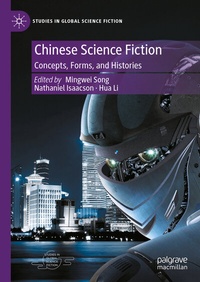
Chinese Science Fiction
Description

Reviews / Votes
"The volume Chinese Science Fiction: Concepts, Forms, and Histories, edited by Mingwei Song, Nathaniel Isaacson, and Hua Li, offers a vital and timely contribution to the field of Chinese science fiction (SF) research. ... Chinese Science Fiction provides a rich, multi-faceted account of Chinese SF. It moves beyond the focus on recent bestsellers to explore . . It is an invaluable resource for scholars and students interested in Chinese literature, SF studies, and global cultural history." (Zichuan Gan, Fafnir - Nordic Journal of Science Fiction and Fantasy Research, Vol. 12 (1), 2025)
"This book offers a robust framework for understanding Chinese science fiction within its broader cultural and literary contexts. ... Meticulously researched and thoughtfully crafted, this is an invaluable resource for a diverse range of readers. It serves as an essential textbook and reference for science fiction scholars worldwide, while also supporting educators, students and researchers interested in Chinese literature. Furthermore, it appeals to general readers intrigued by Chinese science fiction and its reflections on Chinese society and culture." (Yuqin Jiang, The China Quarterly, April 21, 2025)
More details
Other editions
Additional editions
Persons
Mingwei Song is Professor of Modern Chinese Literature at Wellesley College. He is the author of numerous books and research articles, including Young China: National Rejuvenation and the Bildungsroman, 1900-1959 (2015), New Wave in Chinese Science Fiction: History, Poetics, Texts (2020; in Chinese) and Fear of Seeing: A Poetics of Chinese Science Fiction (2023). He is the co-editor of The Reincarnated Giant: An Anthology of Twenty-First Century Chinese Science Fiction (2018).
Nathaniel Isaacson is Associate Professor of Modern Chinese Literature in the Department of World Languages and Cultures at North Carolina State University. His book, Celestial Empire: the Emergence of Chinese Science Fiction (2017), examines the emergence of science fiction in late Qing China and the relationship between science fiction and Orientalism.
Hua Li is Professor of Chinese in the Department of Modern Languages and Literatures at Montana State University. She has published two monographs: Contemporary Chinese Fiction by Su Tong and Yu Hua: Coming of Age in Troubled Times (2011) and Chinese Science Fiction during the Post-Mao Cultural Thaw (2021).
