

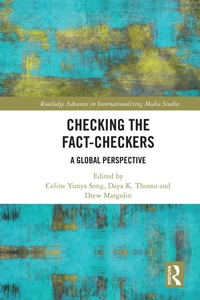
Checking the Fact-Checkers
A Global Perspective
Published on 8. December 2025
338 pages
978-1-040-51163-3 (ISBN)
Description

Checking the Fact-Checkers offers a multi-disciplinary resource of global and state-of-the-art academic research and industrial practices in fact-checking from leading and emerging scholars around the world.
Chapters in this book provide a unique global and multi-disciplinary perspective for understanding the landscape of fact-checking initiatives and formulating effective and context-dependent strategies of fact-checking. Scholars from different regions, fields, and disciplines explore the dynamics of global fact-checking initiatives and provide in-depth analyses of both its practical and theoretical aspects. Arranged thematically, the book first focuses on the impact of fact-checking on the practice and principles of professional journalism and then reports on the latest research into the methods and models of fact-checking techniques and solutions. The focus then shifts to the consumers of fact-checking, on how people use fact-checking and their attitudes toward it, before looking at the civic role of fact-checking in different political systems and how children and young people can be educated and trained to be 'fact-checkers' themselves. The volume concludes with alternative approaches to and critiques of the concept of fact-checking, to understand what its limitations might be.
This book will be an important resource for students, teachers, and researchers in journalism, media and communication, politics and sociology, as well as those in the fields of artificial intelligence, information systems, law, policy, and ethics.
Chapters in this book provide a unique global and multi-disciplinary perspective for understanding the landscape of fact-checking initiatives and formulating effective and context-dependent strategies of fact-checking. Scholars from different regions, fields, and disciplines explore the dynamics of global fact-checking initiatives and provide in-depth analyses of both its practical and theoretical aspects. Arranged thematically, the book first focuses on the impact of fact-checking on the practice and principles of professional journalism and then reports on the latest research into the methods and models of fact-checking techniques and solutions. The focus then shifts to the consumers of fact-checking, on how people use fact-checking and their attitudes toward it, before looking at the civic role of fact-checking in different political systems and how children and young people can be educated and trained to be 'fact-checkers' themselves. The volume concludes with alternative approaches to and critiques of the concept of fact-checking, to understand what its limitations might be.
This book will be an important resource for students, teachers, and researchers in journalism, media and communication, politics and sociology, as well as those in the fields of artificial intelligence, information systems, law, policy, and ethics.
More details
Series
Language
English
Place of publication
London
United Kingdom
Publishing group
Taylor & Francis Ltd
Target group
College/higher education
Professional and scholarly
Illustrations
29 Tables, black and white; 4 Line drawings, black and white; 35 Halftones, black and white; 39 Illustrations, black and white
File size
10,05 MB
ISBN-13
978-1-040-51163-3 (9781040511633)
Copyright in bibliographic data and cover images is held by Nielsen Book Services Limited or by the publishers or by their respective licensors: all rights reserved.
Schweitzer Classification
Other editions
Additional editions
Book
approx. 12/2025
1st Edition
Routledge
€212.00
Not yet published
Persons
Celine Yunya Song is Professor in the Academy of Interdisciplinary Studies at the Hong Kong University of Science and Technology. Her research spans digital media, global communication, computational social science, and cyber-psychology and behavior. Previously, she served as a professor and associate dean at the School of Communication, Hong Kong Baptist University. She is also an associate editor of Computers in Human Behavior and Mass Communication and Society.
Daya K. Thussu is Professor of International Communication at Hong Kong Baptist University. He is the President of the International Association for Media and Communication Research (IAMCR).
Drew Margolin is Associate Professor in the Department of Communication at Cornell University. His research focuses on computational social science, social networks, and misinformation. He is also associate editor for the journal Computational Communication Research.
Daya K. Thussu is Professor of International Communication at Hong Kong Baptist University. He is the President of the International Association for Media and Communication Research (IAMCR).
Drew Margolin is Associate Professor in the Department of Communication at Cornell University. His research focuses on computational social science, social networks, and misinformation. He is also associate editor for the journal Computational Communication Research.
Content
Introduction
1. A study of the causes and generation mechanisms of international fake news: A Crisp-Set Qualitative Comparative Analysis
2. Notes on Truth-seeking Conceptions and Fact-checking Practices in the Chinese News System
3. Expanding Repertoires: The Emerging Fact-Checking Traditions in the 2022 Philippines Election
4. Contextualizing Institutional Roots, Normative Perceptions, and Practices of Fact-Checking: Evidence from Hong Kong's Fact-Checking Initiatives
5. 'Biased facts': exploring fact-checking and ideological contestation in India
6. Mapping the Boundaries of Fact-checking: Concrete vs. Arbitrary Criteria for Misinformation Selection
7. Towards an Integrative Model for the Automated Detection of Fake News
8. Propagation Structure Learning for Misinformation Detection
9. COVID-19 Fake News Detection on Cantonese Social Media: A Comparative Study of Machine Learning-based Methods
10. Selective citations in fact-checking: Proposing an analytical approach
11. Natural Disasters Meet Rumours on Social Media: Do Spatiotemporal and Emotion Proximity Matter for Spread and Correction?
12. Fact-checking, Belief Accuracy and Media Trust: A Research Synthesis
13. The Promises and Pitfalls of Growing Public Participation in Fact-checking: Technical and Cultural Factors in East Asian Societies
14. Fact-checking by the people? Report-based 'rumour-refuting' on Chinese social media and media populism*
15. A remedy for epistemic pollution? Public and professional reactions to fact-checking with Wikipedia in Australian classrooms
16. EUfactcheck.eu student project: the network, the platform, the tools
17. On the democratic role of fact checking. A reflective essay
18. Fact-checking political narratives
19. Conspiracy Theories, Their Critical Value, and the Limits of Factchecking: Climate Change Documentaries
20. From fact-checking to debunking: the French experience in the fight against disinformation
Index
1. A study of the causes and generation mechanisms of international fake news: A Crisp-Set Qualitative Comparative Analysis
2. Notes on Truth-seeking Conceptions and Fact-checking Practices in the Chinese News System
3. Expanding Repertoires: The Emerging Fact-Checking Traditions in the 2022 Philippines Election
4. Contextualizing Institutional Roots, Normative Perceptions, and Practices of Fact-Checking: Evidence from Hong Kong's Fact-Checking Initiatives
5. 'Biased facts': exploring fact-checking and ideological contestation in India
6. Mapping the Boundaries of Fact-checking: Concrete vs. Arbitrary Criteria for Misinformation Selection
7. Towards an Integrative Model for the Automated Detection of Fake News
8. Propagation Structure Learning for Misinformation Detection
9. COVID-19 Fake News Detection on Cantonese Social Media: A Comparative Study of Machine Learning-based Methods
10. Selective citations in fact-checking: Proposing an analytical approach
11. Natural Disasters Meet Rumours on Social Media: Do Spatiotemporal and Emotion Proximity Matter for Spread and Correction?
12. Fact-checking, Belief Accuracy and Media Trust: A Research Synthesis
13. The Promises and Pitfalls of Growing Public Participation in Fact-checking: Technical and Cultural Factors in East Asian Societies
14. Fact-checking by the people? Report-based 'rumour-refuting' on Chinese social media and media populism*
15. A remedy for epistemic pollution? Public and professional reactions to fact-checking with Wikipedia in Australian classrooms
16. EUfactcheck.eu student project: the network, the platform, the tools
17. On the democratic role of fact checking. A reflective essay
18. Fact-checking political narratives
19. Conspiracy Theories, Their Critical Value, and the Limits of Factchecking: Climate Change Documentaries
20. From fact-checking to debunking: the French experience in the fight against disinformation
Index
