

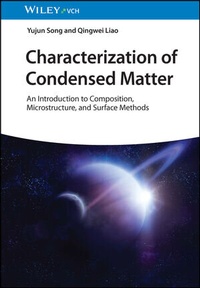
Characterization of Condensed Matter
An Introduction to Composition, Microstructure, and Surface Methods
1st Edition
Published on 1. August 2023
368 pages
978-3-527-83992-6 (ISBN)
Description

A comprehensive book that includes essential techniques with their fundamental, instrumentation and application in structural and composition characterization of condensed matter.
More details
Other editions
Additional editions
Yujun Song | Qingwei Liao
Characterization of Condensed Matter
An Introduction to Composition, Microstructure, and Surface Methods
Book
09/2023
1st Edition
Wiley-VCH
€115.00
Shipment within 5-7 days
Persons
Yujun Song is currently a full Professor in Applied Physics at University of Science and Technology Beijing, China, Deputy Director of Center for Modern Physics Research. After obtaining his Ph D degree in Materials science & Engineering in 2000, he has successively worked at Louisiana State University and Old Dominion University for 8 years, University of Toronto for one year and Harvard University for one and half years. His research areas are focusing in surface and interface controlled fabrication of functional nano/micro materials for biomedical engineering, new energy & industrial catalysis and information technology via novel microfluidic process, template assisted transfer nano-imprinting and varieties of inorganic-organic interface clading processes at nano/atomic scale. He serves as the main lecturer of courses like Characterization methods of Microstructures and Composition of Condensed Matter & Introduction of Advanced Science and Technology courses for undergraduates for 14 years, and also serves as the main lecturer of courses of Testing Methods of Materials & Introduction of Thin films and Coatings of Specific Cases for graduate students.
Qingwei Liao received her PhD degree from Tianjin University, China, in Microelectronics, in 2012, visited Harvard University for one year from 2018 to 2019, and is currently an Associate Professor of Beijing Information Science and Technology University. She has published more than 60 SCI-indexed journal papers. Her research area include: applied physics, nano materials, sensing technology and energy conversion, absorbing materials, ferro/piezo materials. She serves as the main lecturer of courses like Modern analytical testing methods for graduate students.
Qingwei Liao received her PhD degree from Tianjin University, China, in Microelectronics, in 2012, visited Harvard University for one year from 2018 to 2019, and is currently an Associate Professor of Beijing Information Science and Technology University. She has published more than 60 SCI-indexed journal papers. Her research area include: applied physics, nano materials, sensing technology and energy conversion, absorbing materials, ferro/piezo materials. She serves as the main lecturer of courses like Modern analytical testing methods for graduate students.
Content
PART I. Fundamental of Universe, Matter, Condensed Matter and Crystallography
Chapter 1. Universe, Matter, Condensed Matter and Materials
Chapter 2. Laser Interferometer Gravitational Wave Observatory
Chapter 3. Fundamentals of Crystallography for Microstructure Characterization of Condensed Matter
PART II. Electromagnetic Spectroscopy
Chapter 4. Element of X-Ray Diffraction
Chapter 5. X-Ray Fluorescence Spectroscopy (XRF)
Chapter 6. X-Ray Emission Spectroscopy (XES)
Chapter 7. X-Ray Absorption Spectroscopy (XAS): X-Ray Absorption Near Edge Structure (XANES) and Extended X-Ray Absorption Fine Structure (EXAFS)
Chapter 8. X-Ray Raman Scattering (XRS(
Chapter 9. Fourier Transform Infrared Spectroscopy (FTIR)
Chapter 10. Energy Dispersive X-Ray Spectrum of Elements (EDX)
PART III. Characterization Methods Based on the Particle (Electron or Electron Beam, Neutron)-Matter Interaction
Chapter 11. Scanning Electron Microscope (SEM)
Chapter 12. Transmission Electron Microscope (TEM)
Chapter 13. Spherical Aberration Corrected Transmission Electron Microscope (SAC-TEM)
Chapter 14. Environmental Transmission Electron Microscope (ETEM)
Chapter 15. Holography
PART IV. Characterization Methods for Hyperfine Structures Related to the Magnetic Properties of Electrons and Nuclei
Chapter 16. Nuclear Magnetic Resonance Spectroscopy
Chapter 17. Mössbauer Effect and Mössbauer Spectroscopy
PART V. Surface Analysis Method
Chapter 18. Atomic Force Microscope (AFM)
Chapter 19. X-Ray Photoelectron Spectroscopy (XPS)
PART VI. Some Progress and Perspective
Chapter 20. Instrumentation Based on Fundamental Progress in Interaction Electromagnetic Wave and Matter, and Electron-Matter Interaction
Chapter 1. Universe, Matter, Condensed Matter and Materials
Chapter 2. Laser Interferometer Gravitational Wave Observatory
Chapter 3. Fundamentals of Crystallography for Microstructure Characterization of Condensed Matter
PART II. Electromagnetic Spectroscopy
Chapter 4. Element of X-Ray Diffraction
Chapter 5. X-Ray Fluorescence Spectroscopy (XRF)
Chapter 6. X-Ray Emission Spectroscopy (XES)
Chapter 7. X-Ray Absorption Spectroscopy (XAS): X-Ray Absorption Near Edge Structure (XANES) and Extended X-Ray Absorption Fine Structure (EXAFS)
Chapter 8. X-Ray Raman Scattering (XRS(
Chapter 9. Fourier Transform Infrared Spectroscopy (FTIR)
Chapter 10. Energy Dispersive X-Ray Spectrum of Elements (EDX)
PART III. Characterization Methods Based on the Particle (Electron or Electron Beam, Neutron)-Matter Interaction
Chapter 11. Scanning Electron Microscope (SEM)
Chapter 12. Transmission Electron Microscope (TEM)
Chapter 13. Spherical Aberration Corrected Transmission Electron Microscope (SAC-TEM)
Chapter 14. Environmental Transmission Electron Microscope (ETEM)
Chapter 15. Holography
PART IV. Characterization Methods for Hyperfine Structures Related to the Magnetic Properties of Electrons and Nuclei
Chapter 16. Nuclear Magnetic Resonance Spectroscopy
Chapter 17. Mössbauer Effect and Mössbauer Spectroscopy
PART V. Surface Analysis Method
Chapter 18. Atomic Force Microscope (AFM)
Chapter 19. X-Ray Photoelectron Spectroscopy (XPS)
PART VI. Some Progress and Perspective
Chapter 20. Instrumentation Based on Fundamental Progress in Interaction Electromagnetic Wave and Matter, and Electron-Matter Interaction
