

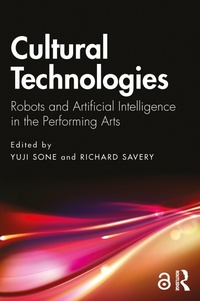
Cultural Technologies
Robots and Artificial Intelligence in the Performing Arts
Published on 23. May 2025
216 pages
978-1-040-36037-8 (ISBN)
Description

Cultural Technologies: Robots and Artificial Intelligence in the Performing Arts presents a diverse range of perspectives from leading scholars and artists on contemporary performing arts practices that engage with robotic and AI (artificial intelligence) technologies.
In Part One, "Robot/AI Cultures and Performing Arts Practices," contributors discuss how cultural understandings of robots and AI influence the audience's reception of performance works that feature such technologies and inspire artistic innovation. The chapters in Part Two, "Performing Arts Cultures and Robots/AI Developments," explore how theories and practices of the performing arts can engender critical dialogue on matters of cultural difference concerning culturally non-specific (though implicitly Western) framings of robotic and AI technologies within science and engineering contexts.
Reorienting the conversation around robotics and AI in the performing arts to place culture at its centre, Cultural Technologies: Robots and Artificial Intelligence in the Performing Arts offers thought-provoking analyses for advanced undergraduates, researchers, and performing arts practitioners interested in the relationships between music, theatre, and dance, and cutting-edge robotic and AI technologies.
In Part One, "Robot/AI Cultures and Performing Arts Practices," contributors discuss how cultural understandings of robots and AI influence the audience's reception of performance works that feature such technologies and inspire artistic innovation. The chapters in Part Two, "Performing Arts Cultures and Robots/AI Developments," explore how theories and practices of the performing arts can engender critical dialogue on matters of cultural difference concerning culturally non-specific (though implicitly Western) framings of robotic and AI technologies within science and engineering contexts.
Reorienting the conversation around robotics and AI in the performing arts to place culture at its centre, Cultural Technologies: Robots and Artificial Intelligence in the Performing Arts offers thought-provoking analyses for advanced undergraduates, researchers, and performing arts practitioners interested in the relationships between music, theatre, and dance, and cutting-edge robotic and AI technologies.
More details
Language
English
Place of publication
London
United Kingdom
Publishing group
Taylor & Francis Ltd
Target group
College/higher education
Professional and scholarly
Illustrations
2 Line drawings, black and white; 26 Halftones, black and white; 28 Illustrations, black and white
File size
10,06 MB
ISBN-13
978-1-040-36037-8 (9781040360378)
Copyright in bibliographic data and cover images is held by Nielsen Book Services Limited or by the publishers or by their respective licensors: all rights reserved.
Schweitzer Classification
Other editions
Additional editions

Cultural Technologies
Robots and Artificial Intelligence in the Performing Arts
Book
06/2025
Routledge
Unfortunately, price unknown
Available (delivery time upon request)
Yuji Sone | Richard Savery
Cultural Technologies
Robots and Artificial Intelligence in the Performing Arts
Book
05/2025
1st Edition
Routledge
€205.40
Shipment within 10-20 days
Yuji Sone | Richard Savery
Cultural Technologies
Robots and Artificial Intelligence in the Performing Arts
Book
05/2025
1st Edition
Routledge
€63.10
Shipment within 10-20 days
Persons
Dr. Yuji Sone is a senior lecturer in the Department of Media, Communications, Creative Arts, Language and Literature at Macquarie University, Australia. His research has focused on the cross-disciplinary conditions of technologised performance.
Dr. Richard Savery is a developer of AI and robotics, using music and creativity as a medium to programme better interactions, understandings, and models. He is currently a research fellow at Macquarie University, Australia, developing new robotic musicians. His current research focuses on the creation of a new drumming and rapping robot, as well as robots painting to music and musical captcha.
Dr. Richard Savery is a developer of AI and robotics, using music and creativity as a medium to programme better interactions, understandings, and models. He is currently a research fellow at Macquarie University, Australia, developing new robotic musicians. His current research focuses on the creation of a new drumming and rapping robot, as well as robots painting to music and musical captcha.
Content
PART ONE: Robot/AI Cultures and Performing Arts Practices
1. Introduction: New conversations across the Performing Arts
Yuji Sone
2. I am Going to Turn into Peter: Glitching Human-Robot interactions
Yaron Shyldkrot
3. Medusai: A Multimodal Large Scale Robotic Musician
Amit Rogel, Jiahe Qian, Ripken Walker, Nicollete Cash, Emily Liu. Hope Phan, Hannah Schlisky, Tristan Al-Haddad and Gil Weinberg
4. Roboethics and Care in 2032 SMART-FAMILY
Marina Hanganu
5. Choreographing the Future: AI, Dance, and Cultural Transformation
Tanvi Raghuram, Kohinoor M. Darda and Emily S. Cross
6. Keiichiro Shibuya's Android Opera: The Theatrics of Exoticism
Yuji Sone
PART TWO: Performing Arts Cultures and Robots/AI Developments
7. Chikamatsu, Mori, and the Uncanny Valley
Karl F. MacDorman
8. Towards Embodied AI: Design Approaches for Robots in Opera
Elizabeth Jochum, Tim Hopkins, Chris Kiefer and Evelyn Ficarra
9. What Does it Mean? On Platform-Invariant "Body-Language" Dictionaries
Amy LaViers
10. Questions of Voice in AI Music.
Denis Crowdy and James Leach
11. What Do I Say? Public Interactions with a Drumming and Rapping Robot
Richard Savery, Trinity Melder and Melissa Hill
12. A.I. Anne: Advocacy, Empathy, and Creative Collaborations between Artists and Generative A.I.
Janet Biggs
1. Introduction: New conversations across the Performing Arts
Yuji Sone
2. I am Going to Turn into Peter: Glitching Human-Robot interactions
Yaron Shyldkrot
3. Medusai: A Multimodal Large Scale Robotic Musician
Amit Rogel, Jiahe Qian, Ripken Walker, Nicollete Cash, Emily Liu. Hope Phan, Hannah Schlisky, Tristan Al-Haddad and Gil Weinberg
4. Roboethics and Care in 2032 SMART-FAMILY
Marina Hanganu
5. Choreographing the Future: AI, Dance, and Cultural Transformation
Tanvi Raghuram, Kohinoor M. Darda and Emily S. Cross
6. Keiichiro Shibuya's Android Opera: The Theatrics of Exoticism
Yuji Sone
PART TWO: Performing Arts Cultures and Robots/AI Developments
7. Chikamatsu, Mori, and the Uncanny Valley
Karl F. MacDorman
8. Towards Embodied AI: Design Approaches for Robots in Opera
Elizabeth Jochum, Tim Hopkins, Chris Kiefer and Evelyn Ficarra
9. What Does it Mean? On Platform-Invariant "Body-Language" Dictionaries
Amy LaViers
10. Questions of Voice in AI Music.
Denis Crowdy and James Leach
11. What Do I Say? Public Interactions with a Drumming and Rapping Robot
Richard Savery, Trinity Melder and Melissa Hill
12. A.I. Anne: Advocacy, Empathy, and Creative Collaborations between Artists and Generative A.I.
Janet Biggs
