

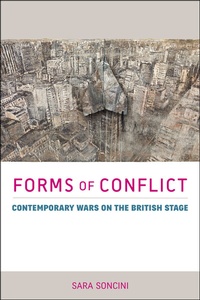
Forms of Conflict
Contemporary Wars on the British Stage
1st Edition
Published on 31. July 2019
314 pages
978-0-85989-083-0 (ISBN)
Description

Forms of Conflict is a full-length study of the representation of contemporary warfare on the British stage and investigates the strategies deployed by theatre practitioners in Britain as they meet the representational challenges posed by the 'new wars' of the global era.
It questions how dramatists have responded aesthetically to the changing nature of conflict, focusing on plays written and performed after the September 11 terrorist attacks. Soncini examines how the works of playwrights such as Caryl Churchill, David Hare, Martin Crimp and Simon Stephens have provided an interpretative means to enlarge our understanding of the new patterns of conflict, ensuring theatre's continued cultural and political relevance.
Forms of Conflict explores the relationship between new forms of warfare and new forms of drama, illustrating what dramatic form can reveal about the post-9/11 landscape and complementing a rapidly growing field of contemporary war studies.
The appendix contains a complete list of war-related plays staged in Britain between 1990 and 2010, with a brief description of their topic and approach.
It questions how dramatists have responded aesthetically to the changing nature of conflict, focusing on plays written and performed after the September 11 terrorist attacks. Soncini examines how the works of playwrights such as Caryl Churchill, David Hare, Martin Crimp and Simon Stephens have provided an interpretative means to enlarge our understanding of the new patterns of conflict, ensuring theatre's continued cultural and political relevance.
Forms of Conflict explores the relationship between new forms of warfare and new forms of drama, illustrating what dramatic form can reveal about the post-9/11 landscape and complementing a rapidly growing field of contemporary war studies.
The appendix contains a complete list of war-related plays staged in Britain between 1990 and 2010, with a brief description of their topic and approach.
Reviews / Votes
Uno studio esemplarmente interdisciplinare.Accanto alle forme del teatro di guerra contemporaneo, ricostruite e indagate con una scrittura agile e vivace, mediate da uno sguardo critico raffinato e scrupolosamente analitico, emergono infatti le opacita e le ambiguita dei conflitti che quella scena illumina. E vengono ripercorse con circostanziata meticolosita le pieghe di una violenza mistificata dagli scenari e dalle narrazioni mediatiche. Per questo sguardo multiplo - estetico, storico e culturale - sostenuto da un solidissimo apparato teorico e bibliografico, Forms of Conflict si propone come un contributo prezioso per chi voglia capire, a ttraverso le forme tuttora in divenire di questo teatro, le logiche di una violenza che continua a perpetuarsi nelle "nuove guerre."
Read the full review by Allessandra Marzola here: http://www.iperstoria.it/joomla/images/PDF/Numero_11/recensioni_11/Marzola.pdf -- Alessandra Marzola, University of Bergamo * Iperstoria, Indice Numero XI - Spring/Summer 2018 * In this rich and expansive study, Sara Soncini grapples with a timely question: how have theatre practitioners - particularly playwrights - represented and responded to the theatrical challenges of contemporary globalized and highly mediatized warfare?
Soncini weaves together an intricate and insightful analysis of the reshaping of dramatic form that has occurred alongside conceptual shifts in contemporary warfare.
Soncini concludes the book with a thorough and much appreciated appendix that catalogues war-centric plays that premiered in the United Kingdom between 1991 and 2011, and provides information including title, playwright, dates and warscape.
Rather than a single, unified explanation, Forms of Conflict offers a multifaceted approach to navigating recent theatrical responses to war. The study is authoritatively argued, far-reaching in its scope and a welcome contribution to the fields of theatre and performance studies. Furthermore, its interdisciplinary approach yields an impact in several diverse fields including globalization studies, trauma studies and postmodern cultural studies. -- Alison Christy, University of Kansas * Theatre Research International, 43.1, Oct. 2017 * With Forms of Conflict, Soncini adds an art-based focus to the growing literature of contemporary war studies and also connects theater studies to political science research into the rhetorical strategies of war. Using detailed descriptions and persuasive close reading of recent performances, Soncini paints a thorough picture of contemporary British theater and offers a timely reminder of art's power to disrupt the discourses of war.
Forms of Conflict contains rich close readings of scripts and meticulous descriptions of performances. Soncini has a knack for imagery that draws readers into the performance experience while simultaneously directing them to key points in her analysis.
Even if the reader is unfamiliar with the scripts or productions Soncini discusses, her colorful depictions form a clear picture. Soncini also provides comprehensive historical context for events like the Bloody Sunday inquiry or the July 7, 2005 bombings in London, and this attention to details strengthens her argument. -- Susanne Shawyer, Elon University * Journal of British Studies, Volume 56, Issue 4, October 2017 * This is a timely and meticulously researched volume on the representation of war on the British stage written around or after the September 11 terrorist attacks. It confronts the aesthetic and political challenges of this representation by focusing on a select group of dramatists who have made significant contributions to British drama.
There is a rapidly growing field of contemporary war studies in university arts, theatre and performance departments and this book would be a welcome addition to the range of texts already on offer.
Dr Dawn Fowler, Senior Lecturer in Drama, University of the West of England -- Dr Dawn Fowler, Senior Lecturer in Drama, University of the West of England
More details
Series
Language
English
Place of publication
Exeter
United Kingdom
Target group
College/higher education
ISBN-13
978-0-85989-083-0 (9780859890830)
Copyright in bibliographic data and cover images is held by Nielsen Book Services Limited or by the publishers or by their respective licensors: all rights reserved.
Schweitzer Classification
Other editions
Additional editions
E-Book
07/2019
1st Edition
University of Exeter Press
from
€50.99
Available for download
Book
04/2016
University of Exeter
€92.85
Shipment within 15-20 days
Book
04/2016
University of Exeter
€27.86
Shipment within 15-20 days
Person
Dr Sara Soncini is a researcher in the Department of Philology, Literature and Linguistics at the University of Pisa. Her research interests include 20th and 21st-century British drama and theatre, with specific emphasis on the representation of war and conflict, and the aesthetics and politics of intertextual and metatheatrical strategies.
Content
Acknowledgments
1. Introduction: Scenes of War
2. This is Not a War: Mimesis in the Age of Simulacra
2.1 Presages
2.2 Far away, so close
2.3 Media narratives
3. War without Conflict / Theatre without Drama
3.1 Fragments from a warrior's discourse
3.2 The rest is silence
3.3 There's method in this randomness
4. 'Why Fabulate?'
4.1 Documenting war
4.2 The tribunal play: extending the code
4.3 Uneasy coaltions
5. The Performance of Witnessing
5.1 The talking cure
5.2 The artist is present
5.3 Technologies of recollection
6. Figures of Mediation
6.1 The translation turn
6.2 The mediator's invisibility
6.3 The combat linguist
6.4 Uncanny bodies
Appendix: New War Plays on the British Stage, 1990-2010
Works Cited
Index
1. Introduction: Scenes of War
2. This is Not a War: Mimesis in the Age of Simulacra
2.1 Presages
2.2 Far away, so close
2.3 Media narratives
3. War without Conflict / Theatre without Drama
3.1 Fragments from a warrior's discourse
3.2 The rest is silence
3.3 There's method in this randomness
4. 'Why Fabulate?'
4.1 Documenting war
4.2 The tribunal play: extending the code
4.3 Uneasy coaltions
5. The Performance of Witnessing
5.1 The talking cure
5.2 The artist is present
5.3 Technologies of recollection
6. Figures of Mediation
6.1 The translation turn
6.2 The mediator's invisibility
6.3 The combat linguist
6.4 Uncanny bodies
Appendix: New War Plays on the British Stage, 1990-2010
Works Cited
Index
