

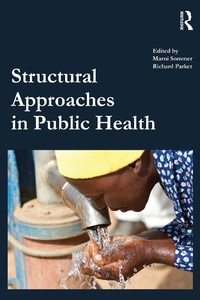
Structural Approaches in Public Health
1st Edition
Published on 26. April 2013
288 pages
978-1-136-76612-1 (ISBN)
Description

A CHOICE Outstanding Academic Title 2014!
That health has many social determinants is well established and a myriad range of structural factors - social, cultural, political, economic, and environmental - are now known to impact on population well-being. Public health practice has started exploring and responding to a range of health-related challenges from a structural paradigm, including individual and population vulnerability to infection with HIV and AIDS, injury-prevention, obesity, and smoking cessation.
Recognising the inadequacy of public health responses that focus solely on individual behaviour change to improve population health outcomes, this text promotes a more holistic approach. Discussing the structural factors related to health and well-being that are both within and outside of an individual's control, it explores what form structural approaches can take, the underlying theory of structure as a risk factor and the local realities, environments, and priorities that public health practitioners need to take into consideration. Anchored in empirical evidence, the book provides case studies of innovative and influential interventions - from the 100% condom program, to urban planning, injury prevention, and the provision of adequate clean drinking water and sanitation systems - and concludes with a section on implementing and evaluating structural public health programs.
This comprehensive text brings together a selection of internationally-recognised authors to provide an overview for students and practitioners working in or concerned with public health around the globe.
That health has many social determinants is well established and a myriad range of structural factors - social, cultural, political, economic, and environmental - are now known to impact on population well-being. Public health practice has started exploring and responding to a range of health-related challenges from a structural paradigm, including individual and population vulnerability to infection with HIV and AIDS, injury-prevention, obesity, and smoking cessation.
Recognising the inadequacy of public health responses that focus solely on individual behaviour change to improve population health outcomes, this text promotes a more holistic approach. Discussing the structural factors related to health and well-being that are both within and outside of an individual's control, it explores what form structural approaches can take, the underlying theory of structure as a risk factor and the local realities, environments, and priorities that public health practitioners need to take into consideration. Anchored in empirical evidence, the book provides case studies of innovative and influential interventions - from the 100% condom program, to urban planning, injury prevention, and the provision of adequate clean drinking water and sanitation systems - and concludes with a section on implementing and evaluating structural public health programs.
This comprehensive text brings together a selection of internationally-recognised authors to provide an overview for students and practitioners working in or concerned with public health around the globe.
Reviews / Votes
'The book is a welcome addition to the literature for professionals and researchers interested in the art and science of defining, designing, implementing, and evaluating structural public health programs. ... This outstanding book should be required reading for those interested in enhancing their understanding of the complexities involved in structural and environmental approaches in public health. Summing Up: Essential. Upper-division undergraduates through professionals/practitioners.' - D.E. Bill, West Chester University, in CHOICE, May 2014'Structural approaches are essential to advance population health, and yet they are often under-resourced and less promoted as compared to medical interventions. This book uniquely brings together the experience of some of the world's experts in this field, covering many aspects of public health' - Peter Piot, Professor of Global Health and Director of the London School of Hygiene and Tropical Medicine, UK
'This book is a must for anyone interested in understanding public health prevention and intervention science in general and structural interventions in particular. The chapters represent a multitude of disciplinary and international perspectives that cover the complex theoretical underpinnings of the field as intelligently as they do its implications for the design and evaluation of specific interventions. Together, the chapters remind us that the successful promotion of public health, both globally and locally, urgently requires solutions that attend to inequality within and between societies, and identify a range of concrete directions and opportunities for developing such solutions.' - Kim M. Blankenship, Professor and Director of the Center on Health, Risk and Society, American University, USA
More details
Language
English
Place of publication
London
United Kingdom
Publishing group
Taylor & Francis Ltd
Target group
College/higher education
Professional and scholarly
Illustrations
8 s/w Tabellen, 30 s/w Zeichnungen
8 Tables, black and white; 30 Line drawings, black and white
File size
4,59 MB
ISBN-13
978-1-136-76612-1 (9781136766121)
Copyright in bibliographic data and cover images is held by Nielsen Book Services Limited or by the publishers or by their respective licensors: all rights reserved.
Schweitzer Classification
Other editions
Additional editions
Marni Sommer | Richard Parker
Structural Approaches in Public Health
An Introduction to Intervention and Evaluation
Book
03/2013
1st Edition
Routledge
€252.30
Shipment within 15-20 days
Marni Sommer | Richard Parker
Structural Approaches in Public Health
An Introduction to Intervention and Evaluation
Book
03/2013
1st Edition
Routledge
€74.80
Shipment within 15-20 days
Persons
Marni Sommer is Assistant Professor of Sociomedical Sciences, and Director of the Global Health Track for the Department of Sociomedical Sciences, at Columbia University's Mailman School of Public Health, USA. She is the Executive Editor of the journal Global Public Health.
Richard Parker is Professor of Sociomedical Sciences and Anthropology, and Director of the Center for the Study of Culture, Politics, and Health at Columbia University, USA. He is Editor-in-Chief of the journal Global Public Health.
Richard Parker is Professor of Sociomedical Sciences and Anthropology, and Director of the Center for the Study of Culture, Politics, and Health at Columbia University, USA. He is Editor-in-Chief of the journal Global Public Health.
Content
Chapter 1. Introduction: Structural Approaches in Public Health Marni Sommer and Richard Parker Part 1: Defining Structural Factors Chapter 2. The History of Structural Approaches in Public Health James Colgrove, Amy Fairchild, and David Rosner Chapter 3. Social Inequalities and Public Health Ruth Bell, Peter Goldblatt, and Michael Marmot Chapter 4. Embracing Complexity: Towards Platforms for Integrated Health and Social Service Delivery Andrew Ellner, Christine Pace, Scott Lee, Jonathan L. Weigel, and Paul Farmer Chapter 5. Ideological Barriers to Structural Interventions: Towards a Model of Values-Based Interventions Michael Sweat and Kevin O'Reilly Chapter 6. Getting the Balance Right: Agency and Structure in HIV Prevention Peter Aggleton, Jean Shoveller, Kate Shannon, Thomas Kerr, and Rod Knight Part 2: Designing and Implementing Structural Interventions Chapter 7. Integrating Water and Sanitation Interventions for Health: A Case Study from eThekwini Municipality Elisa Roma, Neil Macleod, and Christopher Buckley Chapter 8. City Planning as a Structural Determinant of Health: Towards Healthy Urban Governance in the Century of the City Jason Corburn Chapter 9. The 100% Condom Use Programme: A Structural Intervention to Prevent HIV and Sexually Transmitted Infections in Asia Wiwat Rojanapithayakorn and Richard Steen Chapter 10. The Sonagachi/Durbar Programme: A Prototype of a Community-led Structural Intervention for HIV Prevention Dallas Swendeman and Smarajit Jana Chapter 11. Breaking the Links: Legal and Paralegal Assistance to Reduce Health Risks of Police and Pre-Trial Detention of Sex Workers and People Who Use Drugs Daniel Wolfe, Jonathan Cohen, Heather Doyle, and Tatyana Margolin Chapter 12. Structured Environments and Dietary-Related Chronic Diseases Deborah A. Cohen Chapter 13. Structural Approaches for Unintentional Injury Prevention Adnan A. Hyder and Jeffrey C. Lunnen Part 3: Evaluating Structural Interventions Chapter 14. Evaluating Structural Interventions in Public Health: Challenges, Options and Global Best Practice Paul Pronyk, Jennifer Schaefer, Marie-Andree Somers, and Lori Heise Chapter 15. Developing and Evaluating Structural-Environmental Interventions to Reduce HIV Risk Among Female Sex Workers and their Sexual Partners in the Dominican Republic Deanna Kerrigan, Clare Barrington, and Luis Moreno Chapter 16. Helmet Day! Structural Intervention and Strategic Learning in Vietnam Mary Byrne McDonnell and Alyson Metzger Chapter 17. Ending the Tobacco Epidemic: From the Genetic to the Global Level Jonathan M. Samet and Heather L. Wipfli Chapter 18. Social Policy Interventions and Health Celina Su and Peter Muennig
