

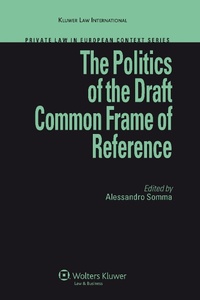
The Politics of the Draft Common Frame of Reference
Published on 22. June 2009
248 pages
978-90-411-4482-9 (ISBN)
Description

This collection of essays reflects both the diversity of the group's work and the common thread that runs through it. The core claim here is that the DCFR, despite the Commission's characterization of its proposals as purely technical, cannot escape politics. The intent is to critically identify and evaluate the model of social justice underlying the DCFR.
More details
Other editions
Additional editions
Alessandro Somma
The Politics of the Draft Common Frame of Reference
Book
06/2009
Kluwer Law International
€194.62
Shipment within 10-20 days
Content
- Intro
- Title Page
- Copyright Page
- List of Contributors
- Summary of Contents
- Table of Contents
- Preface
- List of Abbreviations
- Part One: The Shaping of a European Private Law
- Chapter 1: An Optional Instrument for Consumer Contracts in the EU: Conflict of Laws and Conflict of Policies
- 1. From the European Civil Code to the Optional Instrument: A Brief History
- 2. CFR and Optional Instrument: The Same or Different Bodies of Rules?
- 3. An Optional Instrument for Consumer Contracts
- 4. No Discrimination between Domestic and Cross-Border Consumer Contracts
- 5. The Optional Instrument and the Rome I Regulation
- 6. Conflict of Laws and Conflict of Policies
- 7. An Optional Contract Act Following the Nordic Model?
- Chapter 2: Grand European Code Napole´on or Concise Uniform Contract Law? Defining the Scope of a Common Frame of Reference
- 1. The DCFR as a Step toward a European Code?
- 2. How Big a Code? Or 'Do Contracts Well!'
- 2.1. Which Fields to Include?
- 2.2. Do Contracts Need Torts or Vice Versa?
- 2.3. How to Deal with Little Common Ground and Intersections?
- 3. For Which Private Law Subjects?
- 3.1. Traditional Approaches to the Question of Different Contract Types of Contract Partners
- 3.2. Modern Integration Approaches: Policy Considerations
- 4. Core Substantive Contract Law Questions in Too Grand a Code
- 4.1. Building a Consistent Information Model and Questions of Power within the Formation of Contracts
- 4.2. System Building: Long-Term Service Contracts and Networks Just a Variant of Traditional Exchange Contracts?
- 5. It is Time for System Competition
- Chapter 3: The DCFR: A Technical or Political Toolbox?
- 1. Introduction
- 2. The DCFR as a Technical Toolbox: True or False?
- 2.1. Private Law Rules and the Link to the Market Order
- 2.2. The 'Best Solution': A Non-neutral Stance
- 2.3. The Goals of Transparency, Simplification, and Coherency
- 2.4. A Toolbox Containing Model Rules
- 2.4.1. The Effectiveness of Soft Law
- 2.4.2. Open-Ended Rules and Uniformity
- 3. The Implications of the DCFR as a Political Toolbox
- Chapter 4: Some Like It Soft: Soft Law and Hard Law in the Shaping of European Contract Law
- 1. The Allure of Softness
- 1.1. Overcoming Legal Positivism
- 1.2. The Development of an Order with Graduated Normativity
- 1.3. The Genealogy of Soft Law
- 2. Soft Law and a Europe of Rights
- 2.1. Open Method of Coordination versus Harmonization
- 2.2. EC-Fundamental Rights versus National Fundamental Rights
- 3. A Europe of Markets
- 3.1. The Contribution of Neo-Pandectistic
- 3.2. The Role of Legal Science in Drafting the DCFR
- 3.3. The DCFR as an Academic Codification
- 3.4. The Prestige of the DCFR
- 4. Mandatory and Non-mandatory Rules in European Contract Law
- 4.1. The Private Law Society
- 4.2. The Social Market Economy
- 4.3. Mandatory Contract Law
- 4.4. DCFR and National Laws
- 4.5. Non-mandatory Contract Law
- 5. Soft Law versus Democracy
- 5.1. Towards a Neo-corporatist Democracy
- 5.2. The Role of Catholic Ethics
- 5.3. Echoes of the Fascist Corporatism
- 6. Praise of Democratic Conflict
- Part Two: Freedom of Contract and Social Justice
- Chapter 5: Party Autonomy and Freedom of Contract Today
- 1. The Contract in Its Overall Context
- 2. 'Party Autonomy' and the Definition of Contract in the Draft
- 3. A Textual Comparison between the Formulae of the Draft, of the PECL, and the PICC: 'Party Autonomy' and 'Freedom of Contract'
- 4. Contractual Autonomy in the Systematic Context of the General Part of the Draft
- 5. Codification of the Merger Clause
- 6. Default and Mandatory Rules
- 7. Rethinking Contractual Freedom?
- 7.1. The Formulae
- 7.2. The Environments
- 7.3. Contractual Justice
- 8. Freedom of Contract in a Formal Sense and in a Substantive Sense: An Individualistic Conception and a Collective Conception of Contract - An Ambiguous or Compromising Position of the Draft?
- 9. Drafting of the Individual Contract in the Interest of a Client and the Choices of the Draft in Relation to Freedom of Contract
- Chapter 6: The CFR and Social Justice
- 1. Introduction
- 1.1. CFR in a Broad Sense
- 1.2. Social Justice and Contract Law
- 1.3. Private Law and Democracy
- 1.4. Neo-Liberal or Social-Democratic?
- 2. Underlying Values and Principles
- 2.1. Useful?
- 2.2. Balanced?
- 2.3. Justice
- 3. The Protection of Weaker Parties
- 3.1. Consumer Protection
- 3.2. The Protection of SMEs
- 3.3. Non-discrimination
- 3.4. Other Weaker Parties
- 4. The Role of Good Faith
- 5. Conclusion
- Chapter 7: The DCFR, Public Policy, Mandatory Rules, and the Welfare State
- 1. Introduction
- 2. Public Policy, Mandatory Rules and the DCFR
- 2.1. Fundamental Principles
- 2.2. Mandatory Rules
- 2.3. Conclusion
- 3. Public Policy, Mandatory Rules within the National Legal System and the Welfare State
- 4. Conclusions
- Part Three: Consumer Protection
- Chapter 8: Much Ado About (Almost) Nothing: The Integration of the So-Called 'Consumer Acquis' in the Draft Common Frame of Reference
- 1. The DCFR and the European Consumers' Resulting Questions
- 2. Competences and Other Formal Issues
- 3. The Level of Principles and Values
- 4. Particular DCFR Rules
- 4.1. Absent Rules
- 4.2. Present Rules
- 5. Conclusion
- Chapter 9: Unfair Terms and Unfairness Test in Contracts between Businesses and Consumers
- 1. The Commission Report on the Implementation of the Directive on Unfair Terms in Consumer Contracts
- 2. The Steps Forward: The Revision of the Acquis, the Common Frame of Reference, and Its Draft
- 3. Unfair Terms: Black and Grey List
- 4. Unfairness Test: Significant Imbalance, Good Faith, and List of Factors
- 5. Market Regulation and Enforcement Measures
- Chapter 10: 'Technical Harmonization' versus Substantive Differences: Termination and Withdrawal in the Draft Common Frame of Reference
- 1. Introduction
- 2. Technical Harmonization versus Diversity in Substance
- 3. The Harmonized Approach of the DCFR, Its Limits, and Its Injustices
- 3.1. A Short Overview of the Right of Withdrawal in the DCFR
- 3.2. The Period of Withdrawal
- 3.2.1. The Duration
- 3.2.2. The Beginning of the Period of Withdrawal
- 3.2.3. The Extended Period of Withdrawal
- 3.3. The Consequences of Termination and Withdrawal
- 3.3.1. Brief Overview
- 3.3.2. The Return of Payment
- 3.3.3. The Return of Goods
- 3.3.4. Compensation for Use
- 3.3.5. Liability for Loss and Damage
- 4. Conclusions
- Part Four: Other Specific Issues
- Chapter 11: Non-contractual Liability Arising Out of Damage Caused to Another: The Making of a Hybrid
- 1. Preliminary Remarks
- 2. Content and Structure of DCFR: Book VI
- 2.1. Part One: The Basic Norm and Its Elements
- 2.1.1. Legally Relevant Damage
- 2.1.2. Chapter 3: Accountability
- 2.1.3. Causation
- 2.2. Part Two: Chapters 5-7
- 2.2.1. Chapter 5: Defences
- 2.2.2. Chapter 6: Remedies
- 2.2.3. Chapter 7: Ancillary Rules
- 3. Criticism of the DCFR Model of Liability Law
- 3.1. The Basic Misconception
- 3.1.1. Accountability
- 4. Special Cases of Product and Environmental Liability
- 4.1. Product Liability
- 4.2. Environmental Liability
- 5. The Europeanization of Danno Biologico
- 6. Closing Remarks: 'The Making of a Hybrid'
- Chapter 12: On the Economics of Good Faith Acquisition Protection in the DCFR
- 1. Introduction
- 2. Good Faith Acquisition in the DCFR: Article VIII.-3:101
- 3. The Diversity of Alternative Solutions
- 4. Archetypical Rules
- 5. The Economics of the Good Faith Purchase Rule
- 5.1. Introduction
- 5.2. Theft under the Original Owner Rule
- 5.3. Probability of Tracing Stolen Property
- 5.4. Information Costs and Good Faith
- 5.5. Burden of Proof
- 5.6. The Interests of Trade
- 6. How to Find the Optimal Rule?
- 7. Conclusions: The Efficiency of Good Faith Purchase Protection in the DCFR
