

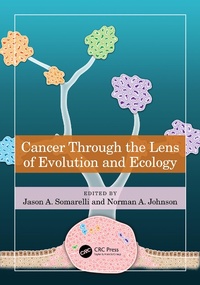
Cancer through the Lens of Evolution and Ecology
1st Edition
Published on 29. May 2024
214 pages
978-1-040-02766-0 (ISBN)
Description

Cancer cells exist in an ever-changing "ecology" and are subject to evolutionary pressures just like any species in nature. This edited book explores the following themes: 1) how the dynamics of mutation, epigenetics, and gene expression noise are sources of genetic diversity; 2) how scarce resources influence cancer therapy resistance; 3) how predator-prey dynamics are mirrored in immune-cancer cross-talk; 4) how cancer cells parallel niche construction theory; 5) how changing fitness landscapes enable cancer growth; and 6) how cancer cells interact within the body. The book is a resource for understanding cancer as a disease of multicellularity grounded in evolutionary principles. By using this knowledge, researchers are starting to exploit these behaviors for treatment paradigms.
Key Features
Bridges disciplines exemplifying the ways disparate fields create new perspectives when integrated.
Offers insights from leading scholars in cancer biology, ecology and evolutionary biology.
Provides a timely recognition by oncologists that evolutionary paradigms are crucial for breakthroughs in cancer treatment.
Integrates basic and applied sciences of oncology and evolutionary biology.
Key Features
Bridges disciplines exemplifying the ways disparate fields create new perspectives when integrated.
Offers insights from leading scholars in cancer biology, ecology and evolutionary biology.
Provides a timely recognition by oncologists that evolutionary paradigms are crucial for breakthroughs in cancer treatment.
Integrates basic and applied sciences of oncology and evolutionary biology.
More details
Edition
1. Auflage
Language
English
Place of publication
London
United Kingdom
Publishing group
Taylor & Francis Ltd
Target group
College/higher education
Professional and scholarly
Illustrations
3 Tables, black and white; 18 Line drawings, color; 9 Halftones, color; 27 Illustrations, color
ISBN-13
978-1-040-02766-0 (9781040027660)
Copyright in bibliographic data and cover images is held by Nielsen Book Services Limited or by the publishers or by their respective licensors: all rights reserved.
Schweitzer Classification
Other editions
Additional editions

Book
07/2024
CRC Press
Unfortunately, price unknown
Available (delivery time upon request)
Jason A. Somarelli | Norman A. Johnson
Cancer through the Lens of Evolution and Ecology
Book
05/2024
1st Edition
CRC Press
€220.80
Shipment within 10-20 days
Jason A. Somarelli | Norman A. Johnson
Cancer through the Lens of Evolution and Ecology
Book
05/2024
1st Edition
CRC Press
€99.50
Shipment within 10-20 days
Persons
Jason A. Somarelli is a molecular biologist, who received his doctoral degree from Florida International University in Miami, FL and was an American Cancer Society postdoctoral fellow at Duke University. He is currently an Assistant Professor in the Department of Medicine at Duke University. Somarelli serves as the Director of Research for the Duke Cancer Institute Comparative Oncology Group and is the Director of the Duke University Marine Laboratory Scholars in Marine Medicine Program. Dr. Somarelli's research uses evolutionary and ecology paradigms to understand molecular adaptations to extreme environments. His work spans diverse topics, such as the evolutionary pressures faced by cancer cells during drug treatment and metastatic spread, the molecular adaptations of whales and other marine mammals to low oxygen conditions, and the evolution of microbes to use plastic as a nutrient source. In addition to his scholarly activities, Dr. Somarelli is passionately involved in training and education, leading multiple outreach and research training programs for high school students and undergraduates in an effort to enhance diversity in STEM careers.
Norman A. Johnson is an evolutionary geneticist, who received his doctoral degree from the University of Rochester and was a postdoctoral fellow at the University of Chicago. He is now an adjunct professor in the Biology department at the University of Massachusetts at Amherst. Johnson has also taught at the University of Chicago, the University of Texas at Arlington, and Hampshire College. Most of his research has been on the genetics and evolution of why hybrids between species are often sterile or inviable. Other research interests include the evolution of sex chromosomes, the evolution of extremely large dietary niches in insects, conflict between different parts of the genome, and the interplay between the relaxation of selection and the loss of traits. Johnson's first book, Darwinian Detectives: Revealing the Natural History of Genes and Genomes (Oxford University Press, 2007), examines how biologists infer the action of natural selection and other evolutionary processes from DNA sequence information. More recently, he wrote Darwin's Reach: 21st Century Applications of Evolutionary Biology (CRC Press, 2022). This book explores how ideas and information from evolutionary are being used in diverse ways in the realms of health, food, the environment, and society at large. Dr. Johnson has been active in science communication and outreach; notably, he co-led the National Evolutionary Synthesis Center working group on communicating the relevance of human evolution.
Norman A. Johnson is an evolutionary geneticist, who received his doctoral degree from the University of Rochester and was a postdoctoral fellow at the University of Chicago. He is now an adjunct professor in the Biology department at the University of Massachusetts at Amherst. Johnson has also taught at the University of Chicago, the University of Texas at Arlington, and Hampshire College. Most of his research has been on the genetics and evolution of why hybrids between species are often sterile or inviable. Other research interests include the evolution of sex chromosomes, the evolution of extremely large dietary niches in insects, conflict between different parts of the genome, and the interplay between the relaxation of selection and the loss of traits. Johnson's first book, Darwinian Detectives: Revealing the Natural History of Genes and Genomes (Oxford University Press, 2007), examines how biologists infer the action of natural selection and other evolutionary processes from DNA sequence information. More recently, he wrote Darwin's Reach: 21st Century Applications of Evolutionary Biology (CRC Press, 2022). This book explores how ideas and information from evolutionary are being used in diverse ways in the realms of health, food, the environment, and society at large. Dr. Johnson has been active in science communication and outreach; notably, he co-led the National Evolutionary Synthesis Center working group on communicating the relevance of human evolution.
Content
Foreword
Randolph Nesse
Chapter 1: A species within a species
Jason A. Somarelli and Norman A. Johnson
Chapter 2: Therapy As a Driver of Evolutionary Selection
Dana Ataya, Joel S. Brown and Robert A. Gatenby
Chapter 3: The Genetic Hitchhiker's Guide to Tumor Evolution
Rohini Janivara and Joseph Lachance
Chapter 4: Multicellularity, phenotypic heterogeneity, and cancer
Christopher Helenek, Jason A. Somarelli, and Gabor Balazsi
Chapter 5: Feedback loops in gene regulatory networks and cell-cell communication networks: drivers of cancer cell plasticity
Yeshwanth Mahesh, Subbalakshmi Ayalur Raghu, Mohit Kumar Jolly
Chapter 6: Polygenic Evolution of Germline Variants in Cancer
Ujani Hazra and Joseph Lachance
Chapter 7: Two-phased cancer evolution: the pattern and scale of genomic and nongenomic landscapes
Andrzej Kasperski and Henry H. Heng
Chapter 8: Evolutionary and ecological perspective on the multiple states of T cell exhaustion
Irina Kareva and Joel S. Brown
Chapter 9: Landscape Genetics for Cancer Biology
Erin L. Landguth and Norman A. Johnson
Chapter 10: Tumor Island Biogeography: Theory and Clinical Applications
Antonia Chroni
Chapter 11: Cancer and the Evolutionary Ecology of Invasions
Joel S. Brown, Sarah A. Amend and Kenneth J. Pienta
Chapter 12: Unifying Theories in Comparative Oncology
Zachary T. Compton
Chapter 13: From Evolutionary Biology to Bedside and Beyond: A View of Comparative Oncology Throughout the Translational Pipeline
Veronica Colmenares, William C. Eward, Laurie A. Graves
Chapter 14: What do we gain from viewing cancer through an eco-evo lens?
Jason A. Somarelli and Norman A. Johnson
Randolph Nesse
Chapter 1: A species within a species
Jason A. Somarelli and Norman A. Johnson
Chapter 2: Therapy As a Driver of Evolutionary Selection
Dana Ataya, Joel S. Brown and Robert A. Gatenby
Chapter 3: The Genetic Hitchhiker's Guide to Tumor Evolution
Rohini Janivara and Joseph Lachance
Chapter 4: Multicellularity, phenotypic heterogeneity, and cancer
Christopher Helenek, Jason A. Somarelli, and Gabor Balazsi
Chapter 5: Feedback loops in gene regulatory networks and cell-cell communication networks: drivers of cancer cell plasticity
Yeshwanth Mahesh, Subbalakshmi Ayalur Raghu, Mohit Kumar Jolly
Chapter 6: Polygenic Evolution of Germline Variants in Cancer
Ujani Hazra and Joseph Lachance
Chapter 7: Two-phased cancer evolution: the pattern and scale of genomic and nongenomic landscapes
Andrzej Kasperski and Henry H. Heng
Chapter 8: Evolutionary and ecological perspective on the multiple states of T cell exhaustion
Irina Kareva and Joel S. Brown
Chapter 9: Landscape Genetics for Cancer Biology
Erin L. Landguth and Norman A. Johnson
Chapter 10: Tumor Island Biogeography: Theory and Clinical Applications
Antonia Chroni
Chapter 11: Cancer and the Evolutionary Ecology of Invasions
Joel S. Brown, Sarah A. Amend and Kenneth J. Pienta
Chapter 12: Unifying Theories in Comparative Oncology
Zachary T. Compton
Chapter 13: From Evolutionary Biology to Bedside and Beyond: A View of Comparative Oncology Throughout the Translational Pipeline
Veronica Colmenares, William C. Eward, Laurie A. Graves
Chapter 14: What do we gain from viewing cancer through an eco-evo lens?
Jason A. Somarelli and Norman A. Johnson
