

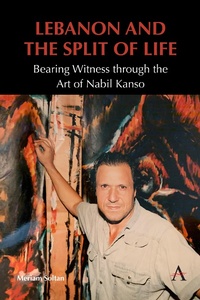
Lebanon and the Split of Life
Bearing Witness through the Art of Nabil Kanso
1st Edition
Published on 14. May 2024
68 pages
978-1-83998-964-3 (ISBN)
Description

This scholarly biography traces the life and art of Lebanese-American neo-expressionist, Nabil Kanso (1940-2019). It explores key moments across the artist's transnational career by foregrounding his longest-running, internationally toured exhibition, the Journey of Art for Peace (1985-1993). More specifically, it traces the historical trajectory of his 10 x 28 mural-scale painting, Lebanon, from the circumstances of its production at the height of the Lebanese Civil War in 1983, through its short-lived exhibition history with the Split of Life series in the few years that followed. The book scaffolds an understanding of the artist as an activist and works toward offering distinctly spatial readings of his painterly practice, of which the act of bearing witness is highlighted as permeating the entirety of his oeuvre. It concludes with a contemporary recontextualization of Lebanon in the country's current social, political, and cultural climate, and emphasizes the artist's work as essential to the theorization of larger traditions of political and protest art.
The first of its kind and the result of a research fellowship wherein the author was invited to be the first to work through the artist's unpublished archive, this book lays the groundwork for scholarship on the art of Nabil Kanso-an essential yet hitherto unstudied pioneer of the neo-expressionist art movement of the 1960s. It draws extensively on primary source material, including personal notes, diaries, sketchbooks, correspondences, paintings, watercolors, photographs, recorded interviews, and the like. To best animate that source material within the context of this publication, each chapter is prefaced with short narrative anecdotes inspired by the artist's personal notes to better ground the subsequent research and scholarship in the artist's own terms and experiences.
Born in Beirut, Kanso, like many of his generation, would seek sought refuge abroad from political instability in his home country. It is through this intrinsic proximity to, yet physical distance from, the cycles of violence and corruption in Lebanon that Kanso would go on to create his grandest greatest mural-scale series. This book, more than anything, explores the artist's oeuvre as an attempt to bear witness and offer testimony to those moments, an inclination that would see the artist grapple with some of the most ferocious crimes against humanity committed throughout his lifetime. As such, this book pairs close readings of Kanso's art and personal practice with both historical and contemporary context meant to animate the relevance of his vast yet never-before-seen artistic archive.
The first of its kind and the result of a research fellowship wherein the author was invited to be the first to work through the artist's unpublished archive, this book lays the groundwork for scholarship on the art of Nabil Kanso-an essential yet hitherto unstudied pioneer of the neo-expressionist art movement of the 1960s. It draws extensively on primary source material, including personal notes, diaries, sketchbooks, correspondences, paintings, watercolors, photographs, recorded interviews, and the like. To best animate that source material within the context of this publication, each chapter is prefaced with short narrative anecdotes inspired by the artist's personal notes to better ground the subsequent research and scholarship in the artist's own terms and experiences.
Born in Beirut, Kanso, like many of his generation, would seek sought refuge abroad from political instability in his home country. It is through this intrinsic proximity to, yet physical distance from, the cycles of violence and corruption in Lebanon that Kanso would go on to create his grandest greatest mural-scale series. This book, more than anything, explores the artist's oeuvre as an attempt to bear witness and offer testimony to those moments, an inclination that would see the artist grapple with some of the most ferocious crimes against humanity committed throughout his lifetime. As such, this book pairs close readings of Kanso's art and personal practice with both historical and contemporary context meant to animate the relevance of his vast yet never-before-seen artistic archive.
Reviews / Votes
"A timely book that sheds light on the incredible work of Nabil Kanso, a unique artist who felt so deeply the pain of the world and rebelled against its injustices with every brushstroke, with every shiver of color."-Tarek El-Ariss, James Wright Professor and Chair of Middle Eastern Studies at Dartmouth College, USA. "Taking us into the archive of Nabil Kanso, Meriam Soltan draws a captivating account of his art and activism. From Lebanese to Arab American to citizen of the world, Kanso bears witness to the horrors of war in mural-scale artworks in search of shared humanity, justice, and peace."-Sonja Mejcher-Atassi, Professor of Modern Arabic and ComparativeLiterature, American University of Beirut, Lebanon. "Author of an immense and prolific work that bears witness to his time, Kanso expresses a universalizing vision of the conflicts of the 20th century and their violence. Being in dialogue with the major aesthetic trends of his century, his work also offers itself as a space for negotiation with the artistic movements of the time. For all these reasons, and because the departure of Kanso confronts us with the need for a better knowledge of the man and his work, this book is of great relevance today."-NaylaTamraz, Professor and Head of the MA and PhD Programs in Art Criticism and Curatorial Studies, Saint Joseph University, Lebanon. Soltan builds a narrative around this creative and deeply contemplative family man who, as an artist, tuned in to the voices of the past and to the torments of history... Soltan writes passionately and sensitively about the artist's struggles and suggests a new relevance of his work in modern times. - The Markaz ReviewMore details
Series
Language
English
Place of publication
London
United Kingdom
Target group
College/higher education
US School Grade: College Graduate Student
Edition type
Digital original
ISBN-13
978-1-83998-964-3 (9781839989643)
Copyright in bibliographic data and cover images is held by Nielsen Book Services Limited or by the publishers or by their respective licensors: all rights reserved.
Schweitzer Classification
Other editions
Additional editions
Book
05/2024
Anthem Press
€34.30
Shipment within 3-4 weeks
Person
Meriam Soltan is a writer and editor interested in the design of fictions and how they are manifested in various contexts politically, culturally, and otherwise.
Content
List of Figures ; Acknowledgments; Introduction; 1. Lebanon in Three Parts; 2. The Journey of Art for Peace; 3. The Artist as Activist; Conclusion; Appendix: Overview of Major Works
