

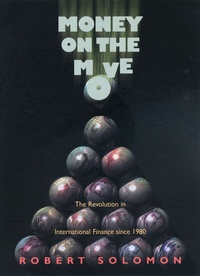
Money on the Move
The Revolution in International Finance since 1980
1st Edition
Published on 16. June 2015
224 pages
978-1-4008-2285-0 (ISBN)
Description

The international monetary system has changed radically in the last twenty years. Capital, information, goods, and services move around the globe with unprecedented ease. Countries from the former communist bloc have joined the system. Europe is on the verge of monetary union. Financial crises in East Asia and Mexico have rocked the world economy. In this book, Robert Solomon--author of the definitive history of the monetary order between 1945 and 1981--presents the first comprehensive history of these and other aspects of this revolution in international finance. Authoritative, accessible, and elegantly written, the book will be indispensable for anyone who wishes to understand how today's international monetary system works.
Solomon begins with the spectacular rise and subsequent decline of the foreign exchange value of the U.S. dollar in the 1980s. He covers the debt crisis of developing countries in the 1980s. He explores the shift from central planning to market economies in many countries in the 1990s and explains the origins, implications, and problems of the move to a single European currency. Solomon examines in detail the striking increase in the mobility of capital--paying particular attention to the costs and benefits for developing countries, and to the role of capital mobility in the Mexican crisis of 1994 and the Asian crisis that began in 1997. In the book's final chapter, Solomon provides an overview of the international monetary system and considers how it might evolve in the future. In this section, he focuses on the key subjects of balance-of-payments adjustments, supply of reserves, and stability. He also evaluates a variety of much-debated policy instruments, including inflation targeting, currency boards, target zones for exchange rates, free-floating exchange rates, the Tobin tax, macroeconomic policy coordination, and special drawings rights.
Throughout, Solomon relates developments in the international monetary system to macroeconomic conditions in the countries involved--arguing that it is impossible to understand one without understanding the other. As a clear, thorough, and unusually perceptive account of global finance and monetary economics in the late twentieth century, Money on the Move will be vital reading for economists, policymakers, and general readers.
Solomon begins with the spectacular rise and subsequent decline of the foreign exchange value of the U.S. dollar in the 1980s. He covers the debt crisis of developing countries in the 1980s. He explores the shift from central planning to market economies in many countries in the 1990s and explains the origins, implications, and problems of the move to a single European currency. Solomon examines in detail the striking increase in the mobility of capital--paying particular attention to the costs and benefits for developing countries, and to the role of capital mobility in the Mexican crisis of 1994 and the Asian crisis that began in 1997. In the book's final chapter, Solomon provides an overview of the international monetary system and considers how it might evolve in the future. In this section, he focuses on the key subjects of balance-of-payments adjustments, supply of reserves, and stability. He also evaluates a variety of much-debated policy instruments, including inflation targeting, currency boards, target zones for exchange rates, free-floating exchange rates, the Tobin tax, macroeconomic policy coordination, and special drawings rights.
Throughout, Solomon relates developments in the international monetary system to macroeconomic conditions in the countries involved--arguing that it is impossible to understand one without understanding the other. As a clear, thorough, and unusually perceptive account of global finance and monetary economics in the late twentieth century, Money on the Move will be vital reading for economists, policymakers, and general readers.
All prices
More details
Edition
Core Textbook
Language
English
Place of publication
Princeton, NJ
United States
Publishing group
De Gruyter
Target group
Professional and scholarly
Edition type
Digital original
Product notice
Reflowable
Illustrations
6 line illus. 2 tables
File size
0,65 MB
ISBN-13
978-1-4008-2285-0 (9781400822850)
Schweitzer Classification
Other editions
Additional editions
Book
01/1999
Princeton University Press
€113.50
Shipment within 10-20 days
Person
Robert Solomon, a Guest Scholar at the Brookings Institution, was for many years the chief international economist at the Federal Reserve Board. He is the author of the classic books The International Monetary System, 1945-1981 (Harper and Row) and The Transformation of the World Economy (Macmillan and St. Martin's Press). He is the publisher of International Economic Letter, a monthly analysis that goes to major central banks, international institutions, and private subscribers.
Content
Preface and Acknowledgments
List of Abbreviations and Acronyms
Ch. 1 The Wide-Ranging Dollar, 1980-1990 3
Ch. 2 The Developing-Country Debt Crisis 34
Ch. 3 Economic and Monetary Integration in Europe 49
Ch. 4 Economies in Transition: International Effects 97
Ch. 5 The 1990s: Capital Mobility and Its Effects 108
Ch. 6 The Present and Future of the System 138
App. Chronology of Important Events 169
Notes 177
Index 201
List of Abbreviations and Acronyms
Ch. 1 The Wide-Ranging Dollar, 1980-1990 3
Ch. 2 The Developing-Country Debt Crisis 34
Ch. 3 Economic and Monetary Integration in Europe 49
Ch. 4 Economies in Transition: International Effects 97
Ch. 5 The 1990s: Capital Mobility and Its Effects 108
Ch. 6 The Present and Future of the System 138
App. Chronology of Important Events 169
Notes 177
Index 201

