

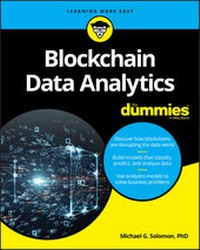
Blockchain Data Analytics For Dummies
Description

Blockchain came to prominence as the disruptive technology that made cryptocurrencies work. Now, data pros are using blockchain technology for faster real-time analysis, better data security, and more accurate predictions. Blockchain Data Analytics For Dummies is your quick-start guide to harnessing the potential of blockchain.
Inside this book, technologists, executives, and data managers will find information and inspiration to adopt blockchain as a big data tool. Blockchain expert Michael G. Solomon shares his insight on what the blockchain is and how this new tech is poised to disrupt data. Set your organization on the cutting edge of analytics, before your competitors get there!
* Learn how blockchain technologies work and how they can integrate with big data
* Discover the power and potential of blockchain analytics
* Establish data models and quickly mine for insights and results
* Create data visualizations from blockchain analysis
Discover how blockchains are disrupting the data world with this exciting title in the trusted For Dummies line!
More details
Other editions
Additional editions
Person
Content
- Intro
- Title Page
- Copyright Page
- Table of Contents
- Introduction
- About This Book
- Foolish Assumptions
- Icons Used in This Book
- Beyond the Book
- Where to Go from Here
- Part 1 Intro to Analytics and Blockchain
- Chapter 1 Driving Business with Data and Analytics
- Deriving Value from Data
- Monetizing data
- Exchanging data
- Verifying data
- Understanding and Satisfying Regulatory Requirements
- Classifying individuals
- Identifying criminals
- Examining common privacy laws
- Predicting Future Outcomes with Data
- Classifying entities
- Predicting behavior
- Making decisions based on models
- Changing Business Practices to Create Desired Outcomes
- Defining the desired outcome
- Building models for simulation
- Aligning operations and assessing results
- Chapter 2 Digging into Blockchain Technology
- Exploring the Blockchain Landscape
- Managing ownership transfer
- Doing more with blockchain
- Understanding blockchain technology
- Reviewing blockchain's family tree
- Fitting blockchain into today's businesses
- Understanding Primary Blockchain Types
- Categorizing blockchain implementations
- Describing basic blockchain type features
- Contrasting popular enterprise blockchain implementations
- Aligning Blockchain Features with Business Requirements
- Reviewing blockchain core features
- Examining primary common business requirements
- Matching blockchain features to business requirements
- Examining Blockchain Use Cases
- Managing physical items in cyberspace
- Handling sensitive information
- Conducting financial transactions
- Chapter 3 Identifying Blockchain Data with Value
- Exploring Blockchain Data
- Understanding what's stored in blockchain blocks
- Recording transaction data
- Dissecting the parts of a block
- Decoding block data
- Categorizing Common Data in a Blockchain
- Serializing transaction data
- Logging events on the blockchain
- Storing value with smart contracts
- Examining Types of Blockchain Data for Value
- Exploring basic transaction data
- Associating real-world meaning to events
- Aligning Blockchain Data with Real-World Processes
- Understanding smart contract functions
- Assessing smart contract event logs
- Ranking transaction and event data by its effect
- Chapter 4 Implementing Blockchain Analytics in Business
- Aligning Analytics with Business Goals
- Leveraging newly accessible decentralized tools
- Monetizing data
- Exchanging and integrating data effectively
- Surveying Options for Your Analytics Lab
- Installing the Blockchain Client
- Installing the Test Blockchain
- Installing the Testing Environment
- Getting ready to install Truffle
- Downloading and installing Truffle
- Installing the IDE
- Chapter 5 Interacting with Blockchain Data
- Exploring the Blockchain Analytics Ecosystem
- Reviewing your blockchain lab
- Identifying analytics client options
- Choosing the best blockchain analytics client
- Adding Anaconda and Web3.js to Your Lab
- Verifying platform prerequisites
- Installing the Anaconda platform
- Installing the Web3.py library
- Setting up your blockchain analytics project
- Writing a Python Script to Access a Blockchain
- Interfacing with smart contracts
- Finding a smart contract's ABI
- Building a Local Blockchain to Analyze
- Connecting to your blockchain
- Invoking smart contract functions
- Fetching blockchain data
- Part 2 Fetching Blockchain Chain
- Chapter 6 Parsing Blockchain Data and Building the Analysis Dataset
- Comparing On-Chain and External Analysis Options
- Considering access speed
- Comparing one-off versus repeated analysis
- Assessing data completeness
- Integrating External Data
- Determining what data you need
- Extending identities to off-chain data
- Finding external data
- Identifying Features
- Describing how features affect outcomes
- Comparing filtering and wrapping methods
- Building an Analysis Dataset
- Connecting to multiple data sources
- Building a cross-referenced dataset
- Cleaning your data
- Chapter 7 Building Basic Blockchain Analysis Models
- Identifying Related Data
- Grouping data based on features (attributes)
- Determining group membership
- Discovering relationships among items
- Making Predictions of Future Outcomes
- Selecting features that affect outcome
- Beating the best guess
- Building confidence
- Analyzing Time-Series Data
- Exploring growth and maturity
- Identifying seasonal trends
- Describing cycles of results
- Chapter 8 Leveraging Advanced Blockchain Analysis Models
- Identifying Participation Incentive Mechanisms
- Complying with mandates
- Playing games with partners
- Rewarding and punishing participants
- Managing Deployment and Maintenance Costs
- Lowering the cost of admission
- Leveraging participation value
- Aligning ROI with analytics currency
- Collaborating to Create Better Models
- Collecting data from a cohort
- Building models collaboratively
- Assessing model quality as a team
- Part 3 Analyzing and Visualizing Blockchain Analysis Data
- Chapter 9 Identifying Clustered and Related Data
- Analyzing Data Clustering Using Popular Models
- Delivering valuable knowledge with cluster analysis
- Examining popular clustering techniques
- Understanding k-means analysis
- Evaluating model effectiveness with diagnostics
- Implementing Blockchain Data Clustering Algorithms in Python
- Discovering Association Rules in Data
- Delivering valuable knowledge with association rules analysis
- Describing the apriori association rules algorithm
- Evaluating model effectiveness with diagnostics
- Determining When to Use Clustering and Association Rules
- Chapter 10 Classifying Blockchain Data
- Analyzing Data Classification Using Popular Models
- Delivering valuable knowledge with classification analysis
- Examining popular classification techniques
- Understanding how the decision tree algorithm works
- Understanding how the naïve Bayes algorithm works
- Evaluating model effectiveness with diagnostics
- Implementing Blockchain Classification Algorithms in Python
- Defining model input data requirements
- Building your classification model dataset
- Developing your classification model code
- Determining When Classification Fits Your Analytics Needs
- Chapter 11 Predicting the Future with Regression
- Analyzing Predictions and Relationships Using Popular Models
- Delivering valuable knowledge with regression analysis
- Examining popular regression techniques
- Describing how linear regression works
- Describing how logistic regression works
- Evaluating model effectiveness with diagnostics
- Implementing Regression Algorithms in Python
- Defining model input data requirements
- Building your regression model dataset
- Developing your regression model code
- Determining When Regression Fits Your Analytics Needs
- Chapter 12 Analyzing Blockchain Data over Time
- Analyzing Time Series Data Using Popular Models
- Delivering valuable knowledge with time series analysis
- Examining popular time series techniques
- Visualizing time series results
- Implementing Time Series Algorithms in Python
- Defining model input data requirements
- Developing your time series model code
- Determining When Time Series Fits Your Analytics Needs
- Part 4 Implementing Blockchain Analysis Models
- Chapter 13 Writing Models from Scratch
- Interacting with Blockchains
- Connecting to a Blockchain
- Using an application programming interface to interact with a blockchain
- Reading from a blockchain
- Updating previously read blockchain data
- Examining Blockchain Client Languages and Approaches
- Introducing popular blockchain client programming languages
- Comparing popular language pros and cons
- Deciding on the right language
- Chapter 14 Calling on Existing Frameworks
- Benefitting from Standardization
- Easing the burden of compliance
- Avoiding inefficient code
- Raising the bar on quality
- Focusing on Analytics, Not Utilities
- Avoiding feature bloat
- Setting granular goals
- Managing post-operational models
- Leveraging the Efforts of Others
- Deciding between make or buy
- Scoping your testing efforts
- Aligning personnel expertise with tasks
- Chapter 15 Using Third-Party Toolsets and Frameworks
- Surveying Toolsets and Frameworks
- Describing TensorFlow
- Examining Keras
- Looking at PyTorch
- Supercharging PyTorch with fast.ai
- Presenting Apache MXNet
- Introducing Caffe
- Describing Deeplearning4j
- Comparing Toolsets and Frameworks
- Chapter 16 Putting It All Together
- Assessing Your Analytics Needs
- Describing the project's purpose
- Defining the process
- Taking inventory of resources
- Choosing the Best Fit
- Understanding personnel skills and affinity
- Leveraging infrastructure
- Integrating into organizational culture
- Embracing iteration
- Managing the Blockchain Project
- Part 5 The Part of Tens
- Chapter 17 Ten Tools for Developing Blockchain Analytics Models
- Developing Analytics Models with Anaconda
- Writing Code in Visual Studio Code
- Prototyping Analytics Models with Jupyter
- Developing Models in the R Language with RStudio
- Interacting with Blockchain Data with web3.py
- Extract Blockchain Data to a Database
- Extracting blockchain data with EthereumDB
- Storing blockchain data in a database using Ethereum-etl
- Accessing Ethereum Networks at Scale with Infura
- Analyzing Very Large Datasets in Python with Vaex
- Examining Blockchain Data
- Exploring Ethereum with Etherscan.io
- Perusing multiple blockchains with Blockchain.com
- Viewing cryptocurrency details with ColossusXT
- Preserving Privacy in Blockchain Analytics with MADANA
- Chapter 18 Ten Tips for Visualizing Data
- Checking the Landscape around You
- Leveraging the Community
- Making Friends with Network Visualizations
- Recognizing Subjectivity
- Using Scale, Text, and the Information You Need
- Considering Frequent Updates for Volatile Blockchain Data
- Getting Ready for Big Data
- Protecting Privacy
- Telling Your Story
- Challenging Yourself!
- Chapter 19 Ten Uses for Blockchain Analytics
- Accessing Public Financial Transaction Data
- Connecting with the Internet of Things (IoT)
- Ensuring Data and Document Authenticity
- Controlling Secure Document Integrity
- Tracking Supply Chain Items
- Empowering Predictive Analytics
- Analyzing Real-Time Data
- Supercharging Business Strategy
- Managing Data Sharing
- Standardizing Collaboration Forms
- Index
- EULA
Chapter 1
Driving Business with Data and Analytics
IN THIS CHAPTER
Discovering the value of data
Complying with regulations
Protecting customer privacy
Predicting expected actions with data
Changing plans to control outcome
In the twenty-first century, personalization is king - and data makes personalization possible. A good friend can pick out a much more personal gift for you than a stranger because that friend knows what you like and dislike. Marketers have known for decades that establishing a connection with someone can dramatically increase the chances that the person will become a customer. Organizations' desire to attract customers and increase sales drives the pursuit of meeting consumers' needs.
Consumers demand personal attention and have come to expect a high level of individualized customer service, online or when physically shopping in a bricks-and-mortar store. Due to advances in consumer interaction sophistication, the bar is high for all types of organizations. For example, it isn't good enough for web searches to return a general list of responses. Consumers expect their searches to be personalized and filtered based on their preferences. Today's search engines, and most shopping sites, suggest responses before you even finish typing. It's almost as if the search function knows you and what you're about to ask.
The capability to guess what a user is likely to ask or find interesting is based on data. Humans are creatures of habit and most processes (and even natural events) tend to be cyclic. The repetitive nature of behavior means that if you have enough historical data, you should be able to predict what comes next. Expending effort to collect, maintain, and analyze data related to your organization's operation can help to reduce costs, limit exposure to fines and lawsuits, and lead to increased revenue.
In short, learning how to use your data helps you learn how to make your organization more profitable. In this chapter, you learn about ways that data can provide value to organizations.
Deriving Value from Data
The increased trend toward personalized offerings both depends on data and exposes data's importance to business operations. Data is no longer simply a consequence of engaging in transactions - data is necessary to increase the volume of transactions. Organizations are learning how valuable data is to their capability to conduct and expand operations. If you want to stay competitive in today's economy, you'll have to provide an experience that's responsive and personal. Data from previous transactions makes it possible to anticipate subsequent activity and tailor offerings to customer and partner preferences.
For example, the items you've bought online in the past give online shopping sites such as Amazon.com enough of your background to be able to make suggestions for additional purchases. Using past data to recommend future purchase or actions is a common way to derive value from data. In this section, I introduce three ways organizations can identify data with the greatest potential value.
Monetizing data
Over the past two decades, many organizations have come to view data as the primary fuel of the information age. Since the dawn of the twenty-first century, many organizations with data as their central business driver either started or expanded rapidly. Amazon relies on customer data to make additional purchase suggestions, while companies such as Facebook and Google rely on data as their primary product to drive advertising revenue. All these organizations found ways to turn data into revenue.
As data becomes more directly associated with revenue, data giants Google, Facebook, and Amazon control a growing demand for access to that data. Users have long been encouraged to share their personal data and activities, with little or no compensation. In the beginning, the perception was that sharing personal data was harmless and had little value.
However, a growing number of consumers and business partners realize that their data has value. Legislative bodies have recognized the importance of personal data and are passing new levels of privacy protection legislation each year. Data not only has value in and of itself but, when linked to other related personal data, can also provide valuable insight into personal behavior.
The realization that personal data has value has resulted in a game of sorts. Organizations that value consumer data attempt to acquire as much data as possible, while consumers are becoming more willing to deny free access to their personal data or demand compensation. Compensation often takes the form not of a direct monetary payment but of other perks or discounts.
Exchanging data
As organizations realize the increasing value of consumer and partner data, the more they explore ways to leverage that value. When consumers interact with any organization, or organizations interact with partners, a trail of data artifacts is left behind. Artifacts that document transaction timing and contents, as well as any changes to data, describe how entities interact with organizations. As more interactions with all types of organizations become more automated, the quantity and frequency of data artifacts increases.
Organizations that collect data artifacts find that not all are useful - at least not to that organization. However, as data becomes more and more valuable, many organizations have expanded the scope of data they collect with the intention of selling that data to other organizations. As data becomes a source of both direct and indirect revenue, data collection and management moves from a supporting role to a strategic planning concern.
For example, political campaigns routinely spend large sums of money to purchase demographic information on customers who have purchased specific types of products. Political candidates who strongly support environmental issues find value in identifying people who purchase green products because these customers are likely potential supporters. The identities can then be used to solicit campaign donations.
The overuse of data selling has led to concern and frustration over personal privacy. Most people come to the eventual realization that online activity has consequences. Every time you provide your email address or telephone number to anyone, your data will likely end up being used by some other organization (or probably multiple organizations). Always be careful about what data you allow others to use.
Sharing and exchanging data isn't always bad. In some cases, you want your data to be shared among businesses and organizations. For example, sharing the complete service history for your car could make getting service easier and more reliable. With shared service data, you could take your car to any service provider and not have to remember the last time you had the oil changed or tires rotated. Techniques that support beneficial and responsible data sharing among organizations can be valuable to business and consumers.
Verifying data
One of the obstacles to realizing the full value of data is the dependence on its quality. Quality data is valuable, while incomplete or untrusted data is often worthless. What's worse, low-quality data may require more budget to clean than it will potentially generate in revenue. The only way to realize data's true value is to ensure that the data is valid and represents entities in the real world.
Verifying data has long been one of the highest costs associated with collecting and using data. Campaigns that depend on physical or email addresses will have little effect if the target addresses are largely incorrect. Bad data can come from many sources, including mischievous data submission, sloppy data collection, or even malicious data modification. An important aspect of relying on data is putting controls in place that verify the source of any collected data, along with that data's adherence to collection requirements.
A simple approach to verifying data in a distributed environment is to carry out a simple validation at the source and again at the server as the data is stored in a repository. While validating data at least twice may seem excessive, the practice makes user errors easier to catch and ensures that data received by the server is clean.
Validating data twice makes it possible for client applications to quickly catch errors, such as too many digits in a phone number or a missing field, while the server handles more complex validation tasks. A server may need access to other related data to ensure that data is valid before storing it in a repository. Server validation could include things such as verifying that order quantities are available in a warehouse and that data wasn't changed by a malicious agent during transmission from the client.
One of the reasons data verification is so important is that organizations are relying more and more on their data to direct business efforts. Aligning business activities with expectations based on faulty data leads to undesirable results. In other words, decisions are only as good as the data on which those decisions are based. The "garbage in, garbage out" adage still holds true.
Understanding and Satisfying Regulatory Requirements
The information age offers many new opportunities and just as many (if not more) challenges. The vast amount of data...
