

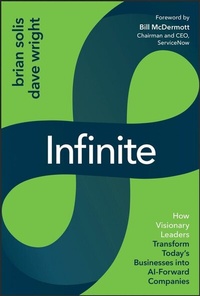
Infinite
Description

Transform your organization by making AI foundational - not just functional
Infinite: How Visionary Leaders Transform Today's Businesses into AI-Forward Companies, written by two senior ServiceNow leaders, introduces the concept of the "Infinite Company"-a new class of organization built with artificial intelligence at its core. Rather than treating AI as an add-on, this book provides a strategic blueprint for seamlessly integrating human talent and AI to achieve greater innovation, productivity, and scale.
Infinite guides readers through the evolution from traditional digital transformation to AI-driven innovation. It challenges conventional business models, exploring how AI-native companies are disrupting legacy organizations and offering strategies for leaders to rethink how they work, measure success, and structure their teams. The book presents a framework for building infinitely adaptable organizations led by AI-native leaders.
Readers will also discover:
- How to shift from AI-enabled operations to building organizations with artificial intelligence embedded at the structural core
- Strategies for developing an AI-native leadership mindset that moves beyond traditional digital transformation approaches
- A framework for creating infinitely adaptable organizations that scale innovation, productivity, and competitive advantage simultaneously
- Insights into how AI-first companies are disrupting legacy business models and rewriting the rules of competition
- Practical guidance on rethinking success metrics, team structures, and workflows for an AI-driven operational environment
Infinite is written for business and technology leaders responsible for guiding their organizations through the shift to AI-driven operations. Whether leading enterprise transformation or building new AI-native ventures, this book delivers the strategic framework needed to compete against organizations already rewriting the rules of business.
More details
Other editions
Additional editions
Persons
Brian Solis is head of global innovation at ServiceNow. He is also a 9x bestselling author, digital anthropologist, futurist, and one of the world's foremost authorities on corporate innovation, digital transformation, and AI business reinvention. Forbes heralded Brian as "one of the more creative and brilliant business minds of our time," while ReadWrite named him a Top Futurist Speaker and ZDNet called him "one of the 21st century business world's leading thinkers." Brian is followed by more than 800,000 people online around the world.
Dave Wright is a senior leader at ServiceNow focused on the intersection of artificial intelligence and enterprise strategy. Wright draws on extensive experience designing and deploying AI-driven workflows at scale, offering a practitioner's perspective on how organizations can embed intelligence into their structural core rather than layering it onto legacy systems.
Content
Reinvent to Win ... Infinitely
Foreword by Bill McDermott vi
Introduction Infinite Companies 1
Chapter 1 Escaping the Iteration Trap 22
Chapter 2 Evolutionary Stages Toward Infinite 48
Chapter 3 How AI Is Reshaping the Future of Work 76
Chapter 4 Expanding Human-Agent Collaboration 98
Chapter 5 Culture Is the Code That Runs the Infinite Operating System 116
Chapter 6 The ROI Paradox: Why AI Demands a New Equation for Value 148
Chapter 7 The Role of a Chief Workflow Officer 166
Chapter 8 The Rise of AI Autonomy 204
Chapter 9 The Founders Table: Conversations to Spur Action 232
Chapter 10 Filling In Your Infinite Canvas: Designing a Future of Human Dignity and Exponential Innovation 256
References 279
Index 293
Introduction
Infinite Companies
"The leaders driving successful AI implementation appreciate the qualitative, not just quantitative, differences in AI and human intelligence."
This book is for bold leaders: executives, founders, strategists, and builders, those who know that AI is more than just a trend to watch or a wave to ride. It's a force reshaping the foundations of business itself. Whether you lead a startup looking to scale infinitely or a legacy enterprise trying to stay ahead of the next wave of disruption, this book offers the vision, vocabulary, and frameworks you'll need to lead in a world where AI is not just a tool, but a coarchitect of the future.
AI is so much more than a means of optimizing yesterday's operations. It's a catalyst to invent entirely new ways of working, creating value, and solving problems.
Already, AI is providing capabilities, insights, and outcomes that exceed what humans alone can hope to achieve. A small group of leaders are rewiring their organizational operating systems, recognizing AI as more than a cost-cutting, productivity, automation, and efficiency tool. They are reimagining end-to-end workflows with AI at the center. They're treating the pursuit of AI autonomy as a staged journey, thoughtfully and deliberately building the data systems, platforms, governance, and talent needed to move from experiments to scaled, mission-critical work led by AI agents. As they free up human time, releasing employees from routine work, they are designing new roles that will be central to the emerging human-agent teams, such as AI orchestrators and hybrid workforce leaders.
The new operating models these leaders are creating around AI are leading the way to fully autonomous AI decision-making, but with human supervision and rigorous governance guardrails. The goal is that agentic AI systems will make an increasing number of decisions, while humans make the decisions that matter most.
A New Kind of Work for a New Kind of Intelligence
The leaders driving successful AI implementation appreciate the qualitative, not just quantitative, differences in AI and human intelligence. When AlphaGo defeated the world's best Go player in 2016, what shocked experts was more than the win; it was how the AI opponent played, making moves no human would make [1]. That's the kind of leap we're talking about. While some may think we're teaching machines to do what we do, the true potential lies in learning how to work with machines that think differently than we do.
Investments in AI transformation should not be rooted in AI as a tool. They should be rooted in a transformative philosophy for navigating in a world where machines are rapidly becoming infinitely more intelligent and, in many but certainly not all ways, more capable than humans. In the face of this reality, yesterday's operational models must be reimagined for a time when humans and AI coexist and collaborate.
The challenge is that there is no playbook for navigating in a world where AI can both perform yesterday's work and execute capabilities that have not yet been realized, or even imagined. In this book, we draw on our own experience working with leaders to design AI transformations for their companies, together with leading research and accounts from pioneers achieving remarkable results with AI, to provide you with powerful insights and practical frameworks you can apply in your organization. We'll help you avoid the pitfalls and begin reaping the rewards.
Despite widespread skepticism about AI, including in C-suites and boardrooms, this is not a time to wait and see, to bide time while others experiment and learn. This is the moment to lean in, ask novel questions, decide what role you want to play moving forward, and take action. If you don't act now, given the pace of progress in AI innovation, you will risk irrelevance.
"AI-native" startups, together with venture capitalists and research labs, are rapidly developing systems that disrupt legacy models. Yesterday's work is being reinvented or outright abandoned in favor of new capabilities and outcomes enabled by AI. By placing AI at the heart of their workflows and team structures, these companies, founded with AI at the core of their business models, are able to scale faster and operate with fewer employees, remaining lean. To give a few examples:
- Midjourney, which offers a powerful AI image generation tool, reportedly achieved $200M annual recurring revenue (ARR) within two years of its founding with approximately 40-45 employees [2].
- Cursor, an AI coding assistant company, scaled to $100M ARR with a team of 20, then to $200M just months later [3, 4].
- ElevenLabs, an AI audio research and deployment company, reportedly hit $100M ARR in two years with a team of 50 people [5].
- Lovable, an AI website creator, achieved $10M ARR in two months with 15 people [6].
AI-native founders aren't waiting for permission or use cases. They're producing staggering revenue per employee (RPE) numbers by scaling with agents and tiny human teams [7]. Venture capitalist Jeremiah Owyang's analysis of what he refers to as "lean AI" startups shows the top players generating multimillion-dollar RPE, multiples of what even elite software as a service (SaaS) companies achieve. AI is powering a new level of productive function. As Owyang observes [8], "We're on a path to seeing a solo-employee startup reach a $1B valuation, and companies generating over $100M in revenue per employee."
Lean AI natives aren't the only ones achieving astonishing results. Some large legacy firms are successfully transforming, including two of the world's largest banks.
JPMorgan Chase reported in 2025 that AI tools had contributed to a 20% gross sales increase in its asset and wealth management division between 2023 and 2024, and saved the company $1.5 billion in fraud prevention, credit decisions, and operational efficiencies. In addition, its Coach AI tool, which helps private client advisors access content and real-time information to better engage customers, is expected to drive a 50% expansion in client rosters over the next three to five years [9]. This is an example of innovating with AI to create entirely new value.
DBS Bank in Singapore is industrializing AI across the organization, and anticipated SGD 1 billion in economic value by the end of 2025 [10]. It focuses on hyper-personalized customer services that balance core banking automation with newer services like "nudging" customers to make investments and offering employees upskilling roadmaps [11].
Legacy firms in a wide range of other industries are also reporting transformative results:
- Pfizer now uses AI models to compress drug discovery timelines by up to 80%, effectively changing the economics of medicine [12].
- Starbucks created DeepBrew, an AI-enabled platform that analyzes millions of daily transactions to recommend individualized offers to customers and optimize store staffing. The company reports it has not only boosted return on investment by approximately 30% but increased customer lifetime value by turning data into relationships, as evidenced by a 15% improvement in customer engagement [13].
- NVIDIA's Omniverse, a digital platform for developing AI applications, has been used by the company to turn chip design and industrial simulation into a continuous, AI-driven feedback loop, in which every iteration makes the next design smarter [14].
After countless warnings from experts over the decades, it appears business as usual has finally run its course. What comes next will not arrive overnight, but instead in accelerating phases, with each more exponential in its impact. And the window is closing faster than most executives realize. According to the Stanford Institute for Human-Centered Artificial Intelligence's 2025 AI Index report, AI adoption jumped from 55% in 2023 to 78% in 2024 [15]. Businesses must get on board now or risk being left behind.
We're entering an era of perpetual disruption, with each wave presenting both threats and opportunities. AI has not arrived, it is arriving. It will continue to improve and reinvent itself. What's more, it will be combined with a rapidly advancing set of other disruptive technologies.
The Wave of Convergence
In his influential 2023 book The Coming Wave: AI, Power, and the Twenty-First Century's Great Dilemma, Mustafa Suleyman issued a stark warning: Left unchecked, artificial intelligence will not just transform industries, it will overwhelm them [16]. Suleyman is the CEO of Microsoft AI and the cofounder and former head of applied AI at DeepMind, an AI company acquired by Google in 2014. In his book, he argues that we are living in a moment of transformational technological convergence. AI, synthetic biology, robotics, and quantum computing are all advancing simultaneously, and faster than we're ready for. The Great Dilemma he refers to is the paradox that these technologies promise enormous advances, including better healthcare, solutions to climate change, and more efficient systems of all kinds . but they also present enormous peril if...
