

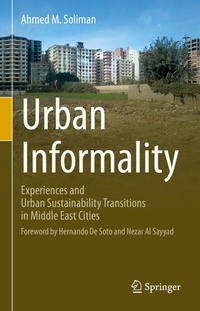
Urban Informality
Description

Urban Informality: Experiences and Urban Sustainability Transitions in Middle East Cities questions urban informality, "as a site of transitions", interrelated and interlinked with urban sustainability transitions in speedy changes in a given environment. The book presents 'urban informality sustainability transitions' regarding resilience and adaptability that require shifts in urban systems. Shifts from a static process to a dynamic process that eradicates the fragmentation between the tensions, anxieties, and pressures of four modes of production, reproduction, consumptions, and distribution of goods and services in the city and its practices. Finally, through eleven chapters, the concluding remarks explore to what extent and how can urban informality transitions be sustainable.
More details
Other editions
Additional editions
Persons
Professor Ahmed M. Soliman has more than forty years of professional practice in Architectural and urban planning. Professor Soliman has undertaken consultancy, research, training, and teaching assignments in Egypt, Lebanon, Britain, and Algeria. He established a consultant office in the early 1980s under the name of Architectural and Planning Studies Center, located in Tanta city, to practice architecture and planning carrier. He has also written, edited, or contributed to many international journals and books and participated in international and national conferences and workshops. He is a specialist in urban housing studies, urban development, and architectural design. He has supervised, designed several planning schemes in Egypt. He had worked for international agencies and organizations in Britain and Peru. He is an external associate adviser to the Ministry of Housing, Utilities, and Urban communities in Egypt. He also is a GIS specialist (Geographic Information System)as he carried out several planning projects using GIS tools. Prof. Soliman is the author of A Possible way out: formalizing housing informality in Egyptian cities, University Press of America, 2004.
