

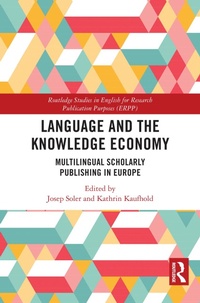
Language and the Knowledge Economy
Multilingual Scholarly Publishing in Europe
Published on 28. February 2025
244 pages
978-1-040-31842-3 (ISBN)
Description

This volume offers a holistic understanding of the interconnections of language, specifically English, scholarly publishing, and knowledge production and circulation through a sociolinguistic lens in contemporary academia across different European settings for research purposes.
The volume is organised around three parts: the first part explores individual factors underpinning knowledge production and their role in shaping scholars' academic careers; the second part critically reflects on the challenges and opportunities for multilingual scholars in the academic landscape, examining the inherent tensions in the interactions between English and other languages; the final part considers the ways in which academic knowledge is institutionalised - at universities, private companies, and on a national scale - and the subsequent impact on knowledge dissemination. Taken together, the chapters provide a coherent and holistic overview of the affordances and limitations that different social actors experience when participating in such cycles, including the different modes of access to resources across geographic contexts and disciplinary traditions. An important contribution of the volume is the multilayered angle that it incorporates into analysing issues of scholarly publishing in today's academia, placing language as a social practice at the heart of the structuring processes that condition the creation, dissemination, and consumption of knowledge in contemporary societies.
This book will be of interest to scholars in English for research and publication purposes, sociolinguistics, language and education, and applied linguistics.
The volume is organised around three parts: the first part explores individual factors underpinning knowledge production and their role in shaping scholars' academic careers; the second part critically reflects on the challenges and opportunities for multilingual scholars in the academic landscape, examining the inherent tensions in the interactions between English and other languages; the final part considers the ways in which academic knowledge is institutionalised - at universities, private companies, and on a national scale - and the subsequent impact on knowledge dissemination. Taken together, the chapters provide a coherent and holistic overview of the affordances and limitations that different social actors experience when participating in such cycles, including the different modes of access to resources across geographic contexts and disciplinary traditions. An important contribution of the volume is the multilayered angle that it incorporates into analysing issues of scholarly publishing in today's academia, placing language as a social practice at the heart of the structuring processes that condition the creation, dissemination, and consumption of knowledge in contemporary societies.
This book will be of interest to scholars in English for research and publication purposes, sociolinguistics, language and education, and applied linguistics.
Reviews / Votes
"This is a timely edited volume, which appears in the midst of the increasing public scrutiny of the role (and indeed, the usefulness) of HE in contemporary society. The contributors write from a range of contexts in Europe, where the notion of knowledge production, a key activity in the so-called knowledge economy (itself a key pillar of the broader neoliberalisation of HE), has become sacrosanct. All the volume's contributions are situated at the crossroads of three key elements - language (especially English and the Englishization of international HE), knowledge production and academic publishing - and many discuss resistance to dominant trends while offering thought-provoking ways forward. The editors, Josep Soler and Kathrin Kaufhold, have done an excellent job of tying together the eleven chapters comprising this eye-opening book, which anyone working in HE, or with an interest in HE, should definitely read."- David Block, Universitat Pompeu Fabra, Barcelona
"This valuable and thought-provoking collection explores the connections between language, the knowledge economy, and scholarly publishing from a sociolinguistic perspective, addressing the political and economic conditions and institutional regimes which shape knowledge production, and how these challenge and affect multilingual scholars. By adopting a practice framing, the editors and contributors are able to provide cogent analyses of the concrete material factors which shape the often abstractly-conceived processes of knowledge production, circulation, and consumption.
The chapters draw out the diversity in knowledge production across Europe, showing particularly how relationships between English and national languages play out differently in different contexts, while also identifying themes which recur across, such as the power of accountability regimes and evaluation of academic publication within a market logic of rankings and competition. Overall, the book provides a powerful critique of the market logic underlying academic publishing, showing its effects both on the nature of the knowledge we produce as academics and on how this knowledge is shared. It will be of great interest to anyone with an interest in academic publishing and more broadly in the language economy of the academic world."
- Karin Tusting, Lancaster University, UK
More details
Series
Language
English
Place of publication
London
United Kingdom
Publishing group
Taylor & Francis Ltd
Target group
College/higher education
Illustrations
16 Tables, black and white; 13 Line drawings, black and white; 13 Illustrations, black and white
File size
2,56 MB
ISBN-13
978-1-040-31842-3 (9781040318423)
Copyright in bibliographic data and cover images is held by Nielsen Book Services Limited or by the publishers or by their respective licensors: all rights reserved.
Schweitzer Classification
Other editions
Additional editions
Josep Soler | Kathrin Kaufhold
Language and the Knowledge Economy
Multilingual Scholarly Publishing in Europe
Book
approx. 07/2026
1st Edition
Routledge
€57.50
Not yet published
Josep Soler | Kathrin Kaufhold
Language and the Knowledge Economy
Multilingual Scholarly Publishing in Europe
Book
02/2025
1st Edition
Routledge
€206.40
Shipment within 10-20 days
Persons
Josep Soler is Professor of English Linguistics at Stockholm University, Sweden.
Kathrin Kaufhold is Associate Professor of English Applied Linguistics at Stockholm University, Sweden.
Kathrin Kaufhold is Associate Professor of English Applied Linguistics at Stockholm University, Sweden.
Content
Contents
List of Figures
List of Tables
List of Contributors
1. Language, scholarly publishing, and the knowledge economy in multilingual Europe: Exploring interconnections
Josep Soler and Kathrin Kaufhold
Part I Conditions for academic knowledge production
2. Knowledge production and consumption in British academia
Sharon McCulloch
3. The political economy of linguistic capital: The Dutch case of academic scholarship
Rene Gabriels and Robert Wilkinson
Part II Challenges for multilingual scholars
4. (Re)drawing the line: Deficit and empowerment in articles on writing research from Central and Eastern Europe
Clauda Dorobolschi and Loredana Bercuci
5. The language of contemporary philosophy
Filippo Contesi
6. What moves with us when we move? Possible Future Academic Selves in trajectories of exile
Baraa Khuder and Bojana Petric
7. Academics' legitimacy and self-worth: Exploring connections between English, professional identity, and neoliberal trends in Italian academia
Beatrice Zuaro
Part III Institutional regimes in the knowledge economy
8. Multilingualism is important for all fields of science: Evidence from Finland and Poland
Janne Poeloenen and Emanuel Kulczycki
9. Problematising academic journals' evaluation systems: A case-study approach to sociolinguistics databases indexing for medium-sized languages
Maria Sabate-Dalmau and Natxo Sorolla
10. English and academic publishing: Capitalist endeavours, colonial entanglements, and knowledge production
Miguel Perez-Milans, Kathrin Kaufhold, and Josep Soler
11. For metascience: A postscript
Linus Saloe
Index
List of Figures
List of Tables
List of Contributors
1. Language, scholarly publishing, and the knowledge economy in multilingual Europe: Exploring interconnections
Josep Soler and Kathrin Kaufhold
Part I Conditions for academic knowledge production
2. Knowledge production and consumption in British academia
Sharon McCulloch
3. The political economy of linguistic capital: The Dutch case of academic scholarship
Rene Gabriels and Robert Wilkinson
Part II Challenges for multilingual scholars
4. (Re)drawing the line: Deficit and empowerment in articles on writing research from Central and Eastern Europe
Clauda Dorobolschi and Loredana Bercuci
5. The language of contemporary philosophy
Filippo Contesi
6. What moves with us when we move? Possible Future Academic Selves in trajectories of exile
Baraa Khuder and Bojana Petric
7. Academics' legitimacy and self-worth: Exploring connections between English, professional identity, and neoliberal trends in Italian academia
Beatrice Zuaro
Part III Institutional regimes in the knowledge economy
8. Multilingualism is important for all fields of science: Evidence from Finland and Poland
Janne Poeloenen and Emanuel Kulczycki
9. Problematising academic journals' evaluation systems: A case-study approach to sociolinguistics databases indexing for medium-sized languages
Maria Sabate-Dalmau and Natxo Sorolla
10. English and academic publishing: Capitalist endeavours, colonial entanglements, and knowledge production
Miguel Perez-Milans, Kathrin Kaufhold, and Josep Soler
11. For metascience: A postscript
Linus Saloe
Index
