

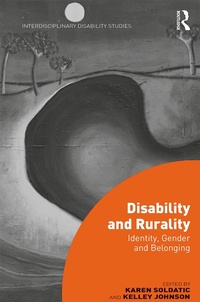
Disability and Rurality
Identity, Gender and Belonging
Published on 21. April 2017
274 pages
978-1-317-15031-2 (ISBN)
Description

This is the first book to explore how far disability challenges dominant understandings of rurality, identity, gender and belonging within the rural literature. The book focuses particularly on the ways disabled people give, and are given, meaning and value in relation to ethical rural considerations of place, physical strength, productivity and social reciprocity.
A range of different perspectives to the issues of living rurally with a disability inform this work. It includes the lived experience of people with disabilities through the use of life history methodologies, rich qualitative accounts and theoretical perspectives. It goes beyond conventional notions of rurality, grounding its analysis in a range of disability spaces and places and including the work of disability sociologists, geographers, cultural theorists and policy analysts. This interdisciplinary focus reveals the contradictory and competing relations of rurality for disabled people and the resultant impacts and effects upon disabled people and their communities materially, discursively and symbolically.
Of interest to all scholars of disability, rural studies, social work and welfare, this book provides a critical intervention into the growing scholarship of rurality that has bypassed the pivotal role of disability in understanding the lived experience of rural landscapes.
A range of different perspectives to the issues of living rurally with a disability inform this work. It includes the lived experience of people with disabilities through the use of life history methodologies, rich qualitative accounts and theoretical perspectives. It goes beyond conventional notions of rurality, grounding its analysis in a range of disability spaces and places and including the work of disability sociologists, geographers, cultural theorists and policy analysts. This interdisciplinary focus reveals the contradictory and competing relations of rurality for disabled people and the resultant impacts and effects upon disabled people and their communities materially, discursively and symbolically.
Of interest to all scholars of disability, rural studies, social work and welfare, this book provides a critical intervention into the growing scholarship of rurality that has bypassed the pivotal role of disability in understanding the lived experience of rural landscapes.
More details
Series
Language
English
Place of publication
London
United Kingdom
Publishing group
Taylor & Francis Ltd
Target group
College/higher education
Illustrations
2 Line drawings, black and white; 2 Illustrations, black and white
File size
1,98 MB
ISBN-13
978-1-317-15031-2 (9781317150312)
Copyright in bibliographic data and cover images is held by Nielsen Book Services Limited or by the publishers or by their respective licensors: all rights reserved.
Schweitzer Classification
Other editions
Additional editions
Book
01/2019
1st Edition
Routledge
€69.30
Shipment within 15-20 days
Book
04/2017
1st Edition
Routledge
€207.90
Shipment within 10-20 days
Persons
Karen Soldatic is an Australian Research Council DECRA Fellow (2016-2019), Institute for Culture and Society, Western Sydney University, Australia.
Kelley Johnson is Professor of Disability and Policy at the Social Policy Research Centre, University of New South Wales (UNSW Australia).
Kelley Johnson is Professor of Disability and Policy at the Social Policy Research Centre, University of New South Wales (UNSW Australia).
Content
Notes on the cover image
Editor biographies
Contributor biographies
Acknowledgements
Introduction - Disability and rurality: identity, gender and belonging (Karen Soldatic and Kelley Johnson)
Part I: Disability, Identity and Rurality
1 - 'I am stronger now': life as a disabled woman in rural Iceland (Harpa Sigurdardottir and Rannveig Traustadottir)
2 - The pull and the push of rural life: Scott and Graham's story (Brigit Mirfin-Veitch, Paul Milner and Jane McDonald)
3 - Young people moving from rural foster care to cities in China (Karen R. Fisher and Xiaoyuan Shang)
4 - Institutionalizing rural life (Jan Walmsley and Kelley Johnson)
5 - Rurality, disability and place identity (Daniela Stehlik)
Part II: Disability, Gender and Rurality
6 - 'It's not complicated': physical disability and farming in rural Iceland (Kristin Bjoernsdottir, James G. Rice and Runar Geir Olafsson)
7 - Hiding, isolation and solace: rural disabled women and neoliberal welfare reform (Hannah Morgan)
8 - Southern gendered disability reflections: the everyday experiences of rural women with disabilities after the armed conflict in Sri Lanka (Niroshini Kandasamy, Karen Soldatic and Dinesha Samararatne)
9 - Youth, masculinity in rural and regional Australia: beer, 4WDs and home (Louisa Smith, Nikki Wedgwood, Russell Shuttleworth and Gwynnyth Llewellyn)
10 - Theoretical reflections: rurality, gender and disability (Jos Boys)
Part III: Disability, Belonging and Rurality
11 - Belonging in country Ireland? 'For me it comes down to work' (Joe McGrath, Kelley Johnson and Rob Hopkins)
12 - In the picture: perspectives of young people with cognitive disability on rural and regional life (Sally Robinson, Karen R. Fisher, Malcolm Hill and Anne Graham)
13 - Shifting landscapes of care and distress: a topological understanding of rurality (Ian M. Tucker)
14 - Problematizing social inclusion and fostering sense of belonging for people with disabilities in rural Cambodia (Alexandra Gartrell)
15 - Reclaiming kith: weaving belongingness into community (Liz Ellis)
16 - Belonging (Phoebe Caldwell)
Conclusion (Kelley Johnson and Karen Soldatic)
Index
Editor biographies
Contributor biographies
Acknowledgements
Introduction - Disability and rurality: identity, gender and belonging (Karen Soldatic and Kelley Johnson)
Part I: Disability, Identity and Rurality
1 - 'I am stronger now': life as a disabled woman in rural Iceland (Harpa Sigurdardottir and Rannveig Traustadottir)
2 - The pull and the push of rural life: Scott and Graham's story (Brigit Mirfin-Veitch, Paul Milner and Jane McDonald)
3 - Young people moving from rural foster care to cities in China (Karen R. Fisher and Xiaoyuan Shang)
4 - Institutionalizing rural life (Jan Walmsley and Kelley Johnson)
5 - Rurality, disability and place identity (Daniela Stehlik)
Part II: Disability, Gender and Rurality
6 - 'It's not complicated': physical disability and farming in rural Iceland (Kristin Bjoernsdottir, James G. Rice and Runar Geir Olafsson)
7 - Hiding, isolation and solace: rural disabled women and neoliberal welfare reform (Hannah Morgan)
8 - Southern gendered disability reflections: the everyday experiences of rural women with disabilities after the armed conflict in Sri Lanka (Niroshini Kandasamy, Karen Soldatic and Dinesha Samararatne)
9 - Youth, masculinity in rural and regional Australia: beer, 4WDs and home (Louisa Smith, Nikki Wedgwood, Russell Shuttleworth and Gwynnyth Llewellyn)
10 - Theoretical reflections: rurality, gender and disability (Jos Boys)
Part III: Disability, Belonging and Rurality
11 - Belonging in country Ireland? 'For me it comes down to work' (Joe McGrath, Kelley Johnson and Rob Hopkins)
12 - In the picture: perspectives of young people with cognitive disability on rural and regional life (Sally Robinson, Karen R. Fisher, Malcolm Hill and Anne Graham)
13 - Shifting landscapes of care and distress: a topological understanding of rurality (Ian M. Tucker)
14 - Problematizing social inclusion and fostering sense of belonging for people with disabilities in rural Cambodia (Alexandra Gartrell)
15 - Reclaiming kith: weaving belongingness into community (Liz Ellis)
16 - Belonging (Phoebe Caldwell)
Conclusion (Kelley Johnson and Karen Soldatic)
Index
