

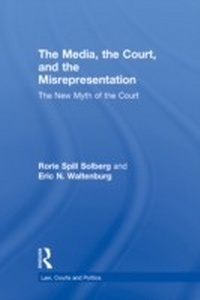
The Media, the Court, and the Misrepresentation
The New Myth of the Court
1st Edition
Published on 2. December 2014
132 pages
978-1-135-91173-7 (ISBN)
Description

The Court's decisions are interpreted and disseminated via the media. During this process, the media paints an image of the Court and its business. Like any artist, the media has license regarding what to cover and the amount of attention devoted to any aspect of the Court and its business. Some cases receive tremendous attention, while others languish on the back pages or are ignored. These selection effects create a skewed picture of the Court and its work, and might affect public attitudes toward the Court. Indeed, studies of media coverage of other governmental institutions reveal that when, and how, their policy decisions are covered has implications for the public's understanding of, compliance with, support for, and cynicism about the policy.
This book uncovers and describes this coverage and compares it to the confirmation hearings, the Court's actual work, even its members. Rorie Spill Solberg and Eric N. Waltenburg analyze media coverage of nominations and confirmation hearings, the justices' "extra-curricular" activities and their retirements/deaths, and the Court's opinions, and compare this coverage to analyses of confirmation transcripts and the Court's full docket. Solberg and Waltenburg contend that media now cover the Court and its personnel more similarly to its coverage of other political institutions. Journalists still regurgitate a mythology supported by the justices, a "cult of the robe," wherein unbiased and apolitical judges mechanically base their decisions upon the law and the Constitution. Furthermore, they argue the media also focus on the "cult of personality," wherein the media emphasize certain attributes of the justices and their work to match the public's preferences for subject matter and content. The media's portrayal, then, may undercut the Court's legitimacy and its reservoir of good will.
This book uncovers and describes this coverage and compares it to the confirmation hearings, the Court's actual work, even its members. Rorie Spill Solberg and Eric N. Waltenburg analyze media coverage of nominations and confirmation hearings, the justices' "extra-curricular" activities and their retirements/deaths, and the Court's opinions, and compare this coverage to analyses of confirmation transcripts and the Court's full docket. Solberg and Waltenburg contend that media now cover the Court and its personnel more similarly to its coverage of other political institutions. Journalists still regurgitate a mythology supported by the justices, a "cult of the robe," wherein unbiased and apolitical judges mechanically base their decisions upon the law and the Constitution. Furthermore, they argue the media also focus on the "cult of personality," wherein the media emphasize certain attributes of the justices and their work to match the public's preferences for subject matter and content. The media's portrayal, then, may undercut the Court's legitimacy and its reservoir of good will.
Reviews / Votes
"Through extensive analysis of media coverage of the Court and its justices, Rorie Spill Solberg and Eric N. Waltenburg explain how journalists increasingly emphasize the personalities of individual justices rather than just 'the cult of the robe.' This 'cult of personality' emerges not only through profiles of the justices but also in docket coverage and reporting on the confirmation process. This book is a must-read for scholars of the Court as well as everyone concerned about public perception of the Court and its impact on the Court's role as an arbiter in American politics and society."-Richard Davis, Brigham Young University"Solberg and Waltenburg's provocative study documents increasing media attention to personalities and politics in Supreme Court coverage, creating critical disconnects between objective reality and its media portrayal. Whether reporting on confirmation hearings, the Court's docket, its landmark cases or the justices themselves, such media portrayal increasingly mimics that of the patently political co-equal branches with potentially damaging consequences for public understanding of the Court and acceptance of its work." -Elliot E. Slotnick, The Ohio State University
"Solberg and Waltenburg's book on media coverage of the Supreme Court is the most comprehensive analysis to date. It covers confirmation hearings, the decisions, and the individuals on the Court in a careful and thoroughly engaging way, and convincingly reveals how media coverage affects public understandings (and misunderstandings) about the Supreme Court."-Valerie Hoekstra, Arizona State University
"Solberg (public policy, Oregon State) and Waltenburg (Purdue Univ.) examine media coverage of the US Supreme Court to ascertain the degree to which the old myth of the "cult of the robe," which stresses judicial objectivity, competes with the new myth of the "cult of personality." Using complex analyses of media coverage in leading outlets, the authors find that they increasingly stress personal and political differences among justices. ... The authors fear that media emphasis on judicial personalities could undermine belief in the justices' fairness but cannot prove that it has yet done so. More importantly, they do not report whether scholars, who long ago exploded the cult of the robe, have done better than the media in focusing on judicial reasoning rather than personalities or politics."
--J. R. Vile, Middle Tennessee State University "Through extensive analysis of media coverage of the Court and its justices, Rorie Spill Solberg and Eric N. Waltenburg explain how journalists increasingly emphasize the personalities of individual justices rather than just 'the cult of the robe.' This 'cult of personality' emerges not only through profiles of the justices but also in docket coverage and reporting on the confirmation process. This book is a must-read for scholars of the Court as well as everyone concerned about public perception of the Court and its impact on the Court's role as an arbiter in American politics and society."-Richard Davis, Brigham Young University
"Solberg and Waltenburg's provocative study documents increasing media attention to personalities and politics in Supreme Court coverage, creating critical disconnects between objective reality and its media portrayal. Whether reporting on confirmation hearings, the Court's docket, its landmark cases or the justices themselves, such media portrayal increasingly mimics that of the patently political co-equal branches with potentially damaging consequences for public understanding of the Court and acceptance of its work." -Elliot E. Slotnick, The Ohio State University
"Solberg and Waltenburg's book on media coverage of the Supreme Court is the most comprehensive analysis to date. It covers confirmation hearings, the decisions, and the individuals on the Court in a careful and thoroughly engaging way, and convincingly reveals how media coverage affects public understandings (and misunderstandings) about the Supreme Court."-Valerie Hoekstra, Arizona State University
"Solberg (public policy, Oregon State) and Waltenburg (Purdue Univ.) examine media coverage of the US Supreme Court to ascertain the degree to which the old myth of the "cult of the robe," which stresses judicial objectivity, competes with the new myth of the "cult of personality." Using complex analyses of media coverage in leading outlets, the authors find that they increasingly stress personal and political differences among justices. ... The authors fear that media emphasis on judicial personalities could undermine belief in the justices' fairness but cannot prove that it has yet done so. More importantly, they do not report whether scholars, who long ago exploded the cult of the robe, have done better than the media in focusing on judicial reasoning rather than personalities or politics."
--J. R. Vile, Middle Tennessee State University
More details
Series
Language
English
Place of publication
London
United Kingdom
Publishing group
Taylor & Francis Ltd
Target group
College/higher education
Illustrations
15 s/w Tabellen, 26 s/w Zeichnungen
15 Tables, black and white; 26 Line drawings, black and white
File size
2,36 MB
ISBN-13
978-1-135-91173-7 (9781135911737)
Copyright in bibliographic data and cover images is held by Nielsen Book Services Limited or by the publishers or by their respective licensors: all rights reserved.
Schweitzer Classification
Other editions
Additional editions
Rorie Spill Solberg | Eric N. Waltenburg
The Media, the Court, and the Misrepresentation
The New Myth of the Court
Book
12/2014
1st Edition
Routledge
€205.60
Shipment within 15-20 days
Rorie Spill Solberg | Eric N. Waltenburg
The Media, the Court, and the Misrepresentation
The New Myth of the Court
Book
12/2014
1st Edition
Routledge
€76.10
Shipment within 10-20 days
Persons
Rorie Spill Solberg is an associate professor in the School of Public Policy at Oregon State University. She is widely published in journals such as Political Research Quarterly, Social Science Quarterly, Policy Studies Quarterly, and the Journal of Empirical Legal Studies. In 2011, she was selected to edit Judicature, the journal of the American Judicature Society. She received her PhD in American politics with a specialty in judicial politics from The Ohio State University in 1997.
Eric N. Waltenburg is an Associate Professor of Political Science at Purdue University. His research interests concern judicial politics and state politics. He has published in such journals as American Politics Research, Political Behavior, and Social Science Quarterly, and he is the author or co-author of three books on judicial politics. He is a co-editor of Politics, Groups, and Identities, the official journal of the Western Political Science Association. He received his PhD from The Ohio State University in 1994 in American Politics, with a focus on Judicial Politics.
Eric N. Waltenburg is an Associate Professor of Political Science at Purdue University. His research interests concern judicial politics and state politics. He has published in such journals as American Politics Research, Political Behavior, and Social Science Quarterly, and he is the author or co-author of three books on judicial politics. He is a co-editor of Politics, Groups, and Identities, the official journal of the Western Political Science Association. He received his PhD from The Ohio State University in 1994 in American Politics, with a focus on Judicial Politics.
Content
1. Introduction: The Myths of the Court 2. Confirmation and the "Cult of Personality" 3. The Decisional Myth 4. The Decisional Myth, Part 2 - The Landmark Cases 5. The Personal Myth 6. Conclusion: Processing the Myths of the Court
